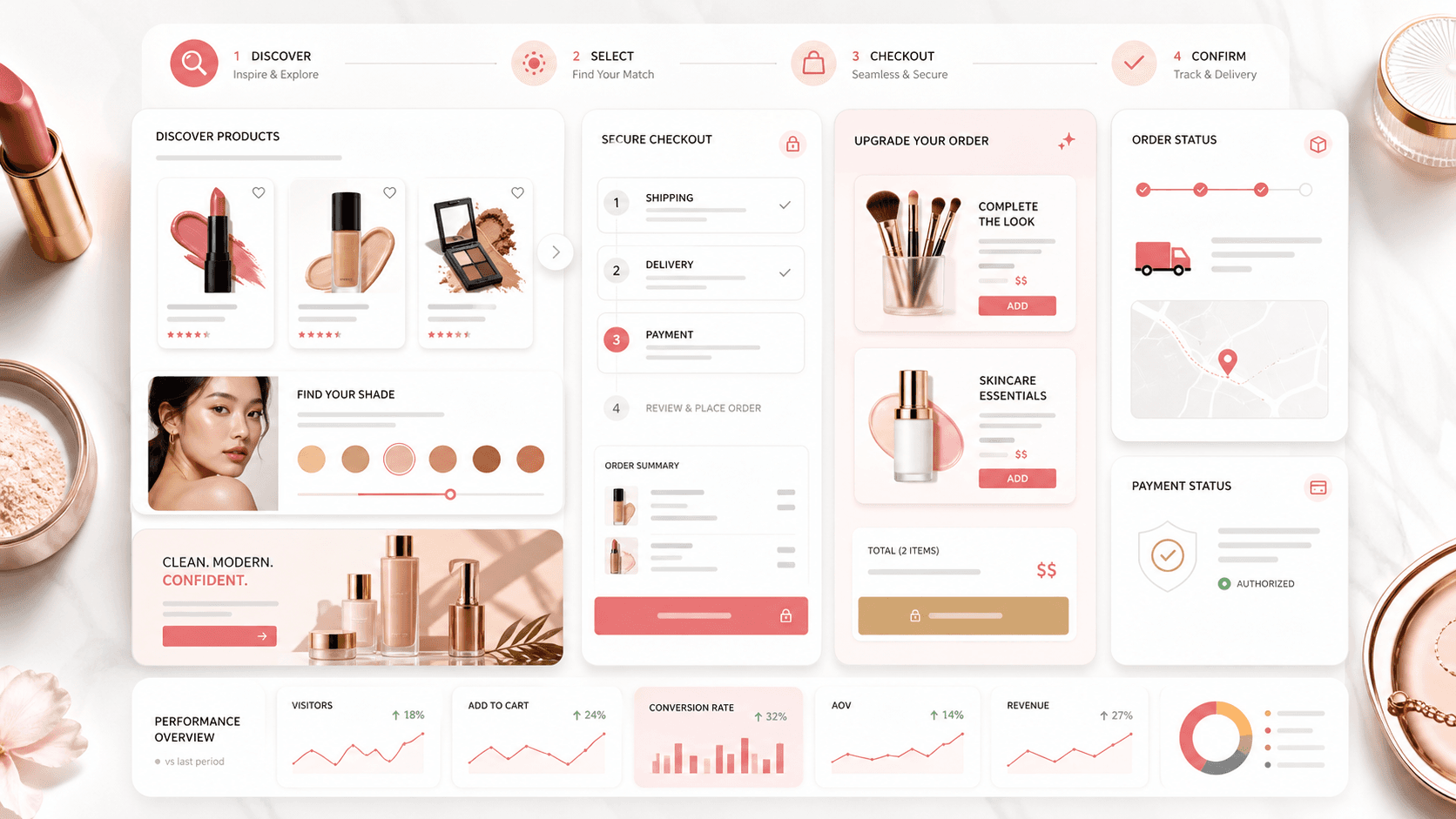
Commerce funnel engineering for product landing pages, offer configuration, checkout, payments, upsells, order handoff, and analytics instrumentation
PHP
campaign landing and order flow
CMS
dynamic page and upsell content
2
payment paths
Shopify
order and variant handoff
Timeline
Campaign-focused ecommerce funnel build and conversion workflow implementation
A beauty product campaign needed more than a static landing page
The commerce experience had to move shoppers from product education into a structured order path, while still giving operators control over offers, upsells, payment choices, shipping fields, tracking scripts, and post-purchase routing.
Product storytelling, guarantee messaging, testimonials, and order forms needed to work together in one conversion path
Operators needed dynamic content for campaign pages and upsell offers without hardcoding every promotion
Checkout had to support shipping, billing, product variants, add-ons, and payment-specific flows
Analytics, geo routing, and customer support scripts had to be present without disrupting checkout momentum
A conversion-focused funnel with dynamic offers and payment orchestration
GlowCart brings product landing content, CMS-powered page fields, variant-aware order selection, upsell flows, Stripe and PayPal routing, Shopify order payloads, and thank-you handling into a single promotional commerce system.
Landing and order pages combine product education, product imagery, guarantee blocks, testimonials, and checkout entry points
Dynamic page and upsell collections feed product copy, background images, price blocks, subscription flags, testimonials, and offer settings
Session-backed order state carries selected products, add-ons, shipping, billing, contact details, payment method, and upsell choices across steps
Payment and order handling connect Stripe tokens, PayPal form submission, Shopify variants, shipping lines, and thank-you routing
Product surfaces
What the platform brought together
The work spanned core product operations, daily user workflows, data-heavy coordination, and resilient platform management.
Product landing and order capture
The front of the funnel combines campaign storytelling with an order-ready form so shoppers can move quickly from interest to purchase.
Variant-aware product selection with quantity limits, shade or offer metadata, and visible pricing context
Shipping, billing, email, phone, address, city, state, country, and zip capture with client-side validation
Dynamic offer management
Campaign content comes from structured page and upsell records so offers can change without rebuilding the funnel.
Page collection fields for order text, testimonials, shipping price, product images, product variants, and PayPal availability
Upsell collection fields for offer headers, product blocks, before and after prices, subscription settings, and supporting visuals
Popup and third-offer logic that lets operators test add-ons and continuation paths after the primary order step
Checkout and payment routing
The checkout layer coordinates buyer details, selected products, payment method, payment tokens, and order totals across multi-step flows.
Stripe token creation and order continuation for credit-card checkout
PayPal cart form submission with customer, address, item, shipping, and return URL context
Session-based state transfer from the order page to upsells and final confirmation
Order handoff and campaign instrumentation
Commerce operations needed clean downstream order data and enough tracking to measure funnel behavior.
Shopify-style line items, variant IDs, shipping lines, customer details, and add-on product handling
Thank-you flow that assembles final order context, selected upsells, shipping price, payment method, and campaign version
Google Tag Manager, visitor recording, geo redirect, Facebook plugin, and support contact surfaces around the campaign
Buyer priorities
What mattered most to the people evaluating the platform
Prospective buyers want to know whether the work solved real workflow, adoption, reliability, data, and operations problems. These priorities shaped the product decisions.
Conversion speed
Beauty commerce campaigns depend on reducing the distance between product desire and purchase completion.
The funnel keeps product proof, guarantee messaging, product selection, and checkout on a focused path
Client-side validation catches missing contact, address, email, phone, and zip details before payment handoff
Payment-specific flows reduce friction for shoppers who prefer cards or PayPal
Offer agility
Operators needed to change offer copy, product blocks, testimonials, pricing, and upsell choices without repeatedly editing the main template.
Page records control product copy, shipping, testimonials, order text, product variants, and product images
Upsell records control offer sections, price blocks, imagery, and subscription flags
Session state makes it possible to continue the buyer journey across primary order, upsell, and confirmation pages
Operational handoff
A campaign funnel only works if selected products, addresses, payment context, and order data make it to the systems that fulfill them.
Variant IDs and line-item structures prepare orders for downstream commerce handling
Shipping lines and customer data stay attached to the final order context
Analytics and visitor scripts help teams understand campaign behavior and support conversion tuning
System model
How the platform connects roles, workflows, and product surfaces
The product architecture brings every role into the same operating model, with shared data moving cleanly between web, mobile, media, and notification layers.
Campaign to checkout workflow
A focused path connects product education, variant selection, buyer details, payment choice, upsell offers, and thank-you confirmation.
Offer operations model
Page records, product variants, upsell records, payment routing, and order payloads work together behind the campaign.
Buyer and operator loops
The buyer journey and campaign operations layer stay connected through content, analytics, payment state, and fulfillment data.
Technology
The Stack We Used And Why
The stack section is written for buyers who need to understand the product architecture, operational trade-offs, and long-term maintainability of the system.
Landing and funnel runtime
Used to serve the campaign pages, process form submissions, hold session state, and render dynamic PHP templates for landing, order, upsell, and thank-you flows.
Used to support funnel analytics, session recording, geo routing, remarketing hooks, and customer support visibility.
Google Tag ManagerInspectletGeo redirect scriptsFacebook pluginsSupport email routing
Why A Focused Funnel Runtime
Campaign commerce often needs fast iteration around a small set of high-value pages rather than a full catalog experience.
PHP templates kept landing, order, upsell, and thank-you pages close to the campaign logic
Server sessions carried buyer and offer state between checkout steps
Composer-supported bundling helped manage campaign CSS and JavaScript assets
Why Dynamic Offer Content
A promotional beauty product funnel needs marketing teams to adjust offers, testimonials, and price presentation without shipping code for every campaign change.
CMS collection fields powered page-specific order copy, testimonials, product assets, and pricing context
Upsell records made continuation offers configurable after the primary order step
Variant IDs kept marketing content connected to fulfillment-ready product choices
Why Multiple Payment Paths
Checkout conversion improves when shoppers can choose a familiar payment method and the platform can still keep order data consistent.
Stripe tokenization supported direct card checkout
Shared session and order structures kept selected products, shipping, and add-ons consistent across both paths
Delivery
How the product came together
The work moved from domain modeling to core platform delivery, mobile adoption, and operational hardening.
1
Map The Campaign Journey
The work started by turning a product promotion into a step-by-step funnel from landing proof to checkout and confirmation.
2
Connect Content And Offers
Dynamic page and upsell records were wired into the templates so campaign content could change without rebuilding every page.
3
Orchestrate Checkout State
Order data had to remain consistent while shoppers selected products, added offers, entered addresses, and chose payment methods.
4
Instrument And Stabilize
Analytics, visitor scripts, validation, responsive styling, and support surfaces made the funnel easier to operate after launch.
Operational depth
What made the platform usable after launch
The strongest case studies are not only feature lists. They show how the system is operated, monitored, governed, and improved when real users depend on it.
Configurable campaign fields
Operators could control content and commerce fields through structured campaign records.
Order text, testimonials, flat shipping price, PayPal visibility, product variants, and product images
Popup and continuation-offer settings tied to the same buyer session
Checkout continuity
The funnel preserved context across payment and post-payment steps instead of treating each page as isolated.
Selected product, variant, add-ons, upsells, contact, shipping, billing, payment method, and total price
Stripe token state and PayPal form values mapped from the same order form inputs
Thank-you logic reconstructed final order, shipping, version, payment, and upsell context
Campaign instrumentation
Conversion funnels need measurement and support hooks as much as they need forms.
Google Tag Manager and visitor recording supported performance review
Geo routing and Facebook plugins supported campaign-specific traffic handling
Support contact and guarantee messaging helped reduce purchase hesitation
Results
The measurable and observable lift from the work
The strongest improvements are the ones a buyer can connect to daily work: fewer disconnected tools, safer operations, clearer workflows, and more reliable product behavior.
4-step
Funnel Coverage
Landing, checkout, upsell, and thank-you states work as one connected campaign journey.
CMS-led
Offer Agility
Campaign text, products, testimonials, prices, images, and upsell fields can be adjusted through structured records.
Dual pay
Checkout Choice
Stripe and PayPal paths give shoppers familiar options while preserving shared order and shipping context.
Variant-aware
Fulfillment Readiness
Shopify-style variants, line items, add-ons, and shipping lines make campaign orders easier to hand off.
Outcome
A stronger operating system for beauty commerce conversion platform
The platform reduced tool fragmentation and gave each role a clearer path from live activity to day-to-day action.
A campaign-ready beauty commerce funnel with product storytelling, order capture, variant selection, payment routing, upsells, and confirmation flows
Dynamic page and upsell content powered by structured collection fields for copy, pricing, images, testimonials, shipping, product variants, and subscription flags
Checkout orchestration across Stripe tokenization, PayPal cart submission, Shopify-style line items, shipping lines, customer details, and session-backed order state
Analytics and campaign support foundations through tag management, visitor recording, geo routing, customer support surfaces, and responsive checkout behavior
FAQ
Frequently Asked Questions About GlowCart
Answers about the beauty commerce conversion platform scope, platform model, technology choices, operational workflows, and related build patterns.
What Kind Of Platform Does GlowCart Represent?
GlowCart represents a beauty ecommerce conversion platform with product landing pages, dynamic offer content, checkout forms, Stripe and PayPal payment routing, Shopify-style product variants, upsells, analytics, and thank-you flows.
Why Does A Beauty Campaign Need A Custom Funnel?
Beauty campaigns often depend on product education, visual proof, guarantees, testimonials, offer testing, add-ons, and payment choice. A custom funnel lets the product story, checkout, and post-purchase offers stay tightly connected.
How Did The Platform Support Offer Changes?
The platform used dynamic page and upsell records for text, product blocks, images, pricing, testimonials, shipping, variants, and subscription flags, reducing the need to hardcode every campaign change.
Can This Pattern Support Other Direct-To-Consumer Products?
Yes. The same pattern can support cosmetics, supplements, skincare, wellness products, accessories, limited-run campaigns, influencer promotions, and other DTC products that need landing pages, checkout, upsells, and analytics.
Related services
Build a similarly ambitious product without starting from a blank page.
We can help scope the web, mobile, AI, media, and operating layers needed for your own platform.