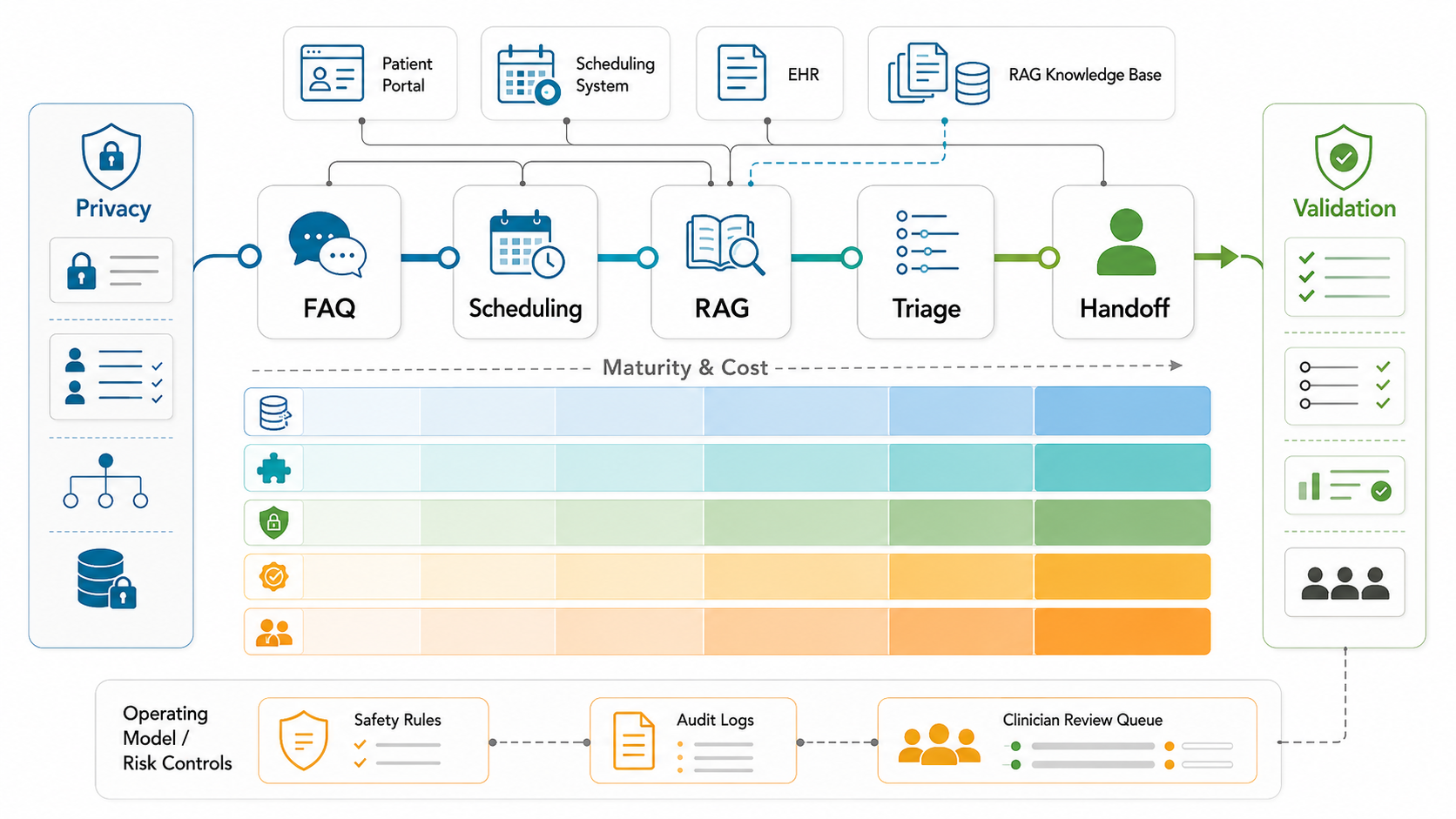

Healthcare chatbot development usually costs $25,000 to $120,000 for a focused patient-support or scheduling assistant, $80,000 to $250,000 for a RAG-powered healthcare knowledge assistant with integrations, and $250,000 to $500,000+ for supervised triage or enterprise clinical-support workflows. The real budget depends less on the chat bubble and more on whether the system touches protected health information, connects to scheduling or EHR systems, retrieves approved clinical content, routes uncertain cases to staff, and produces audit-ready evidence.
If you are planning a healthcare chatbot, do not start with a generic AI feature list. Start with the operating boundary: what can the bot answer, what must it refuse, what data can it see, when does a human take over, and which systems need to stay in sync? That framing gives product, compliance, and clinical teams a usable budget before development begins.
This guide is for healthcare founders, clinics, hospitals, and digital health product teams comparing AI chatbot options. It explains cost tiers, architecture choices, hidden budget drivers, HIPAA and AI governance considerations, RAG design, appointment scheduling, triage limits, human handoff, and the build plan NextPage would use before moving into production.
Healthcare Chatbot Cost Ranges By Scope
The fastest way to estimate cost is to separate five product types. Each one has a different risk profile, validation burden, and integration path.
| Chatbot Type | Typical Budget | Best Fit | Main Cost Drivers |
|---|---|---|---|
| FAQ or service navigation bot | $15,000-$40,000 | Clinic website, payer FAQ, service discovery, basic intake routing | Conversation design, CMS/source content cleanup, analytics, website widget |
| Appointment scheduling assistant | $25,000-$80,000 | Booking, rescheduling, reminders, insurance intake, clinic operations | Calendar integration, identity checks, notification workflows, staff overrides |
| RAG healthcare knowledge assistant | $80,000-$250,000 | Patient education, staff knowledge base, policy assistant, benefits support | Document ingestion, retrieval quality, citations, access control, evaluation tests |
| Supervised triage intake assistant | $150,000-$350,000 | Symptom intake, urgency routing, pre-visit preparation, nurse queue support | Clinical review, safety rules, escalation design, audit logs, liability review |
| Enterprise clinical-support workflow | $250,000-$500,000+ | Multi-site health system, EHR-connected care workflows, disease management support | EHR integration, governance, model monitoring, security review, change management |
Competitor cost pages often publish wide ranges because the underlying products are not equivalent. Appinventiv frames AMIE-like healthcare chatbot development around a $40,000-$400,000+ range, while other development guides cite lower basic ranges and higher enterprise ranges. Those pages are useful for benchmarking, but a buyer still needs to know why a scheduling bot and a clinical-support assistant should not be estimated the same way.
NextPage's practical rule is simple: each additional layer of data access, clinical responsibility, integration, and monitoring raises both the initial build budget and the annual operating budget. If the chatbot only answers service questions from approved marketing content, cost stays closer to web app scope. If it reads PHI, pulls from an EHR, summarizes patient history, or affects triage, the budget must include privacy engineering, clinical validation, governance, and support operations.
What Actually Makes A Healthcare Chatbot Expensive
The cost center is rarely the large language model itself. The expensive work is turning a probabilistic assistant into a bounded, observable healthcare workflow.
1. Data Readiness And Content Governance
A RAG chatbot is only as useful as the material it can retrieve. Healthcare teams often need to clean PDFs, service pages, insurance documents, discharge instructions, care program rules, and internal SOPs before they are safe to expose. The content also needs ownership: someone must approve what the bot can say, what it cannot say, and when content expires.
Budget for document inventory, chunking strategy, metadata, source permissions, freshness checks, and answer evaluation. A thin RAG implementation can look impressive in a demo and fail in production because it retrieves outdated policy text or mixes instructions from different service lines.
2. Scheduling, EHR, CRM, And Portal Integrations
Integrations move the chatbot from information to action. Booking an appointment, checking eligibility, opening a support ticket, creating a pre-visit intake note, or escalating to a care coordinator all require APIs, identity handling, failure states, and audit trails.
If the first release needs only lead capture or a callback request, a lightweight AI chatbot development project may be enough. If it must coordinate patient accounts, staff queues, reminders, and EHR-adjacent records, treat it as a healthcare workflow product, not a widget.
3. Privacy, Security, And HIPAA Operating Controls
HHS guidance identifies a third-party AI chatbot on a provider patient portal as a business associate scenario when it provides services involving PHI such as symptom assessment, medical reminders, and appointment scheduling. That means the implementation plan must account for business associate agreements, permitted data use, downstream subcontractors, security controls, and incident reporting expectations.
For teams using cloud services, the same HHS posture applies: covered entities and business associates remain responsible for HIPAA Privacy, Security, and Breach Notification obligations when ePHI is created, received, maintained, or transmitted through a vendor. In practical terms, chatbot architecture should minimize PHI exposure, avoid unnecessary prompt logging, restrict retrieval by user role, encrypt data, and preserve audit evidence.
4. Clinical Boundaries And Safety Review
Healthcare AI research is moving quickly. Google's AMIE research, published in Nature, shows why diagnostic dialogue is attractive and difficult: physician-patient conversation includes history-taking, diagnosis, management, communication, and trust. A production chatbot for a clinic should not imply it can replace licensed clinical judgment unless the product, regulatory, and clinical evidence support that claim.
Most teams should begin with bounded workflows: service navigation, appointment preparation, benefits support, medication reminder routing, post-visit education from approved sources, or nurse-reviewed intake. If symptom triage is in scope, the design needs red-flag detection, safe refusal, emergency guidance, clinician review, and careful measurement of false reassurance risk.
5. Evaluation, Monitoring, And Change Management
A healthcare chatbot needs tests that mirror real conversations. That includes hallucination checks, retrieval accuracy, unsafe advice detection, escalation coverage, PHI leakage tests, response latency, multilingual behavior, accessibility, staff review workflows, and rollback procedures.
ONC's HTI-1 rule brought algorithm transparency requirements into certified health IT for AI and predictive decision support, with emphasis on fairness, appropriateness, validity, effectiveness, and safety. Even when a chatbot is outside certified EHR functionality, those concepts are useful evaluation categories for healthcare buyers.
RAG Architecture For Healthcare Chatbots
RAG, or retrieval-augmented generation, is often the right architecture when the chatbot must answer from approved healthcare content without training a custom model from scratch. A healthcare RAG assistant typically has seven parts:
- Approved source library: patient education, service lines, policies, insurance content, care instructions, and internal SOPs.
- Ingestion and chunking: pipelines that split, label, and refresh content without losing context.
- Access control: user, patient, department, region, and role rules that decide what content can be retrieved.
- Retriever: vector and keyword search tuned for clinical terms, synonyms, service names, and policy language.
- Answer generator: a model prompt that cites sources, avoids unsupported advice, and follows escalation rules.
- Safety layer: red-flag detection, refusal patterns, medical disclaimer logic, and human handoff triggers.
- Observability: logs, analytics, quality scoring, reviewer queues, and issue triage.
For a basic knowledge assistant, this can fit into an $80,000-$150,000 build if the data is clean and integrations are light. For an assistant that reads patient context, coordinates staff workflows, or supports triage, the same architecture becomes more expensive because privacy, permissioning, validation, and clinical review are no longer optional.
Triage And Human Handoff Design
The handoff model should be designed before the first production conversation. A good healthcare chatbot does not merely say, "contact support" when it is uncertain. It packages the context a staff member needs to continue safely.
At minimum, define these handoff rules:
- Emergency triggers: symptoms, phrases, or patient states that require immediate emergency guidance rather than chatbot continuation.
- Clinical uncertainty: questions where the assistant cannot answer from approved sources or where patient-specific advice is required.
- Identity and consent gaps: cases where the user has not authenticated or has not consented to a workflow.
- Operational exceptions: unavailable appointment slots, payment issues, insurance mismatch, or portal access problems.
- Human queue ownership: nurse queue, front desk, care coordinator, billing, technical support, or physician escalation.
This is where AI Agent Readiness Assessment work pays off. If the queue, owner, SLA, and escalation data are unclear, automation will expose operational confusion faster than it reduces work.
Build Vs. Buy: Which Route Costs Less?
Buying an off-the-shelf healthcare chatbot is often cheaper for commodity website FAQ, basic appointment routing, or standard patient communication. Building a custom chatbot makes more sense when you have proprietary workflows, custom portal UX, unusual integrations, multi-step clinical operations, or a need to control the RAG and governance stack.
| Decision Factor | Buy | Build Custom |
|---|---|---|
| Website FAQ | Usually faster | Useful if deeply tied to service conversion |
| Scheduling | Good if your scheduling vendor supports it | Better for custom routing, multi-location logic, or portal flows |
| RAG knowledge base | Works for generic content | Better for source controls, permissions, citations, and evaluation |
| Clinical triage | Only if vendor evidence and governance fit | Requires clinical oversight, safety review, and careful scope |
| EHR workflow | Depends on vendor ecosystem | Often needed for custom data models and operational queues |
Many healthcare teams land in the middle: start with a platform or model API, then build custom orchestration, retrieval, integrations, dashboards, and review workflows around it. That approach can reduce model infrastructure cost while keeping product differentiation in the workflow layer.
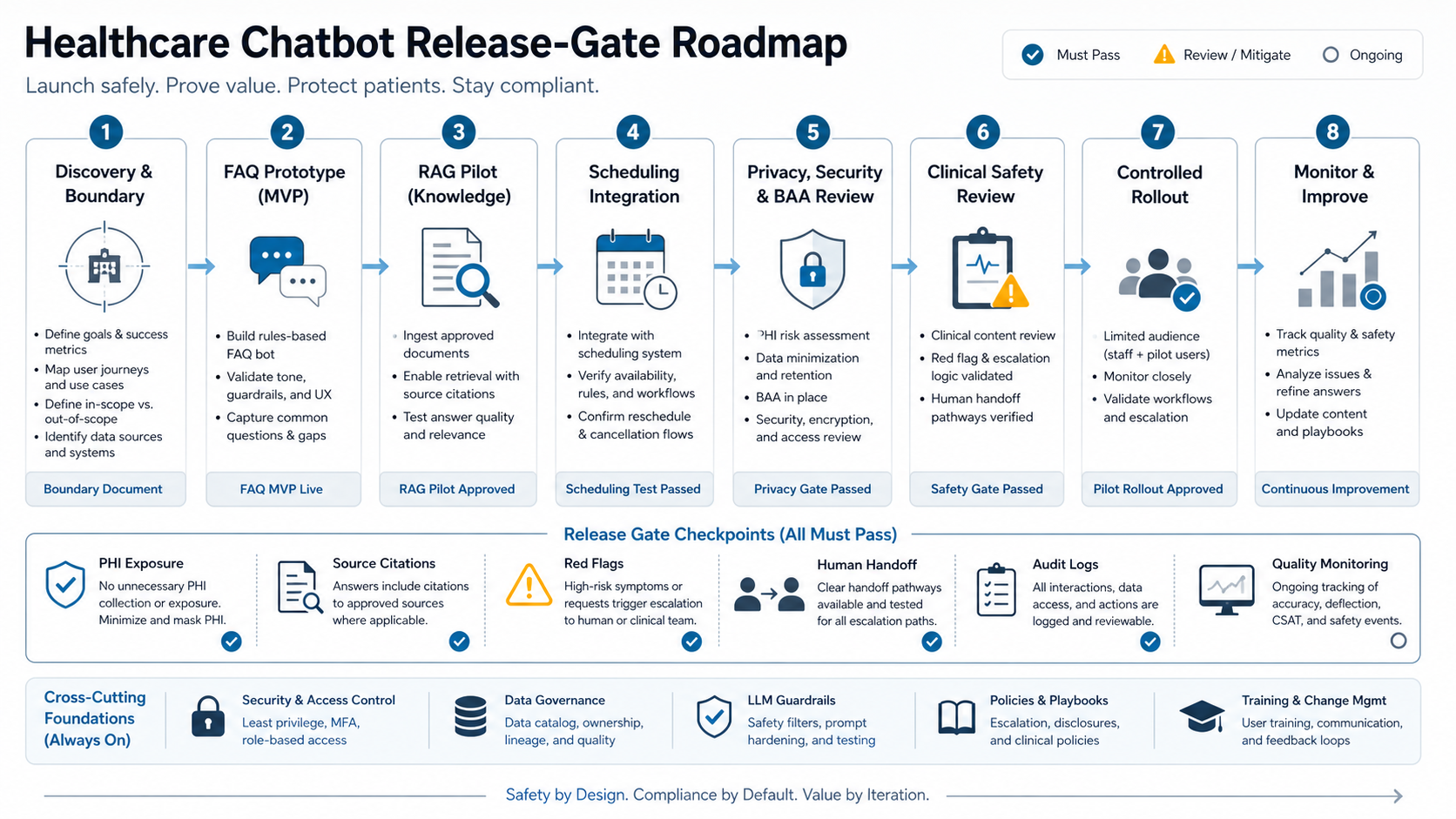
A Practical Build Roadmap
A compliant healthcare chatbot project should move through staged evidence, not one big launch.
- Discovery and risk boundary: define users, intents, data exposure, prohibited answers, escalation rules, and success metrics.
- Conversation prototype: test FAQ, scheduling, and handoff flows with realistic patient questions before connecting sensitive systems.
- RAG pilot: ingest approved content, measure retrieval quality, tune citation behavior, and review unsafe answers.
- Integration phase: connect scheduling, CRM, ticketing, portal, or EHR-adjacent workflows with least-privilege access.
- Clinical and compliance review: validate red flags, disclaimers, audit logs, BAAs, data retention, and incident procedures.
- Controlled rollout: launch to one service line, clinic, or workflow with human monitoring.
- Scale and optimize: add languages, channels, analytics, staff dashboards, and additional use cases only after quality is stable.
If your team is also planning broader healthcare AI agent workflows, treat the chatbot as one interface into a larger operating system. Intake, scheduling, RCM, patient education, and staff support can share retrieval, governance, and observability foundations when designed intentionally.
Release Gates Before Scale
Before expanding to more service lines, languages, or patient channels, use explicit release gates. Each gate should answer one question: is the workflow still bounded, accurate, private, observable, and easy for staff to take over? If not, add more automation later and harden the current release first.
For teams that plan to reuse the same retrieval, guardrail, and monitoring layer across multiple assistants, NextPage's machine learning development services can help turn the first chatbot into a governed AI product foundation rather than a disconnected experiment.
Example Budget Breakdown
For a mid-market clinic group building a RAG-enabled scheduling and patient education assistant, a realistic first release should include both launch budget and run-budget assumptions. A first release might look like this:
| Workstream | Estimated Share | What It Covers |
|---|---|---|
| Discovery and product design | 10%-15% | Use cases, conversation flows, handoff rules, risk boundary, roadmap |
| UX and frontend | 10%-15% | Web widget, portal experience, accessibility, patient-friendly states |
| RAG and AI orchestration | 20%-30% | Prompting, retrieval, citations, guardrails, evaluation sets |
| Integrations | 20%-30% | Scheduling, CRM, support queue, identity, optional EHR-adjacent data |
| Security and compliance | 10%-20% | Access control, logging, encryption, BAA/vendor review support, retention |
| QA and rollout | 10%-20% | Conversation tests, red-team prompts, clinical review, monitoring, launch |
That points to an $80,000-$180,000 first release for many teams, plus ongoing maintenance. Annual support commonly includes model and API usage, hosting, monitoring, prompt and retrieval updates, source-content refreshes, security review, staff feedback, analytics, and new workflow development. Treat that support as part of the product case, not as a vague maintenance line.
Annual Operating Budget After Launch
Healthcare chatbot cost does not stop at launch. A useful annual run budget should cover model and API usage, HIPAA-aware hosting, source-content refresh, conversation QA, clinical review time, analytics, monitoring, integration maintenance, and new workflow releases. For many teams, annual operating cost lands around 20%-60% of the first-release build budget, depending on conversation volume, PHI exposure, integration depth, and how much clinical review the workflow requires.
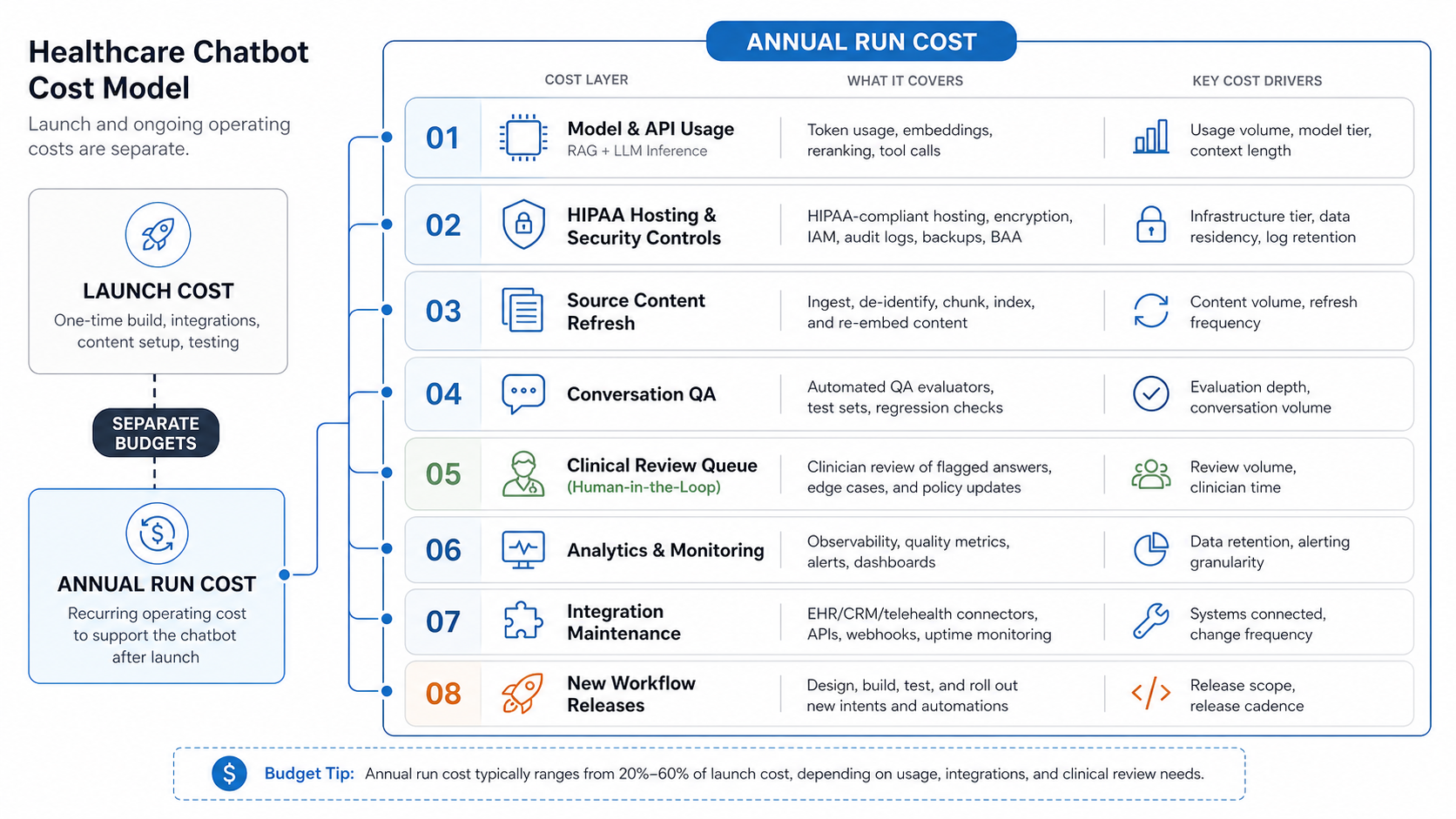
This is also where ROI planning should be explicit. Use a tool such as NextPage's AI Automation ROI Calculator to compare reduced call volume, faster scheduling, fewer abandoned requests, staff review time, infrastructure cost, and quality-monitoring effort. A chatbot that saves front-desk time but creates a large clinical review queue may still be worth building, but the operating model needs to be visible before procurement treats the project as a one-time software expense.
Costly Mistakes To Avoid
- Starting with diagnosis: patient education and operations workflows are safer first releases than open-ended diagnosis.
- Ignoring content ownership: if nobody owns the source library, the RAG assistant will decay.
- Skipping human handoff: automation without a real queue creates patient frustration and staff risk.
- Logging too much PHI: prompts, transcripts, analytics, and vendor dashboards need privacy review.
- Underfunding QA: healthcare chatbot testing must include unsafe prompts, edge cases, accessibility, and escalation behavior.
- Launching all channels at once: web, WhatsApp/SMS, portal, call center, and mobile each add operational complexity.
How NextPage Would Scope The Project
NextPage would start with a narrow, evidence-backed product slice rather than a generic chatbot build. For example, a strong first release might combine service navigation, appointment preparation, RAG answers from approved patient education content, and supervised handoff to staff. That creates business value without pretending the assistant is ready to practice medicine.
The scope would then connect to the right service path: AI chatbot development for the conversation experience, AI development services for retrieval and model orchestration, custom software development for workflow and integration depth, and AI customer service agent development patterns for safe escalation and support metrics.
The best budget is not the smallest number. It is the smallest controlled release that proves patients get useful answers, staff trust the handoff, compliance can audit the workflow, and the product team can improve the assistant without rebuilding it.
Sources Reviewed
This article was informed by current official and research sources including HHS business associate guidance, ONC HTI-1 algorithm transparency information, FDA AI-enabled device software guidance, WHO guidance on large multi-modal models for health, and AMIE diagnostic dialogue research in Nature. SERP and cost benchmarking included Appinventiv, Strivemindz, Ahex, and the queued SparxIT reference page.