
Quick Answer: How Should Healthcare Teams Build AI Agents?
Healthcare AI agent development should start with bounded operational workflows, not open-ended autonomy. The safest first candidates are patient intake, call routing, appointment scheduling, eligibility checks, prior authorization preparation, documentation support, claims follow-up, denials triage, and staff task routing. These workflows repeat often, already have owners, and can be measured against wait time, rework, claim status, staff effort, and patient experience.
The practical rule is simple: let the agent read, classify, draft, route, reconcile, and recommend before it is allowed to take irreversible clinical, financial, access, or entitlement actions. Every healthcare agent needs role-based access, PHI-aware logging, human review for sensitive decisions, escalation paths, model/output evaluation, and integration boundaries around EHR, practice-management, contact-center, CRM, payer, billing, and document systems.
This guide is for digital health founders, clinic operators, healthtech CTOs, and provider teams deciding where agents belong in the care journey. A focused AI Agent Readiness Assessment can help rank workflows before you spend on a broad pilot.
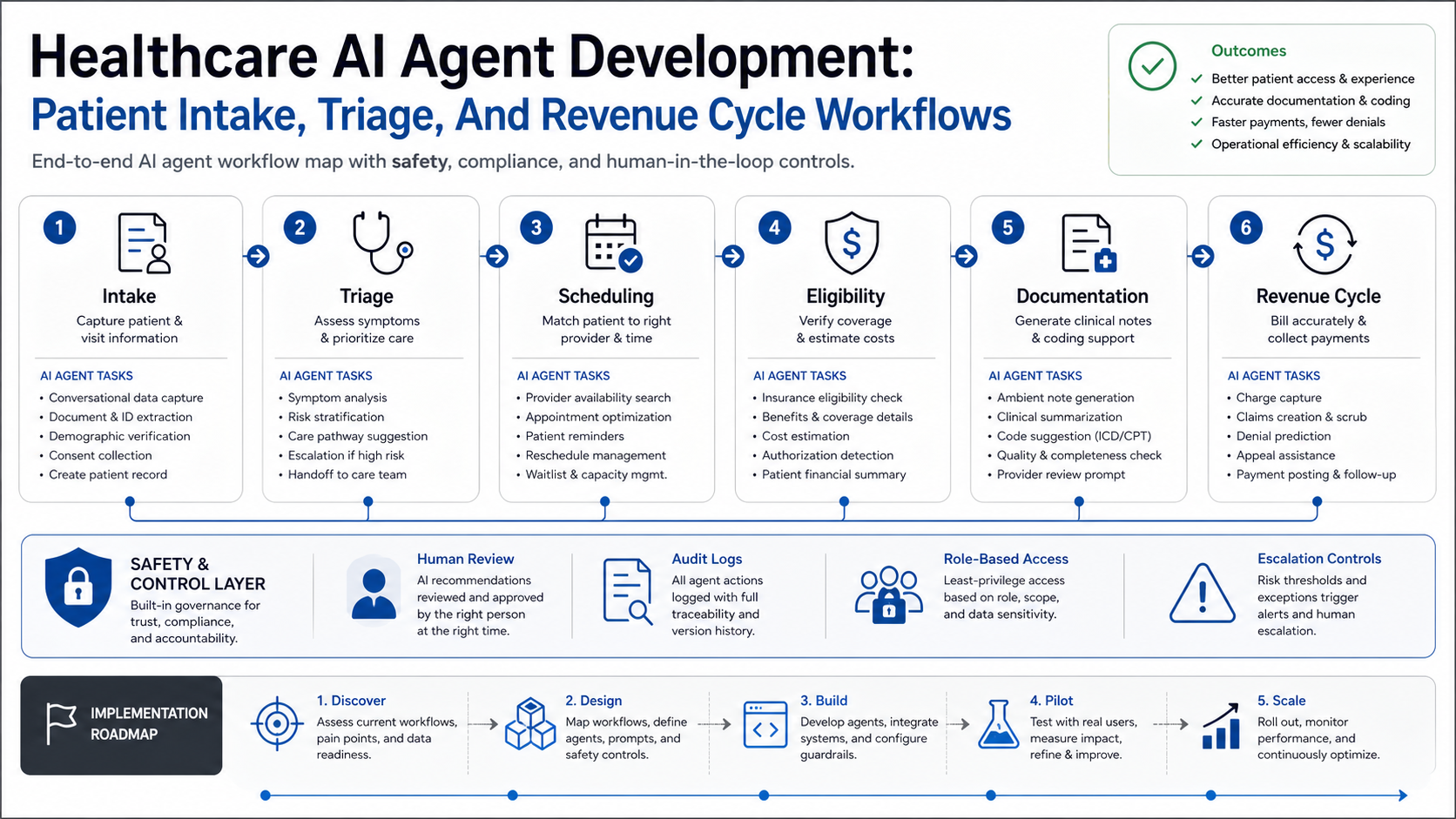
Why Healthcare Agents Need Workflow Boundaries
Healthcare agents are different from generic chatbots because they sit close to regulated data, clinical context, payer rules, and patient expectations. A retail support bot can usually apologize and escalate when it is wrong. A healthcare agent may affect access to care, documentation quality, claim timing, patient disclosure, or staff workload. That changes the design standard.
The better implementation pattern is workflow-first. Define the trigger, input data, allowed action, system of record, human owner, failure mode, and measurement target. Then decide whether the agent should summarize, classify, draft, retrieve, validate, update a low-risk field, or execute a controlled action. If those boundaries are unclear, the workflow is not ready for agentic automation.
Current healthcare AI guidance and market activity point in the same direction: useful AI needs practical impact, monitoring, nondiscrimination controls, and human override for sensitive decision support. HHS has continued to frame AI adoption around measurable healthcare impact, while nondiscrimination guidance for patient-care decision support makes monitoring, human override, and disclosure important design inputs. For builders, that means the product backlog must include security, consent/disclosure where applicable, auditability, bias review, and operational governance alongside prompts and models. The same inventory discipline used in enterprise AI agent governance applies here, but healthcare workflows need tighter review gates because errors can affect access, payment, documentation, or clinical prioritization.
Healthcare AI Agent Workflow Map
A useful healthcare agent roadmap usually spans front office, clinical support, and revenue cycle. The agent does not need to own all of these at once. Start with one workflow where the business case is visible and risk can be contained.
| Workflow | Agent Can Help With | Human Review Needed When | Primary Integration |
|---|---|---|---|
| Patient Intake | Collect symptoms, demographics, insurance details, consent prompts, documents, and pre-visit forms | Symptoms suggest urgency, data conflicts, or the patient asks for medical advice | Patient portal, EHR, CRM, document store |
| Triage And Routing | Classify request type, urgency band, department, provider match, and missing information | The classification affects clinical priority, safety, or access to care | EHR, contact center, scheduling system |
| Scheduling | Find slots, handle reminders, reschedule, route cancellations, and check referral requirements | Visit type, provider, location, or insurance constraints are ambiguous | Scheduling, EHR, messaging |
| Eligibility And Benefits | Check coverage, flag missing payer details, prepare prior authorization packets, and explain next steps | Coverage decision, authorization denial, or patient responsibility requires interpretation | Payer APIs, practice management, RCM |
| Documentation Support | Summarize calls, draft visit notes, prepare coding context, and extract structured data | Clinical judgment, diagnosis, coding finalization, or signed documentation is involved | EHR, transcription, document management |
| Revenue Cycle | Prioritize claim follow-up, denial worklists, payment posting exceptions, underpayment checks, and patient billing tasks | The action changes balance, claim status, appeal strategy, or patient communication | Billing, clearinghouse, payer portals, RCM tools |
The workflow map should also classify each agent action by autonomy level. Reading data, drafting a response, summarizing a call, and preparing a worklist are safer early actions. Updating records, sending patient messages, changing claim status, or advising on urgency should require stronger guardrails, test evidence, and visible human approval. That distinction keeps the roadmap practical for both operational automation and regulated patient-facing experiences.
What To Automate First
The best first workflow has high volume, clear rules, clean data, reversible actions, and a measurable baseline. Appointment reminders, intake completeness checks, contact-center routing, benefits-verification preparation, and denial worklist prioritization are often better starting points than autonomous clinical advice or automated financial decisions.
Revenue cycle is a strong candidate because many tasks are rules-heavy and measurable. Industry analysis in 2026 describes agentic AI as a credible path toward a more automated revenue cycle, including a potential 30-60% reduction in cost to collect when workflows are redesigned around automation, exception handling, and staff focus. Start with back-end workflows such as accounts receivable follow-up, underpayment management, denials management, and cash posting because they expose clearer baselines than broad clinical automation. That does not mean every task should be fully autonomous. It means agent design can remove manual search, classification, drafting, and queue management while keeping humans in exception control. For financial modeling, pair the baseline with the AI Automation ROI Calculator before committing to a larger roadmap.
For patient-facing work, start narrower. A conversational intake or support agent should answer policy, appointment, form, and status questions, then escalate clinical or emotional situations. NextPage's AI chatbot development work is a useful adjacent pattern because healthcare agents still need conversation design, escalation, knowledge retrieval, analytics, and admin visibility.
The Healthcare AI Agent Readiness Scorecard
Score every candidate workflow before assigning a team. A workflow with a high pain score can still be a poor first pilot if integrations are unavailable, PHI handling is unclear, or the decision is too sensitive for early automation.
| Dimension | Strong Signal | Delay Signal |
|---|---|---|
| Volume | Repeated daily or weekly with visible staff burden | Rare edge cases with little baseline data |
| Decision Rules | Documented policies, examples, scripts, payer rules, or routing logic | Every case depends on senior judgment |
| Data Access | APIs, structured fields, reliable documents, known owners | Manual exports, screenshots, shared logins, missing fields |
| Risk | Drafting, retrieval, routing, and reversible updates | Clinical, payment, eligibility, or access decisions without review |
| Evaluation | Gold cases, expected outputs, override categories, quality rubric | No one can say what good output means |
| Operations | Named owner, monitoring, escalation, support, change control | No post-launch owner or incident process |
Use the scorecard to split the roadmap into three buckets: build now, prepare next, and do not automate yet. Build-now workflows can proceed to a pilot. Prepare-next workflows need data cleanup, API access, policy mapping, or staff workflow design. Do-not-automate-yet workflows should stay manual until the risk boundary is better understood. If the backlog includes multiple departments, compare candidates against AI workflow automation patterns so the team can separate workflow orchestration work from model experimentation.
Compliance And Safety Controls
Healthcare AI agent development has to assume protected health information, sensitive decisions, and audit needs from the beginning. The implementation should include minimum necessary access, role-based permissions, encrypted storage, signed vendor agreements where required, secure logging, data retention rules, source attribution for retrieved context, and separation between patient-facing text and staff-only notes.
Human override is not a cosmetic feature. It should be part of the workflow state machine. For example, an intake agent may collect information and suggest a routing category, but a nurse or trained staff member should review urgent symptoms, conflicting details, or anything that affects clinical priority. A revenue-cycle agent may prepare an appeal packet, but billing leadership should approve strategy and final submission rules for sensitive or high-value claims.
The team should also test for bias and inconsistent outputs across patient groups, languages, insurance types, locations, and accessibility needs. A good healthcare software development company checklist should include these operational controls, not only engineering capacity.
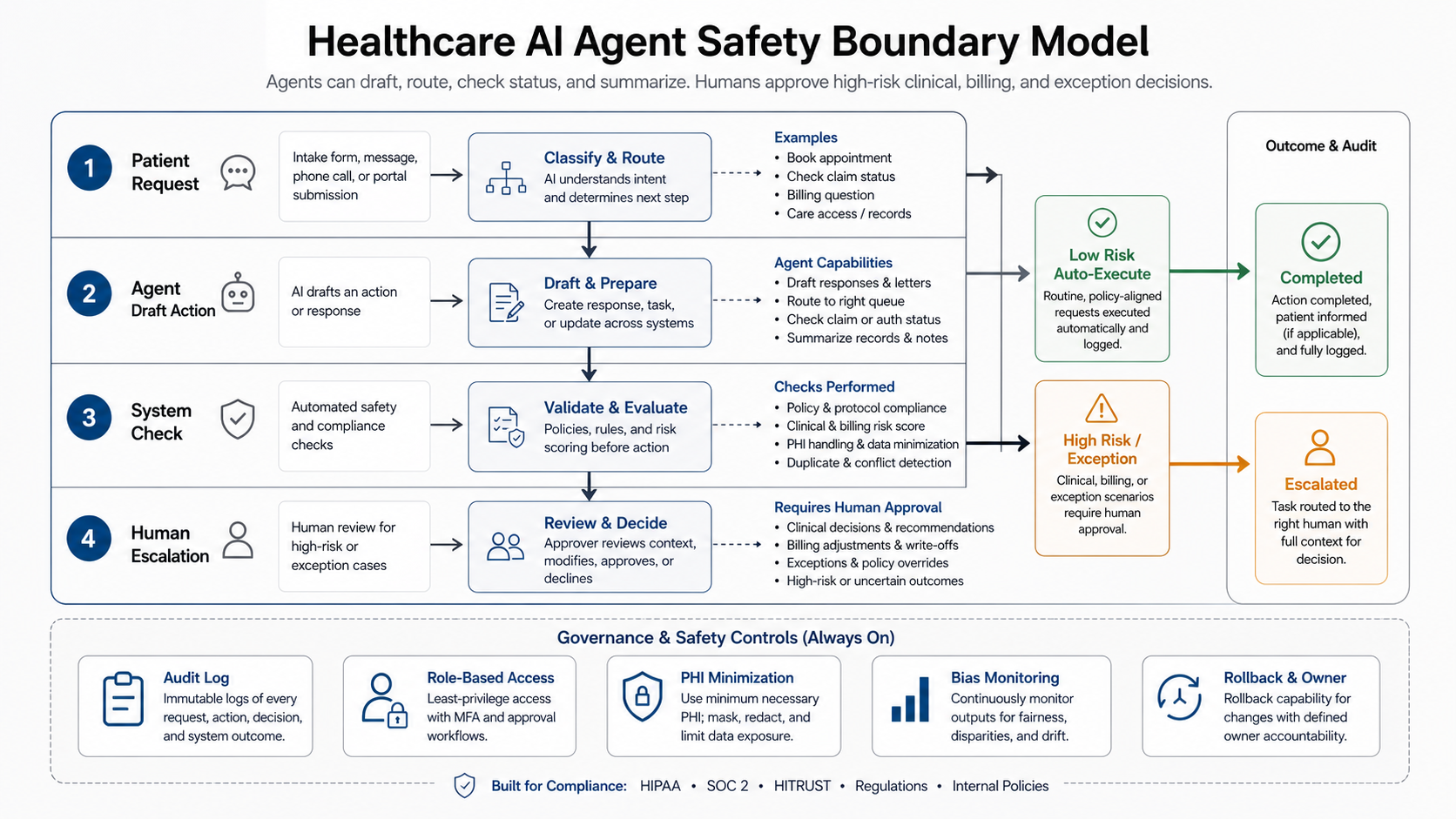
Integration Architecture For Healthcare Agents
A healthcare agent normally needs five layers. The trigger layer starts the job from a form submission, call transcript, appointment change, claim event, document arrival, or staff request. The context layer retrieves EHR data, policy rules, payer requirements, knowledge-base articles, schedules, or prior notes. The reasoning layer classifies the case, drafts output, or recommends a next step. The tool layer reads or writes to business systems. The control layer handles permissions, review, logging, evaluation, and rollback.
Do not connect the agent to every system at once. A first intake pilot might read a patient form and appointment context, draft missing-information questions, and create a staff task. A scheduling pilot might read available slots and location rules, then draft reschedule options. An RCM pilot might read claim status and payer notes, then prioritize worklists and draft appeal summaries.
For teams with private knowledge, retrieval architecture matters. Source freshness, document ownership, access control, and citation behavior affect trust. For model-heavy use cases, AI development services should cover evaluation, orchestration, prompt/version management, monitoring, and production support rather than only model selection. When the agent needs LLM orchestration, retrieval, summarization, or multi-step tool use across healthcare systems, a generative AI development track can define model access, privacy boundaries, evaluation fixtures, and release controls before write-back is enabled.
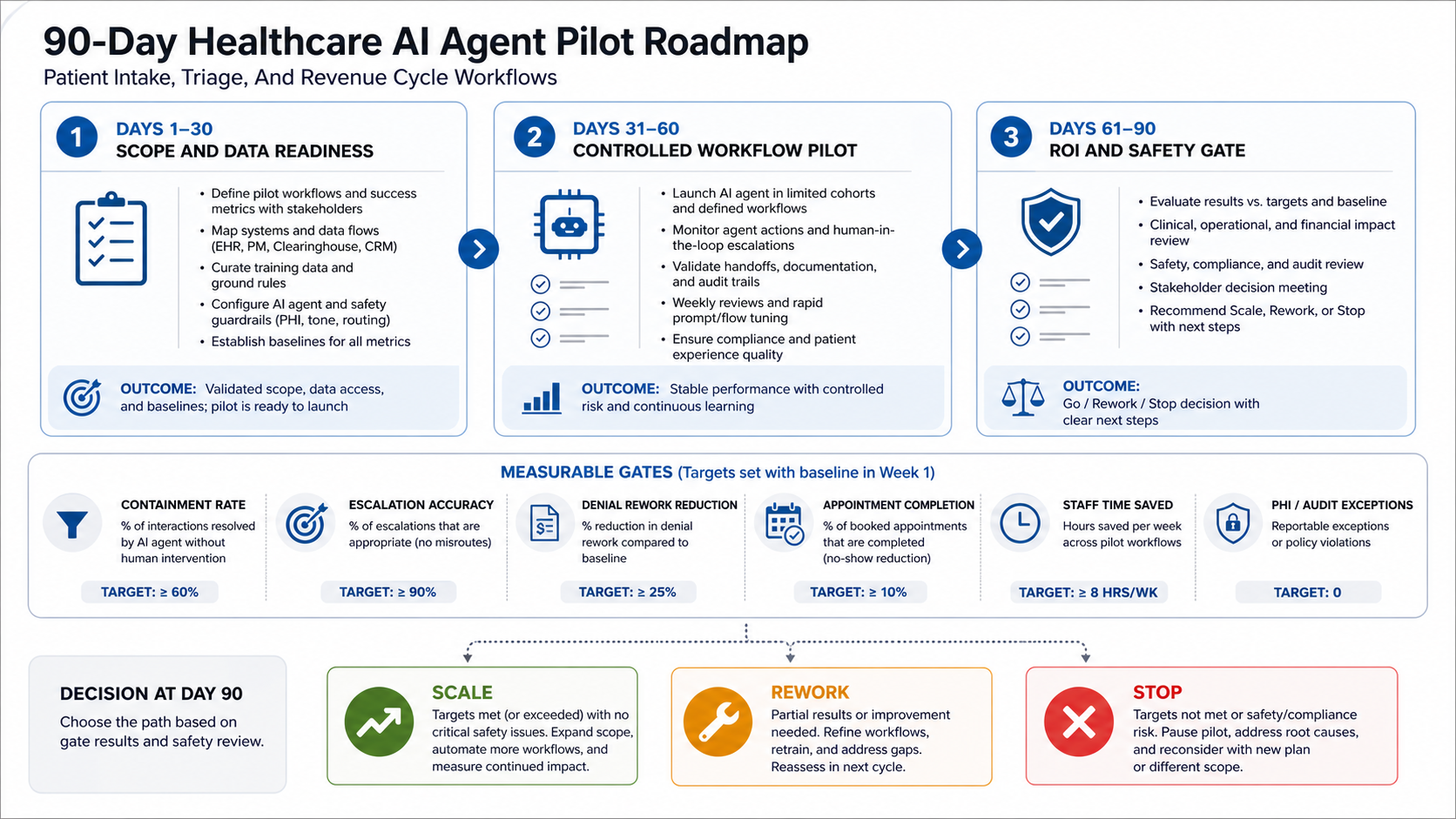
A 90-Day Pilot Roadmap
A practical healthcare AI agent pilot should prove workflow value and safety before it proves breadth. Ninety days is enough for a narrow slice when data access and stakeholders are ready.
| Phase | Timeline | Output | Gate |
|---|---|---|---|
| Workflow Discovery | Weeks 1-2 | Workflow map, systems, data fields, risk register, KPI baseline | Proceed only if owner, value, and review path are clear |
| Prototype Slice | Weeks 3-5 | Agent prompt/tool path, retrieval sources, approval screen, test set | Proceed only if representative cases work |
| Shadow Mode | Weeks 6-7 | Agent recommendations compared with staff decisions | Proceed only if errors are categorized and fixable |
| Controlled Pilot | Weeks 8-11 | Limited users, monitored output, human approval, audit trail | Proceed only if KPI and guardrails pass |
| Scale Decision | Week 12 | ROI summary, risk review, backlog, rollout plan | Scale, narrow, harden, or stop |
For revenue cycle workflows, the ROI model may include staff minutes saved, claim touches reduced, denial backlog changes, appeal completion rate, payment speed, and quality audit outcomes. For intake and scheduling, measure completion rate, no-show impact, handoff time, patient satisfaction, escalation rate, and staff edits. If the pilot depends on EHR data movement or write-back, use an EHR integration roadmap to plan API access, data migration, audit trails, testing, and rollout risk before scaling.
Build Vs Buy For Healthcare AI Agents
Buying a vertical agent can be faster when the workflow is common, vendor integrations are mature, and the organization accepts the vendor's roadmap. Building or customizing makes more sense when the agent must fit proprietary workflows, custom portals, unusual payer/provider rules, internal data products, or differentiated patient experience.
The decision is rarely pure build or buy. Many teams use vendor AI features for commodity steps, then build custom orchestration around intake, routing, reporting, approvals, or patient/member experience. NextPage's AI automation services work often combines product UX, workflow automation, API integrations, and AI guardrails so the agent fits the operating model instead of forcing staff into a generic tool. If the agent needs custom autonomy policies, evaluation harnesses, tool permissions, and rollback workflows, agentic AI development services are the better fit than a simple chatbot rollout.
Implementation Checklist
- Name one workflow, owner, baseline KPI, and review authority.
- Document what the agent can read, draft, recommend, update, and never do.
- Map PHI handling, user roles, audit logs, retention, and vendor obligations.
- Prepare representative test cases, including edge cases and escalation examples.
- Design the human review screen before expanding tool access.
- Measure output quality, override rate, escalation rate, latency, cost, and user adoption.
- Keep a rollback plan and prompt/model version history.
- Refresh training, policy, and knowledge sources on a named cadence.
- Run a weekly safety review during pilot mode: false positives, false negatives, escalations, patient complaints, staff overrides, cost, latency, and PHI/audit exceptions.
- Define the exact scale, rework, or stop threshold before launch so the team does not rationalize poor safety or ROI data after the pilot.
Common Mistakes To Avoid
The first mistake is treating healthcare AI agents as a content problem instead of a workflow problem. The prompt is only one component. The real product is the operating loop around data, permissions, review, integrations, metrics, and support.
The second mistake is skipping shadow mode. Teams need to compare agent recommendations against staff decisions before write-back. Shadow mode reveals missing policy rules, confusing documents, payer exceptions, language gaps, and escalation failures while the agent is still low risk.
The third mistake is measuring only productivity. Healthcare agents should also be judged on quality, patient safety, staff trust, compliance readiness, and downstream rework. A faster workflow that creates more exceptions is not a successful automation. The fourth mistake is buying a vertical tool before the team has mapped data ownership, review authority, and patient communication rules. Vendor features can help, but the operating model still decides whether the agent is safe to scale.
How NextPage Helps
NextPage helps healthcare and healthtech teams turn agent ideas into scoped software pilots. We audit candidate workflows, map data and integration needs, define approval boundaries, build patient or staff interfaces, connect EHR/CRM/RCM systems, create evaluation sets, and launch controlled pilots with monitoring.
The right starting point is a readiness review. Bring one target workflow, sample cases, source systems, current cycle-time baseline, risk concerns, and a business owner. The output should be a build-ready pilot scope with acceptance criteria, integration plan, human-review model, evidence of expected ROI, and a clear decision on whether to build now, prepare next, or hold.