
Quick Answer: What Do ChatGPT Development Services Include?
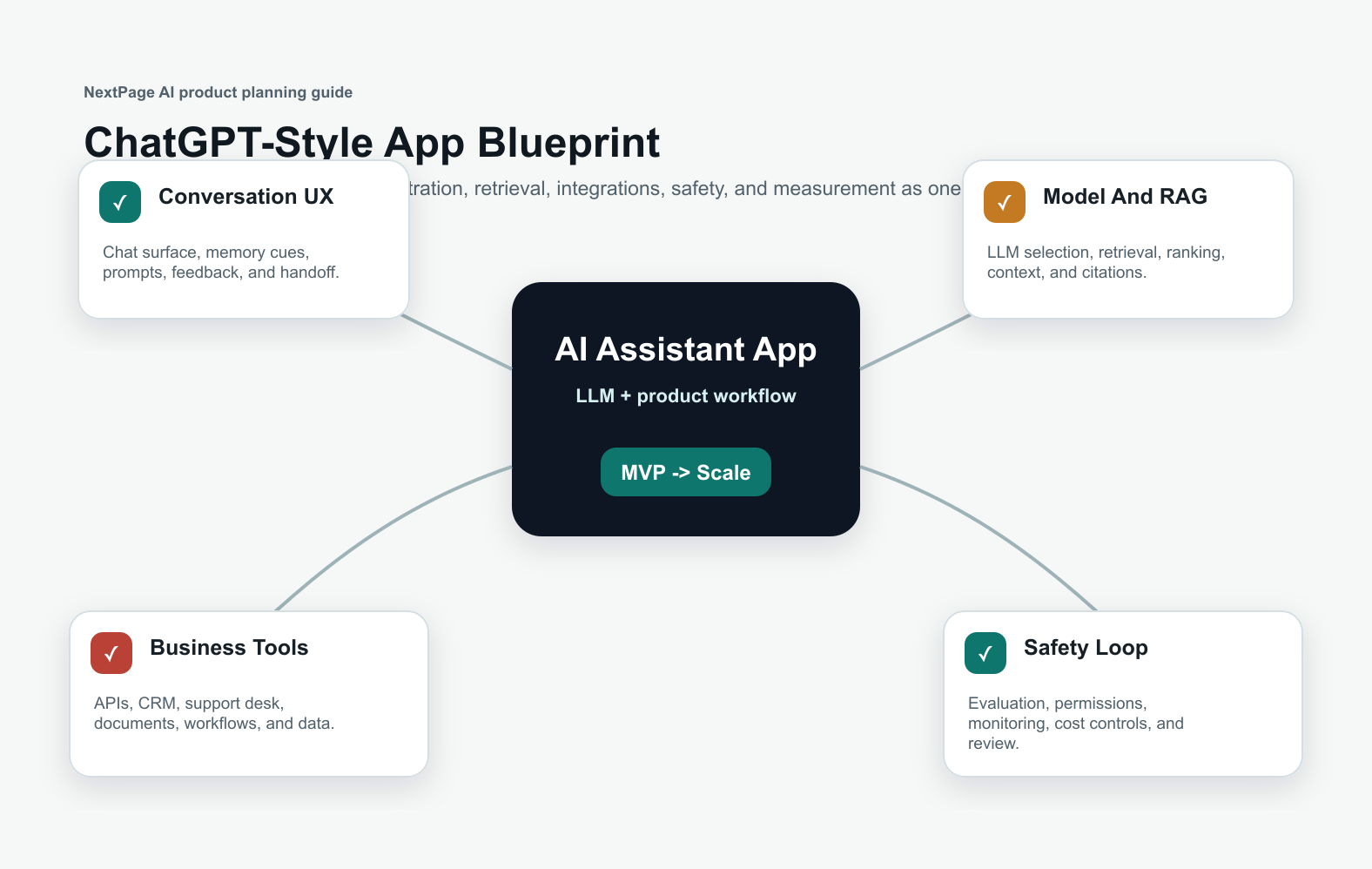
ChatGPT development services help a business design, build, integrate, and operate AI assistants powered by large language models. A strong engagement covers product strategy, conversation design, model selection, retrieval-augmented generation, integrations, security, evaluation, analytics, deployment, and ongoing improvement.
The goal is not to add a generic chatbot to a website. The goal is to turn repeatable conversations and knowledge-heavy workflows into reliable software. That can mean a customer support assistant, internal knowledge copilot, sales qualification bot, document analysis workflow, onboarding assistant, or AI agent that completes controlled actions through approved tools.
Why Businesses Invest In ChatGPT Development
Companies usually explore ChatGPT development because important workflows are still handled through slow manual conversations, scattered documents, repetitive support answers, or disconnected tools. A production AI assistant can reduce response time, improve knowledge access, qualify requests, summarize records, draft routine content, and guide users through complex decisions.
The commercial value comes from focus. A support assistant should understand support policies, product data, ticket history, and escalation rules. A sales assistant should know qualification criteria, pricing boundaries, CRM fields, and handoff points. An internal copilot should retrieve answers from approved documentation without exposing information to the wrong user. If your team is still defining the right use case, NextPage's generative AI development work can help turn AI interest into a buildable product plan.
What ChatGPT Development Services Usually Include
| Service Area | What It Covers | Why It Matters |
|---|---|---|
| Discovery and strategy | Workflow selection, user journeys, data readiness, risk level, business metrics, and rollout plan. | Prevents the project from becoming a broad demo with no measurable owner. |
| Conversation design | Assistant personality, prompt patterns, clarifying questions, source citations, fallback states, and human handoff. | Improves user trust and keeps the assistant useful when context is incomplete. |
| LLM and RAG architecture | Model selection, retrieval pipeline, embeddings, vector search, ranking, context windows, and prompt orchestration. | Connects the assistant to business-specific knowledge instead of generic responses. |
| Integrations | CRM, help desk, databases, portals, calendars, documents, payment systems, and internal APIs. | Turns conversational answers into workflow progress. |
| Safety and governance | Permissions, moderation, data retention, audit logs, evaluations, approval steps, and monitoring. | Controls risk before the assistant affects customers or business records. |
| Launch and optimization | Analytics, feedback loops, quality reviews, cost tracking, latency tuning, and continuous improvement. | Keeps the system aligned with real usage after launch. |
If the primary use case is support, sales, onboarding, or internal help desk automation, a focused AI chatbot development approach is often the right starting point. If the project includes broader machine learning, workflow intelligence, or enterprise automation, compare it with NextPage's wider AI development services.
Architecture For A Production ChatGPT Solution
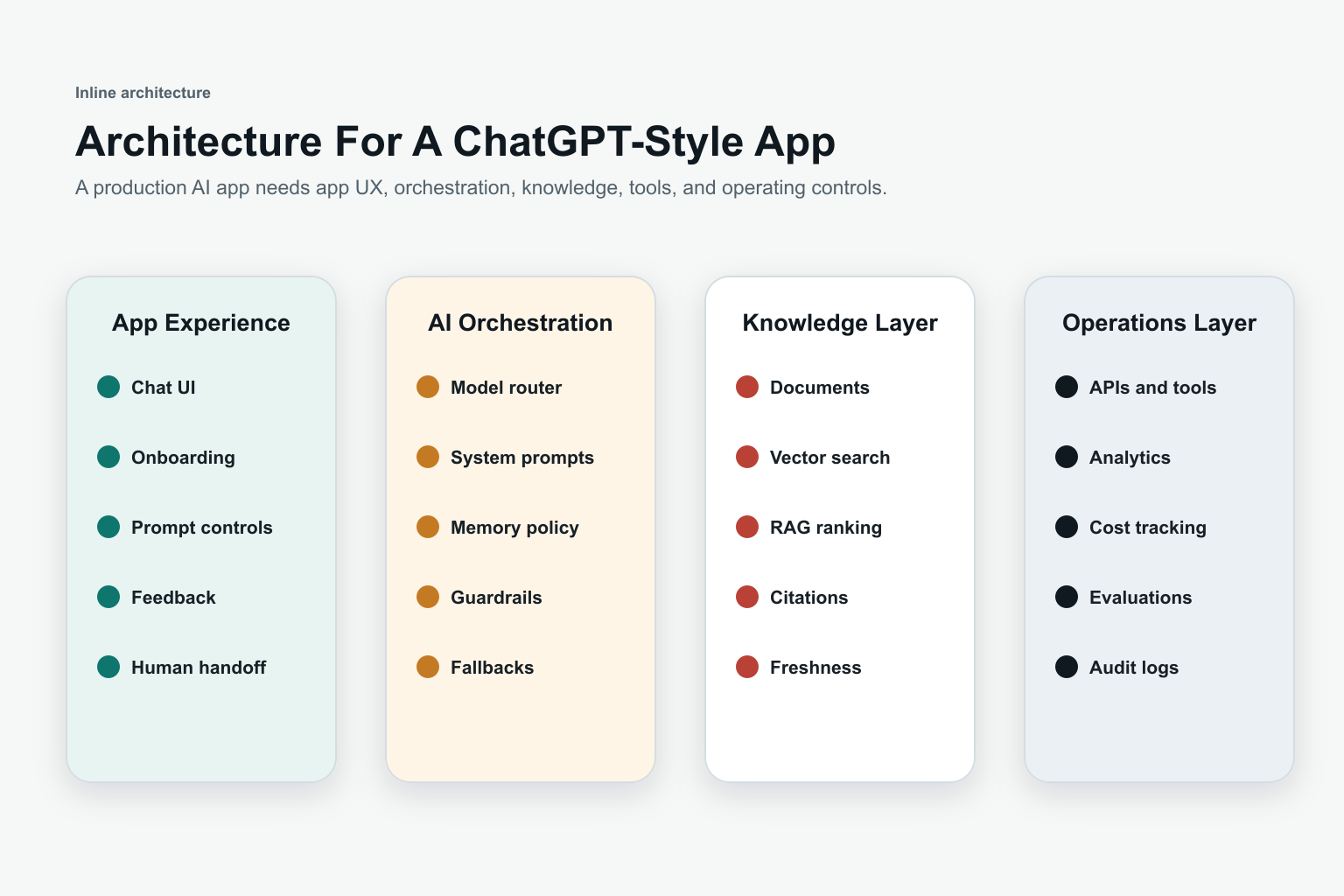
The application layer manages authentication, roles, chat history, file uploads, feedback, admin controls, and user interface states. The AI orchestration layer decides what instructions to apply, when retrieval is needed, which model to call, what tool can be used, and how the system should respond when confidence is low.
The knowledge layer is often the difference between a novelty and a useful business tool. Retrieval-augmented generation connects the assistant to approved documents, policies, product data, tickets, records, or knowledge bases. For complex products, LLM development should include retrieval design, evaluations, security, and monitoring rather than only prompt writing.
High-Value Use Cases For ChatGPT Development
Customer support: answer common questions, summarize ticket history, suggest replies, route cases, and escalate sensitive issues to humans. This works best when the assistant can retrieve policy, order, account, or product context.
Sales and lead qualification: collect requirements, answer product questions, score lead fit, draft follow-up notes, and pass clean context into a CRM. The assistant should have clear boundaries around pricing, promises, and legal claims.
Internal knowledge management: help employees search policies, SOPs, training material, project notes, and technical documentation. Access control matters because internal assistants often touch sensitive operational information.
Document and workflow automation: summarize documents, extract fields, compare records, prepare drafts, and trigger review steps. If the assistant will move work across systems, read AI workflow automation guidance before adding too much autonomy.
Implementation Roadmap
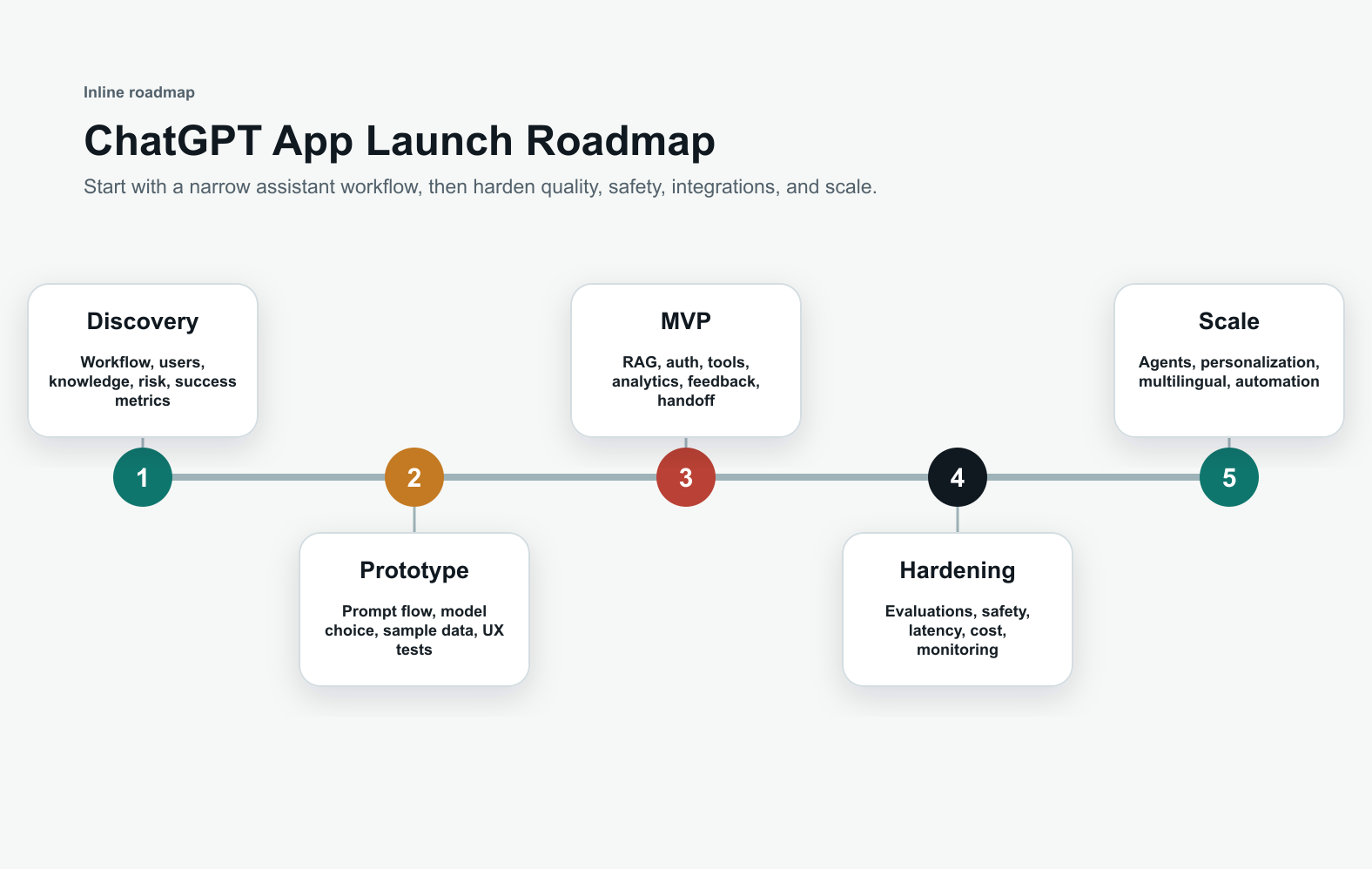
- Discovery: define the workflow, user groups, source data, risk level, integration needs, success metrics, and escalation path.
- Prototype: test prompts, model choices, retrieval samples, conversation UX, answer quality, and edge cases with representative data.
- MVP: build authentication, chat UI, RAG, document ingestion, feedback capture, analytics, admin controls, and a reliable human handoff path.
- Production hardening: add evaluations, monitoring, permissions, audit logs, moderation, cost controls, latency tuning, and rollback behavior.
- Scale: add tool use, workflow automation, personalization, multilingual support, voice, and AI agents after the assistant has proven value.
The AI Agent Readiness Assessment is useful when the roadmap includes tool-using agents, approvals, or supervised automation. For financial framing, the AI Automation ROI Calculator can connect expected time savings to investment decisions.
Risks To Control Before Launch
ChatGPT applications can sound confident even when they are missing context. That makes evaluation, source grounding, and fallback behavior essential. Build test sets from real customer questions, expected answers, prohibited answers, failed conversations, and integration edge cases. Track helpfulness, hallucination risk, source quality, escalation quality, latency, cost, and user feedback.
Privacy and access control also need early design. Decide what data can be sent to the model, how long conversations are retained, which users can retrieve which documents, when the assistant should redact sensitive information, and what actions require human approval. This becomes even more important if the roadmap moves from chatbot responses to agentic actions. The differences between content generation, tool use, and autonomous workflows are covered in Generative AI vs AI Agents vs Agentic AI.
Cost Drivers For ChatGPT Development Services
Cost depends on scope. A prototype with a simple chat interface and model API is much smaller than a secure enterprise assistant with RAG, SSO, admin roles, CRM integration, audit logs, evaluations, analytics, and human approval workflows.
The main cost drivers are product discovery depth, frontend complexity, model usage volume, data cleanup, retrieval quality, number of integrations, security requirements, QA coverage, analytics, multilingual needs, voice or multimodal features, and ongoing monitoring. When the assistant must connect deeply to business systems, the work often overlaps with custom software development.
How To Choose A ChatGPT Development Partner
Look for a partner that can discuss product value, data readiness, architecture, security, evaluation, and operations in the same conversation. Prompt writing alone is not enough. The partner should be able to explain model tradeoffs, retrieval quality, integration risk, monitoring, human review, cost controls, and how the assistant will improve after launch.
Ask for a scoped discovery phase, a prototype plan, a measurable MVP, and a realistic roadmap for hardening. The best ChatGPT development services make the system narrower, safer, and more useful before they make it more autonomous.
Final Recommendation
Use ChatGPT development services when your business has a repeatable conversation, knowledge, support, sales, or operational workflow that can become faster and more consistent with an AI assistant. Start with one measurable use case, connect it to trusted knowledge, design the user experience carefully, and add integrations only when they help users complete real work.
A well-built ChatGPT solution should answer accurately, know when to ask for clarification, respect permissions, hand off when needed, and generate data your team can use to keep improving it.