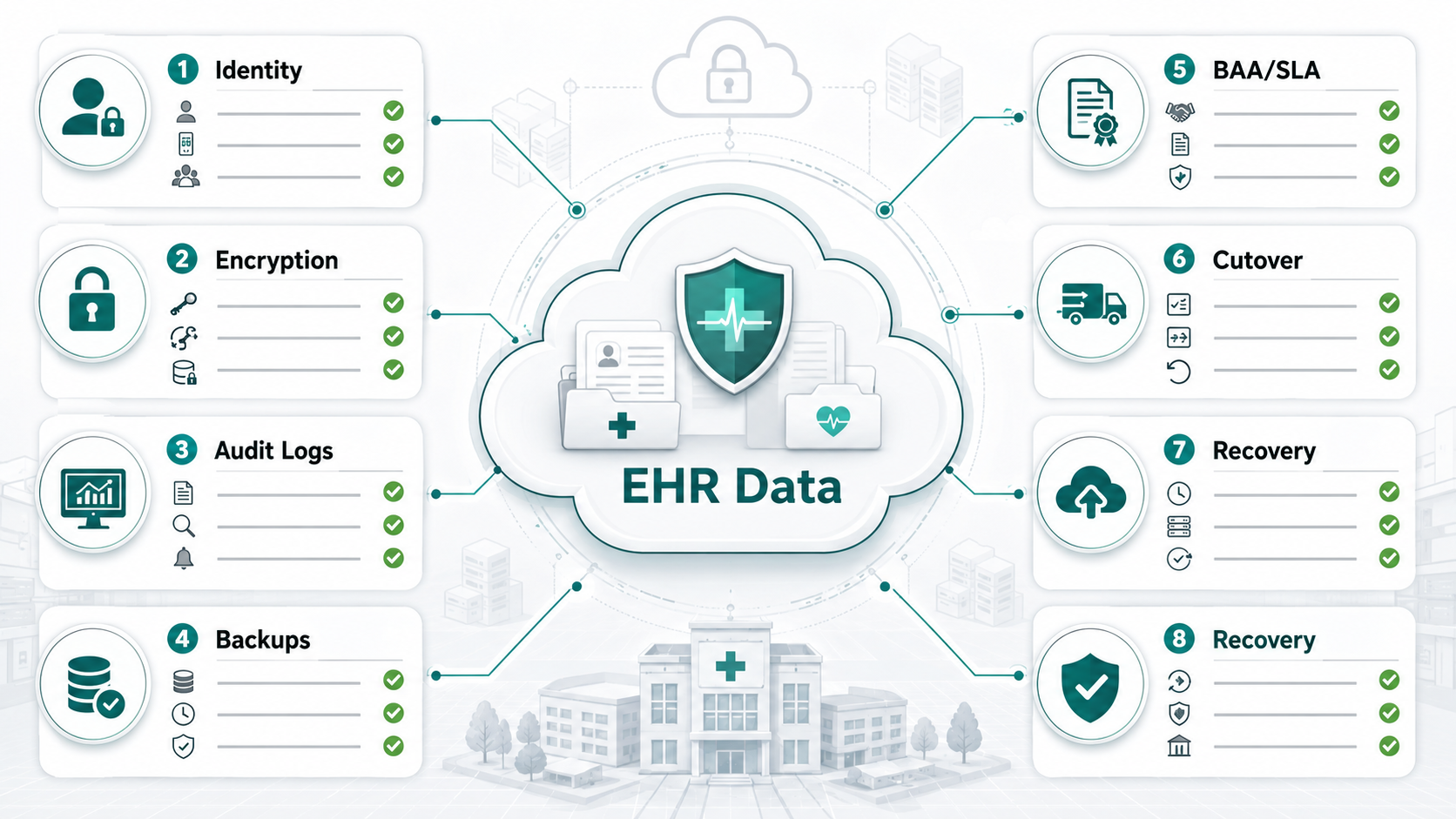

A healthcare cloud security checklist should prove five things before any EHR, patient, billing, analytics, or care-management workload moves to production: who is responsible for ePHI, who can access it, how it is encrypted and monitored, how the organization will recover, and how migration risk is controlled during cutover. The checklist is not a static compliance document. It is an operating plan for shared responsibility, vendor evidence, access control, audit logs, backups, incident response, and safe modernization.
Healthcare teams often frame cloud security as a hosting decision. In practice, it is a product, data, compliance, and operations decision. A secure cloud migration for healthcare software has to account for HIPAA obligations, business associate agreements, EHR interfaces, identity governance, clinical uptime, ransomware resilience, and rollback plans. If those controls are not designed before the move, the cloud can make weak operating practices faster and harder to audit.
This checklist is for CTOs, compliance leads, product owners, and engineering teams modernizing patient-data systems. It explains what to verify before migration, what evidence to ask from vendors, how to map controls to the application architecture, and where NextPage typically starts a healthcare cloud readiness review.
Healthcare Cloud Security Checklist
Use this table as the executive checklist before approving a healthcare cloud migration, replatforming effort, or new cloud-native healthcare product.
| Checklist Area | What To Confirm | Evidence To Keep |
|---|---|---|
| HIPAA role and BAA | Every vendor that creates, receives, maintains, or transmits ePHI is classified correctly and covered by a business associate agreement when required. | Signed BAA, subcontractor list, permitted-use terms, data retention terms. |
| Shared responsibility | The team knows which controls belong to the cloud provider, SaaS vendor, application team, DevOps team, and security/compliance owner. | Responsibility matrix, architecture diagram, control owner register. |
| EHR and patient-data inventory | ePHI flows, EHR interfaces, analytics exports, backups, logs, file stores, and third-party APIs are mapped before migration. | Data-flow map, system inventory, integration list, classification labels. |
| Identity and access | Least-privilege roles, MFA, service-account rotation, break-glass access, and privileged access review are defined. | IAM policy exports, access review logs, role matrix, emergency access procedure. |
| Encryption and key management | Data is encrypted in transit and at rest, keys are controlled intentionally, and encryption coverage includes logs, backups, queues, and file stores. | KMS policy, TLS requirements, key rotation records, encrypted-storage checks. |
| Audit logs and monitoring | Security events, access events, API activity, infrastructure changes, and application errors are logged and reviewed. | SIEM/dashboard links, retention policy, alert routing, runbooks. |
| Backups and recovery | Backups are tested, immutable/offline protections are considered, restore time and restore point targets are documented. | Restore test evidence, backup policy, ransomware recovery runbook. |
| Migration cutover risk | Cutover, rollback, data reconciliation, downtime windows, and stakeholder approvals are planned before production migration. | Cutover plan, rollback plan, reconciliation report, sign-off record. |
| Vendor and platform evidence | Cloud, SaaS, observability, AI, support, and integration vendors provide current security and compliance evidence. | SOC 2/HITRUST where applicable, penetration test summary, SLA, DPA/BAA. |
| Operating cadence | Security reviews, access reviews, patching, vulnerability response, DR tests, and compliance evidence refreshes have owners and dates. | Governance calendar, ticket workflow, executive risk register. |
Start With HIPAA Role, BAA, And Shared Responsibility
HHS cloud computing guidance is clear that covered entities and business associates may use cloud services for ePHI, but they remain responsible for complying with applicable HIPAA Privacy, Security, and Breach Notification requirements. A cloud service provider can be a business associate when it creates, receives, maintains, or transmits ePHI on behalf of a covered entity or business associate. The fact that a provider cannot view encrypted data because it lacks the key does not automatically remove that business associate role.
That means the first checklist item is not a firewall setting. It is the operating model. Identify each vendor and workload, decide whether ePHI is involved, confirm whether a BAA is required, and document what the vendor can and cannot do with the data. The BAA should not be treated as a procurement formality. It should influence logging, support access, data return, deletion, subcontractors, breach notification, and service availability expectations.
For engineering teams, convert that responsibility model into an architecture-level control matrix. If the cloud provider secures the physical data center but your team controls IAM, network segmentation, backup configuration, API access, and application logging, the checklist must assign those controls to named owners. This is where many cloud migrations fail: the provider may be compliant, but the deployed workload is not operated in a compliant way.
Map EHR Data, PHI Flows, And Hidden Copies
Healthcare cloud security starts with knowing where patient data actually moves. EHR interfaces, HL7/FHIR APIs, billing exports, patient portal messages, call-center notes, analytics pipelines, file attachments, support transcripts, application logs, and backup snapshots can all create ePHI exposure. A migration plan that covers the main database but ignores logs, object storage, queues, and BI exports is incomplete.
Before migration, build a data-flow map with system owners, data types, source systems, destinations, retention periods, and access roles. Mark where ePHI enters the system, where it is transformed, where it is stored, and where it leaves. Then classify each dataset by sensitivity and business criticality. This helps the team decide which systems need stronger encryption, stricter access, shorter retention, higher availability, or a separate migration wave.
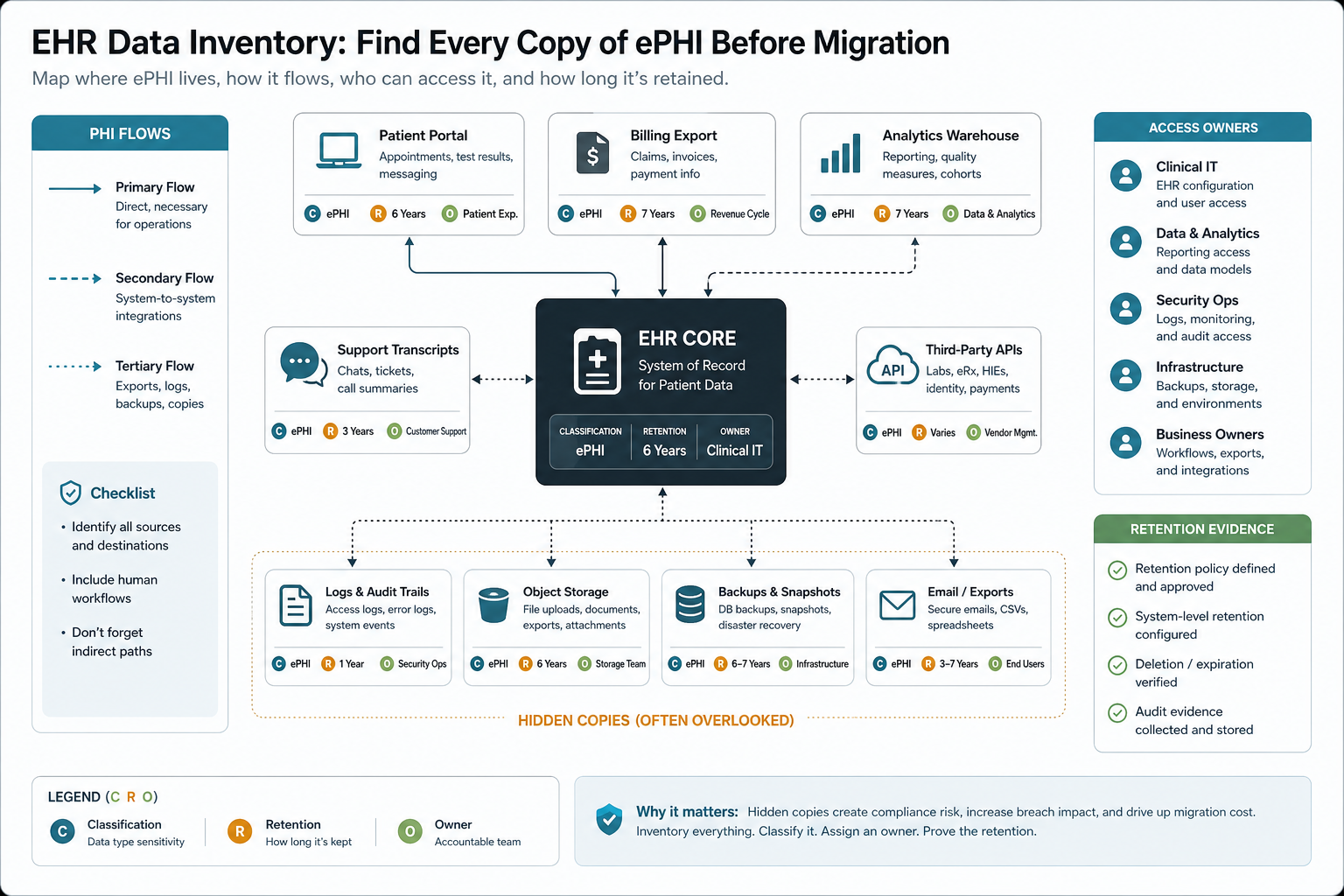
A useful inventory should also name the accountable owner for each copy of patient data. That owner should confirm retention, deletion, access review, monitoring, and evidence storage. Without that ownership layer, teams often secure the primary database while leaving patient identifiers in exports, logs, attachments, or temporary migration stores.
For complex legacy systems, an application replatforming services assessment can separate what should move as-is from what needs redesign. Teams often discover that the technical migration is straightforward but the data cleanup, integration mapping, and access model require more time than expected.
Design Identity And Access Controls Before Migration
Identity is the control plane for healthcare cloud risk. Every engineer, clinician, support user, analyst, service account, CI/CD runner, integration key, and emergency account needs an access story. Least privilege should be the default. Privileged access should be time-bound or reviewed frequently. Service accounts should have rotation, scope limits, and clear ownership.
A practical healthcare IAM checklist should include MFA, SSO where possible, role-based access, separation of duties, emergency access, joiner/mover/leaver workflows, quarterly access reviews, service-account inventories, and alerting for risky access changes. The checklist should also define who can query production data, who can view logs that may contain ePHI, who can export reports, and who can approve elevated access.
The most common mistake is treating cloud IAM and application authorization as separate projects. They have to be designed together. A staff user may have the right to view a patient record inside the product, while an engineer should only see redacted logs and controlled diagnostics. Your cloud policies, application roles, support workflows, and audit evidence should agree with each other.
Verify Encryption, Key Management, And Data Segmentation
Encryption is necessary, but it is not sufficient by itself. HHS guidance notes that covered entities and business associates must still perform risk analysis and implement reasonable safeguards even when using cloud services. In practical terms, healthcare teams should verify encryption in transit, encryption at rest, key ownership, key rotation, backup encryption, queue and object-store encryption, and any exceptions for legacy protocols or third-party integrations.
Key management should be intentional. Decide whether keys are provider-managed, customer-managed, or externally managed. Document who can administer keys, what happens if a key is disabled, how rotation works, and how recovery is handled. For multi-tenant healthcare SaaS, also review how tenant isolation, database partitioning, and object storage boundaries reduce cross-customer risk.
If the migration includes analytics or AI workflows, add a separate control review for de-identification, tokenization, data minimization, prompt logging, model-provider terms, and downstream retention. Healthcare cloud security increasingly overlaps with AI governance because patient data can move into analytics, summarization, and decision-support pipelines if boundaries are not explicit.
Make Audit Logs Useful, Not Just Available
Audit logs only reduce risk when they are complete, retained, reviewed, and connected to response workflows. A healthcare cloud checklist should confirm logs for authentication, authorization, administrative changes, database access, API calls, file downloads, failed access attempts, infrastructure changes, deployment activity, backup actions, and security alerts.
Define retention periods and evidence requirements early. Some logs need to support security investigations, some support compliance audits, and some help application teams troubleshoot incidents without exposing sensitive data. Redaction and role-based access to logs are important because logs can become a second copy of PHI when applications write request bodies, identifiers, or patient details too freely.
NIST Cybersecurity Framework 2.0 is useful as a governance lens here because it frames security outcomes across Govern, Identify, Protect, Detect, Respond, and Recover. For healthcare cloud programs, that means detection and response cannot be bolted on after launch. They need owners, tooling, thresholds, runbooks, escalation paths, and executive visibility.
Plan Backups, Ransomware Resilience, And Recovery Tests
Healthcare downtime has operational and patient-care consequences, so backup design deserves more than a checkbox. CISA ransomware guidance emphasizes backup discipline, logging, alerting, and recovery preparation. In a healthcare cloud environment, the team should know what is backed up, how often, where backups live, who can delete them, whether immutability or offline protection is available, and how long a realistic restore takes.
Set recovery time objectives and recovery point objectives by workload. A patient portal, EHR integration engine, data warehouse, public website, and internal admin tool should not necessarily have the same targets. Then test restores. A backup that has never been restored under realistic conditions is only an assumption.
Recovery should also include application configuration, secrets, infrastructure-as-code, DNS, certificates, monitoring rules, and vendor access. If the production database can be restored but the integration credentials, worker queues, and DNS failover are undocumented, the recovery plan is incomplete.
Control Migration Risk During Cutover
Cloud security in healthcare is not only a steady-state issue. The migration window itself creates risk. Data may be copied into temporary stores, test environments may receive production-like records, old and new systems may run in parallel, and teams may relax access controls to move faster. That is why a healthcare cutover plan needs explicit security controls.
Before cutover, confirm migration tooling, temporary storage, reconciliation scripts, access permissions, rollback triggers, downtime windows, communication owners, and incident escalation. After cutover, reconcile counts, validate critical workflows, review logs, confirm backup jobs, and remove temporary permissions or migration artifacts. Temporary credentials and one-off scripts are a common source of lingering risk.
NextPage's regulated application migration checklist and GCP migration checklist are useful companion reads when your cloud program involves phased migrations, regulated data, or platform-specific governance. For systems with many exports and integrations, data migration services planning should run alongside infrastructure work.
Ask Vendors For Evidence That Matches Your Workload
Security questionnaires are useful only when they connect to the actual workload. A generic vendor trust page may not answer whether your support team can access PHI, whether logs are retained outside your chosen region, whether subcontractors touch support tickets, whether backup deletion requires multiple approvals, or whether the SLA covers your clinical operating needs.
For each cloud, SaaS, observability, AI, support, and integration vendor, ask for the evidence that maps to your use case. That may include BAA terms, SOC 2 reports, HITRUST status where relevant, penetration test summaries, vulnerability management process, data-processing terms, subprocessors, backup and deletion process, incident notification windows, support-access controls, and service availability commitments.
Do not collect evidence once and forget it. Vendor posture changes, product features change, and your use of the vendor may expand. Add an evidence refresh cadence to the operating checklist and record owner, due date, and decision status.
Turn The Checklist Into An Operating Cadence
The best healthcare cloud checklist becomes a recurring operating rhythm. Quarterly access reviews, monthly vulnerability review, backup restore drills, annual disaster recovery exercises, vendor evidence refresh, policy review, incident tabletop exercises, and architecture reviews should be scheduled, owned, and tracked.
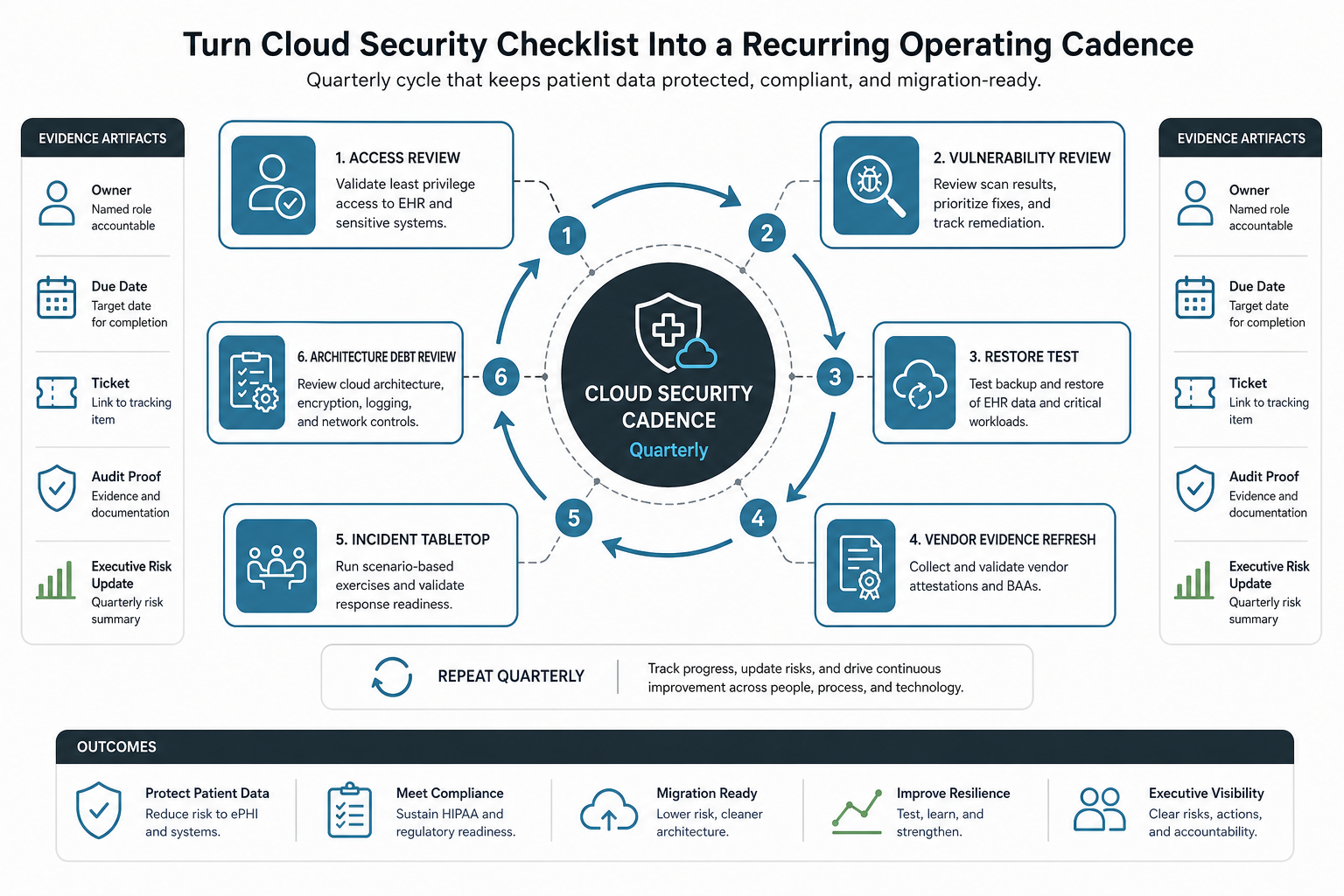
The cadence should produce artifacts an auditor, buyer, or incident-response lead can actually use: access-review exports, vulnerability tickets, restore-test results, vendor evidence decisions, tabletop findings, and an executive risk update. If a control has no owner, due date, and evidence location, it is still an intention rather than an operating practice.
The HHS Security Rule NPRM reinforces a broader direction in healthcare security: more specificity, stronger documentation, and clearer accountability for technical safeguards. Even before every proposal becomes a final rule, healthcare technology leaders should expect auditors, partners, and enterprise buyers to ask for better evidence than "the cloud provider is compliant."
For organizations modernizing legacy healthcare systems, the operating cadence should also include release governance and architecture debt review. Security deteriorates when old interfaces, unsupported libraries, manual data exports, and informal admin access survive every migration wave. Pair cloud migration with legacy software modernization when the old architecture prevents clean controls.
How NextPage Would Run A Healthcare Cloud Readiness Review
NextPage would start with a short evidence sprint, not a generic cloud migration estimate. The first step is to map workloads, ePHI flows, vendors, identity roles, integrations, uptime needs, and migration constraints. The second step is to score gaps across BAA/shared responsibility, data classification, IAM, encryption, audit logs, backups, incident response, and cutover readiness. The third step is to turn those findings into a phased modernization roadmap.
That roadmap may lead to cloud migration services for infrastructure and platform movement, application replatforming services for legacy workloads that need architecture changes, or custom software development when the secure path requires product workflow changes, integration redesign, or role-based operational tooling.
The goal is not to produce a bigger checklist. The goal is to make the migration auditable, recoverable, and usable by the people who operate patient-data systems every day. A good healthcare cloud security plan gives compliance leaders evidence, engineers clear controls, executives migration risk visibility, and users a stable product after cutover.
Sources Reviewed
This article was informed by current official sources and discovery references, including HHS guidance on HIPAA and cloud computing, HHS Security Rule NPRM factsheet material, NIST Cybersecurity Framework 2.0, CISA ransomware guidance, and the queued SparxIT reference on cloud security in healthcare. The final recommendations translate those sources into practical product, migration, and software modernization decisions for healthcare teams.