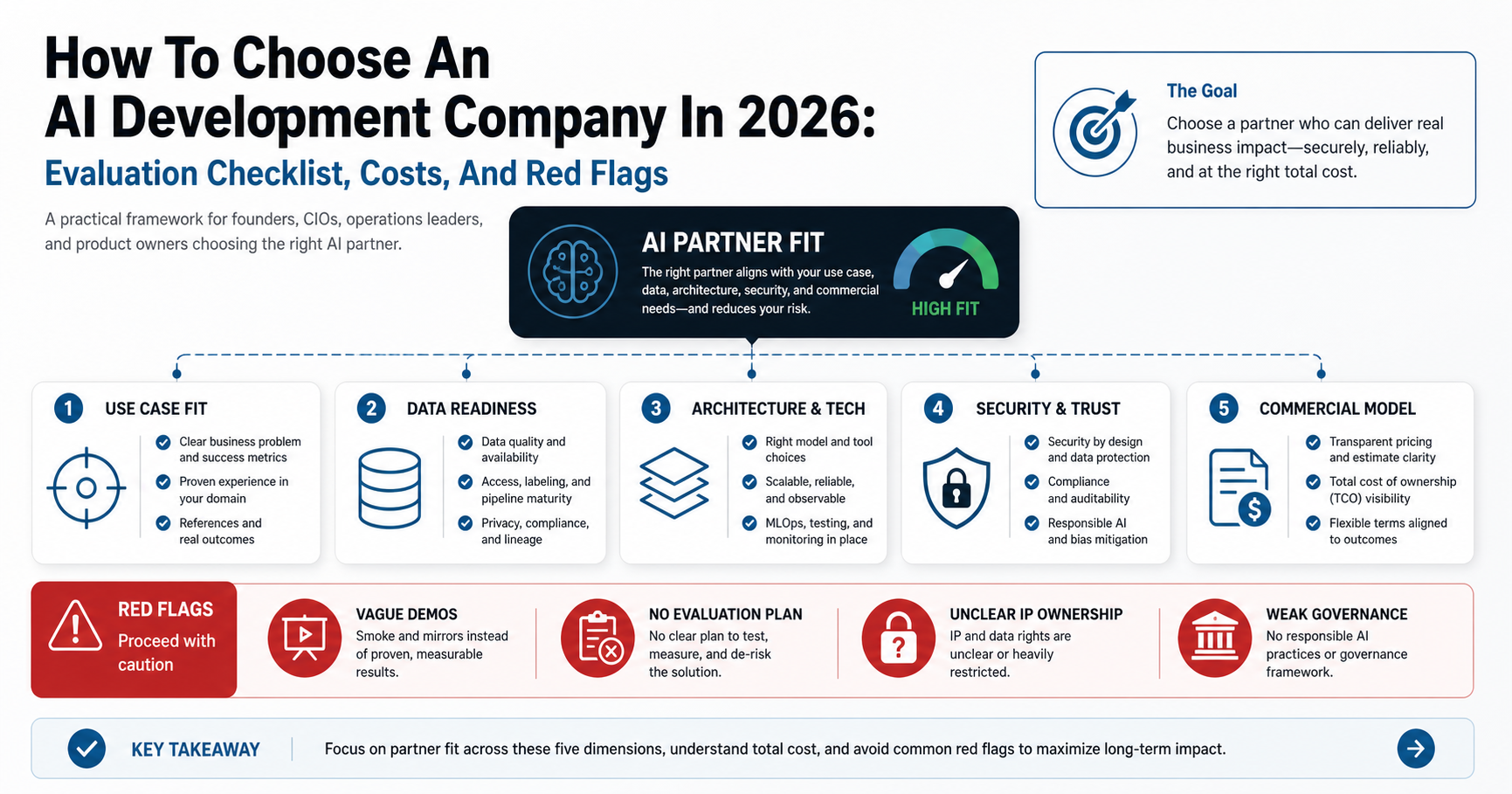

Quick Answer: How To Choose An AI Development Company
Choose an AI development company by scoring how well it understands your business workflow, data environment, architecture options, security obligations, delivery model, and expected return. The strongest partner should be able to explain what not to build, where simple automation beats an AI model, how the system will be evaluated, and who owns the data, prompts, code, infrastructure, and production operations after launch.
For most 2026 projects, the best first step is not a vendor shortlist. It is a structured AI project fit review: define the workflow, inspect available data, estimate value, identify risks, then ask every vendor to respond against the same evidence. NextPage uses this approach in its AI development services work because it makes vendor comparison practical instead of brand-led.
The market is crowded with lists of AI companies. Shortlists can help with discovery, but they do not tell you whether a partner can ship a safe, measurable, maintainable AI workflow for your business. Use this guide as a due-diligence checklist before you sign a discovery, prototype, pilot, or production build.
Start With The Use Case, Not The Vendor Logo
A good AI development company will push you to describe the work before discussing models. The question is not whether the team can build with GPT, Claude, Llama, vector databases, or orchestration tools. The question is which business decision or repeated workflow should improve, what constraints apply, and what proof will show the system worked.
Write a one-page use-case brief before outreach. Include the current process, user roles, systems touched, data sources, pain points, compliance limits, expected volume, and success metrics. For example, a support AI agent might target first-response quality, average handle time, escalation accuracy, and knowledge-base coverage. A document automation workflow might target cycle time, review accuracy, exception handling, and auditability.
If the use case is still unclear, run an internal scoring exercise first. The AI Agent Readiness Assessment can help compare workflow clarity, data readiness, integration access, risk, and operating ownership before you invite vendors into the conversation.
AI Development Company Evaluation Scorecard
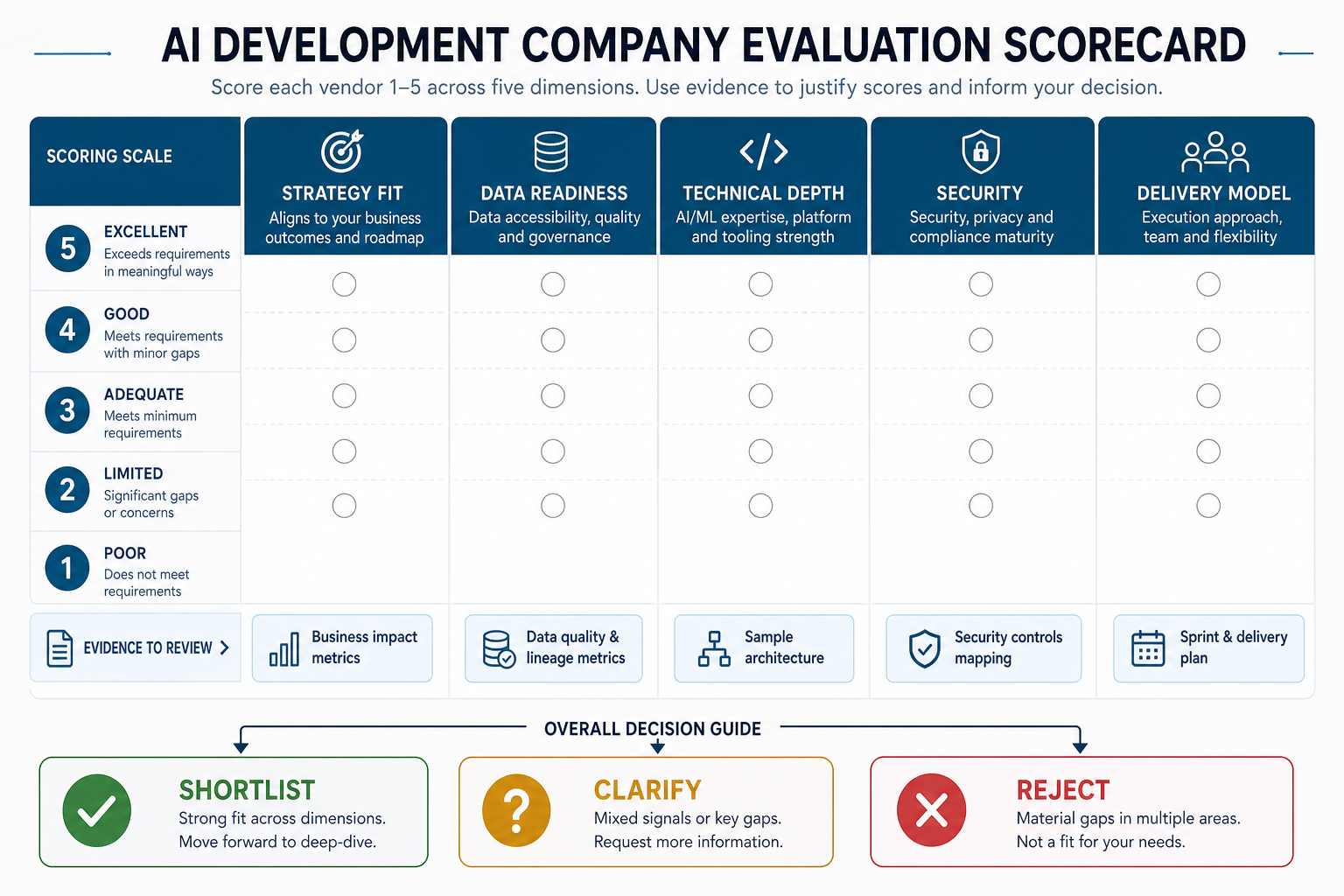
Use the same scorecard for every vendor. It keeps the conversation objective and exposes gaps that a sales deck can hide. Score each AI development company from 1 to 5 across the five pillars below, then ask for evidence that justifies the score.
| Evaluation Area | What To Check | Strong Signal | Weak Signal |
|---|---|---|---|
| Strategy Fit | Workflow, users, decision points, expected value, and constraints. | The vendor challenges the use case and narrows scope. | The vendor jumps straight to tools or model names. |
| Data Readiness | Sources, quality, access, governance, labeling, retention, and evaluation data. | The vendor asks for sample data and maps risk early. | The vendor assumes your data will be clean and available. |
| Architecture Depth | RAG, agents, fine-tuning, APIs, MLOps, evaluation, fallback behavior, and monitoring. | The vendor explains tradeoffs and failure modes. | The vendor presents one default architecture for every problem. |
| Security And Governance | Privacy, prompt/data handling, access control, audit logs, human review, and AI risk management. | The vendor defines controls before build scope. | Security is treated as a late checklist item. |
| Delivery Model | Discovery, sprint cadence, demos, acceptance criteria, documentation, and support handoff. | The vendor defines a pilot gate and operating plan. | The vendor sells a large build before a narrow proof point. |
Technical Depth To Look For
AI development is not one capability. A production-grade partner should understand when to use retrieval-augmented generation, when to build an AI agent, when fine-tuning is unnecessary, and when traditional software logic is safer than probabilistic output. If your team is still deciding between workflow automation, RAG, agents, or a custom model, compare the vendor's recommendations with the tradeoffs in generative AI development and LLM development work.
For LLM-heavy products, ask how the team handles retrieval quality, chunking, citations, prompt and policy versioning, evaluation sets, fallback behavior, token cost, latency, and data leakage. For agentic workflows, ask how tool permissions, approvals, audit logs, and escalation rules work. For predictive or recommendation systems, ask how model drift, retraining, monitoring, and performance thresholds will be managed.
The vendor should also know when to simplify. If a rules-based approval workflow, search experience, or dashboard solves the problem with lower risk, that should be part of the recommendation. AI vendors that sell AI for every problem are optimizing for scope, not buyer outcomes.
Data Readiness Questions To Ask Before Signing
Data readiness is where many AI projects slow down. A vendor that ignores data quality during sales will usually discover it after the budget is already committed. Ask these questions before a full estimate:
- Which data sources are required for the first useful version?
- Who owns access, cleaning, labeling, approvals, and retention decisions?
- What data cannot leave your environment or approved providers?
- How will confidential, regulated, or customer-specific records be handled?
- What is the minimum evaluation dataset needed before launch?
- How will the system detect stale, missing, low-quality, or contradictory information?
If those questions expose gaps, pause before building. NextPage's AI Data Readiness Checklist and Enterprise AI Readiness Checklist cover the operational work needed around data, workflows, security, and governance before a serious implementation.
What Portfolio Proof Actually Matters?
Relevant proof is not a logo wall. Ask for examples that match your risk profile: similar data sensitivity, integration complexity, user workflow, industry constraints, and production support needs. A healthcare triage assistant, a finance document workflow, and a sales research agent may all use LLMs, but their governance and evaluation needs are very different.
Good proof includes before-and-after process metrics, screenshots or walkthroughs of the workflow, architecture explanation, role of human review, data protections, incident and fallback handling, and what changed after pilot feedback. If a vendor cannot discuss outcomes because of confidentiality, they should still be able to describe patterns, tradeoffs, and anonymized lessons.
AI Development Company Costs And Pricing Models
AI development company pricing usually depends on scope maturity, integrations, data preparation, model complexity, interface needs, governance requirements, and post-launch support. Treat any number without assumptions as a placeholder. Use an AI automation ROI calculator or a simple internal cost model to compare expected value against discovery, build, run, and support costs.
| Engagement Type | Best For | Typical Budget Logic | Buyer Gate |
|---|---|---|---|
| Discovery Or Readiness Sprint | Validating use case, data, architecture, and ROI. | Fixed short engagement with clear artifacts. | Do we have enough evidence for a prototype? |
| Prototype | Testing feasibility with limited users and controlled data. | Fixed or sprint-based build cost with limited production hardening. | Does the workflow produce credible results? |
| Pilot | Running a narrow workflow with real users and measurable criteria. | Build plus evaluation, security, integrations, and support. | Can the system operate safely at small scale? |
| Production System | Business-critical AI workflow or product feature. | Full engineering, monitoring, governance, and operating cost. | Are ownership, support, and risk controls funded? |
| Dedicated AI Pod | Ongoing roadmap across multiple AI features. | Monthly team model with architecture, product, data, QA, and DevOps roles. | Is there enough roadmap depth for a standing team? |
Security, Compliance, And Ownership Checklist
Security cannot be added at the end of an AI project. Your partner should define how prompts, embeddings, user files, logs, model outputs, integration tokens, and human approvals are handled. They should also explain which providers process data, where data is stored, and how access is revoked.
For LLM and agent projects, use current AI risk references as a conversation baseline. NIST AI RMF helps structure trustworthy AI risk management, OWASP LLM Top 10 highlights common LLM application risks such as prompt injection and insecure output handling, and ISO/IEC 42001 gives organizations a management-system lens for AI governance. You do not need every project to become a formal compliance program, but your vendor should understand these patterns and translate them into practical controls.
- Who owns source code, prompts, evaluation datasets, workflows, and deployment accounts?
- Can the system run in your cloud or approved vendor environment?
- Are logs redacted before model, analytics, or observability processing?
- How are human approvals recorded for high-risk actions?
- What happens when output is wrong, incomplete, unsafe, or policy-violating?
- How will vendor access be removed after delivery?
For regulated or higher-risk AI, ask the vendor to create a risk register during discovery. It should cover data privacy, hallucination risk, biased outputs, access control, auditability, operating cost, and escalation paths.
Red Flags When Evaluating AI Development Companies
Watch for these warning signs before you commit budget:
- The vendor promises a production AI system before reviewing your data, workflow, or integrations.
- The proposal names models but does not define evaluation criteria.
- There is no human review design for sensitive actions.
- The team cannot explain run costs, token costs, monitoring, or maintenance.
- The contract is unclear about IP, source code, prompts, data, and cloud accounts.
- The vendor treats fine-tuning as the default answer for every LLM problem.
- Security and compliance are handled as a later phase instead of a design input.
- The demo is impressive, but there is no plan for edge cases or support handoff.
Questions To Send Each Vendor
Send the same questions to every shortlisted AI development company:
- Which parts of our use case should not use AI?
- What data do you need before you can estimate accurately?
- Would you use RAG, an AI agent, fine-tuning, rules-based automation, or a hybrid architecture, and why?
- How will you evaluate accuracy, safety, latency, cost, and business impact?
- What will the prototype prove, and what will it intentionally not prove?
- How do you design human review and escalation?
- What are the likely production run costs?
- Which roles will work on the project week by week?
- What do we own at the end?
- What would make you recommend delaying, shrinking, or re-scoping the project?
Recommended Selection Process
Use a staged process instead of choosing from a pitch deck. The goal is to prove the workflow and governance model before expanding scope.
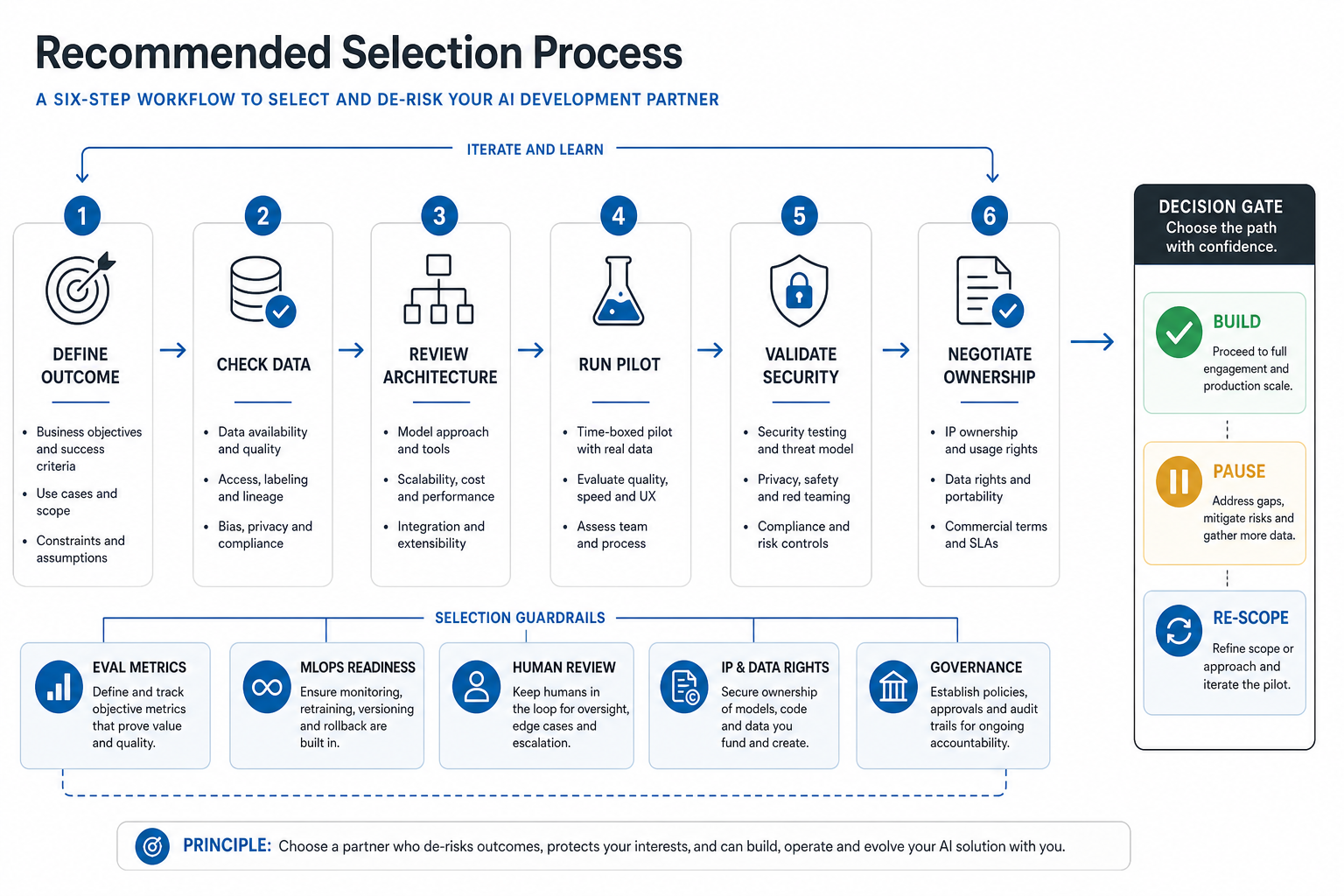
- Internal brief: define workflow, users, data, systems, constraints, and success metrics.
- Readiness check: score workflow clarity, data readiness, integration access, governance, and operating owner.
- Vendor screen: shortlist partners by relevant proof, technical depth, security posture, and communication quality.
- Paid discovery: ask the top candidate to produce architecture, risk, cost, evaluation, and pilot plans.
- Pilot: build a narrow real workflow with measurable acceptance criteria and a rollback path.
- Production decision: approve scale only after evaluation, user feedback, security validation, and operating-cost review.
This is why many teams start with AI workflow automation planning before building a large AI product. A narrow pilot gives you evidence about data, users, integration friction, and operating risk.
How NextPage Helps You Choose And Build The Right AI System
NextPage helps teams move from AI intent to a buildable plan. We can score your use case, inspect data and integration readiness, design an LLM, RAG, or agent architecture, estimate delivery and run costs, then build the first production workflow with clear ownership and review controls. For governed autonomous workflows, our agentic AI development services help teams design tool permissions, human approvals, audit trails, and production support from the start.
If you are comparing AI development companies now, start with an AI project fit and readiness review. It gives your team a clearer brief before vendor calls and helps you decide whether the right next step is discovery, prototype, pilot, or a managed AI development pod.