Portfolio case study

MarketWatcher: Facebook Marketplace monitoring and saved-search mobile app

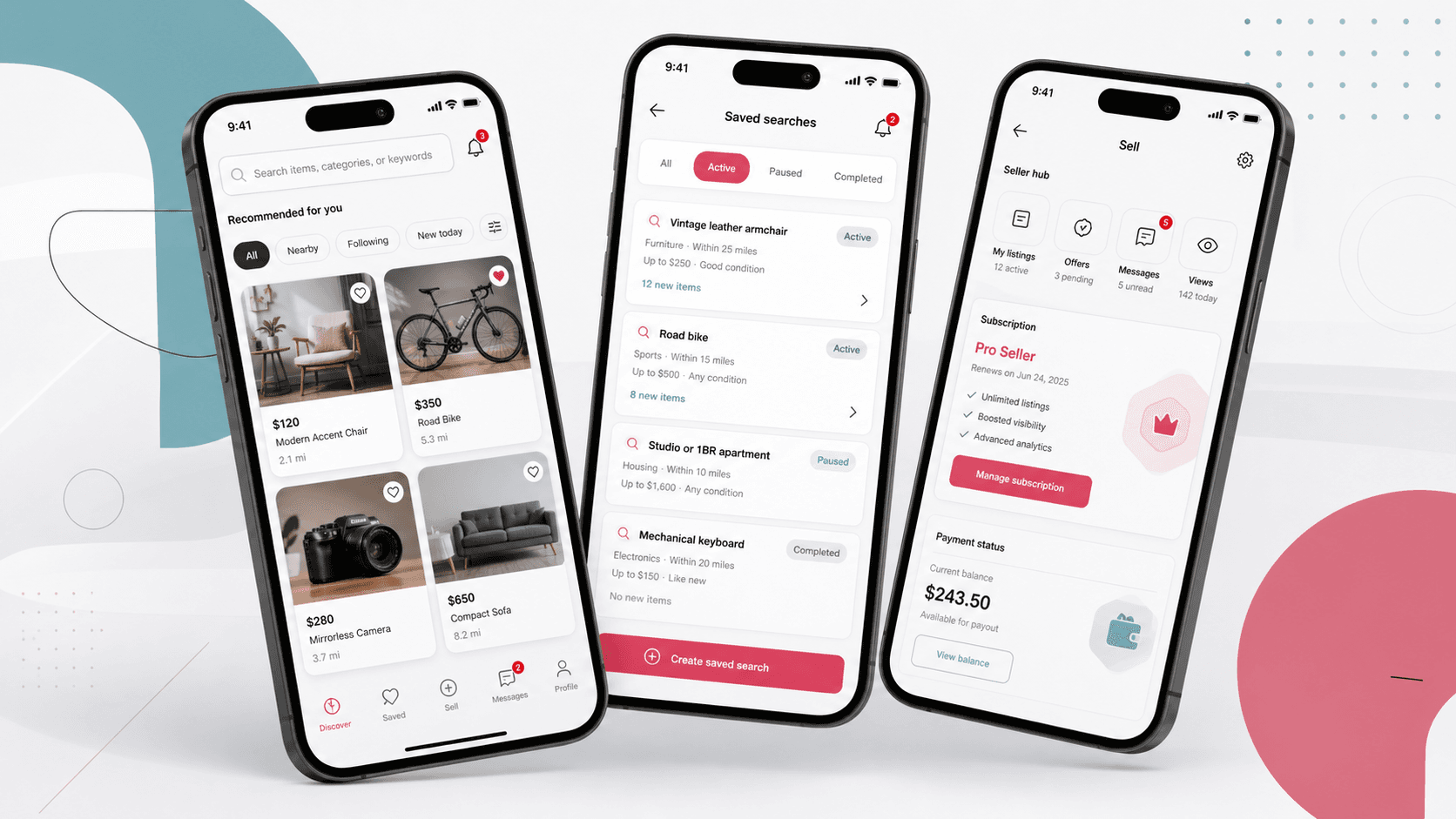
A Flutter Facebook Marketplace monitoring app that helps buyers track saved searches, review filtered marketplace listings, manage notifications, block sellers, access help content, and handle subscription payments from one mobile workspace.

Name changed to respect NDA.

Facebook Marketplace monitoring mobile app visual with saved searches, filtered listing cards, seller controls, notifications, and subscription status
Project scope

Flutter mobile app engineering, API integration, state management, subscription flow, and release-ready UI delivery

3
core app tabs
10+
API-backed workflows
Stripe
subscription payment flow
iOS + Android
mobile release targets

Timeline

Cross-platform mobile app build for a Facebook Marketplace monitoring workflow

Facebook Marketplace monitoring needed a focused mobile command center

The product needed to help users monitor Facebook Marketplace listings without repeatedly rebuilding searches, losing track of sellers, or jumping between notifications, saved filters, and account settings.

  • Users needed Facebook Marketplace saved searches with item, category, location, radius, price, and year filters
  • Listing feeds needed to combine Facebook Marketplace product cards, seller context, delivery data, location, and price information
  • Blocked seller controls had to be accessible enough to reduce unwanted listing noise
  • Subscription, support, help, and account workflows needed to live inside the same mobile experience

A Flutter app for Facebook Marketplace saved-search monitoring

MarketWatcher turns Facebook Marketplace monitoring into a structured app experience with feed browsing, saved-search management, listing detail actions, notifications, help content, and subscription payment screens.

  • A bottom-tab mobile shell gives users quick access to feed, search, settings, and help areas
  • Saved-search forms support category, item, radius, price, year, city, state, and country criteria
  • Listing detail flows expose seller, location, favorite, contact, reporting, and block actions
  • Settings connect subscriptions, Stripe payment, snippets, blocked sellers, password changes, and support content

Product surfaces

What the platform brought together

The work spanned core product operations, daily user workflows, data-heavy coordination, and resilient platform management.

Facebook Marketplace feed and listing details

The app presents API-backed Facebook Marketplace items as mobile cards and detail screens for quick review and follow-up.

  • Feed retrieval with filter payloads, loading states, and reusable listing cards
  • Listing fields for product image, title, category, price, seller, city, state, delivery, and source URL
  • Detail actions for favorites, contact paths, reporting, seller context, and blocking

Saved-search workflow

Users can create and manage Facebook Marketplace searches that capture what they want to monitor across geography, category, price, and year ranges.

  • Search creation, listing, update, and delete flows through repository-backed API calls
  • Country, state, and city selection support for location-aware marketplace monitoring
  • Validation and form controls for item, category, price, year, radius, and postal inputs

Account and subscription operations

Settings screens bring paid Facebook Marketplace monitoring access, help content, snippets, blocked sellers, and password workflows into one account area.

  • Subscription plan retrieval and plan selection before payment
  • Stripe card token flow for mobile subscription purchase
  • Blocked seller list, unblock dialogs, change-password screens, and help/support flows

Mobile app foundation

A shared Flutter foundation keeps Facebook Marketplace monitoring state, navigation, API calls, assets, typography, and persistent session data consistent.

  • Provider-based state stores for users, searches, listings, notifications, app settings, snippets, FAQs, and subscriptions
  • Dio API client, typed response wrappers, endpoint constants, and repository classes
  • SharedPreferences session storage, custom Mulish typography, SVG icons, loading states, and responsive sizing

Buyer priorities

What mattered most to the people evaluating the platform

Prospective buyers want to know whether the work solved real workflow, adoption, reliability, data, and operations problems. These priorities shaped the product decisions.

Fast buyer workflows

Facebook Marketplace monitoring only works when users can set criteria once and return to a filtered stream without rebuilding context.

  • Saved searches reduce repeated manual filtering
  • Feed cards make price, image, seller, location, and delivery details scannable
  • Notifications and saved-search states help users know when monitoring needs attention

Trust and control

A Facebook Marketplace monitoring app has to give users enough control over sellers, support, and account details to keep the experience usable over time.

  • Blocked seller management gives users a clear path to remove unwanted sources
  • Help and support screens provide FAQs plus contact forms inside the app
  • Settings expose password, subscription, terms, and account operations from one place

Paid feature readiness

The app included subscription and payment flows so commercial access could be layered onto the Facebook Marketplace monitoring experience.

  • Subscription plans are fetched from backend endpoints
  • Stripe card-token creation supports mobile checkout behavior
  • Plan selection and billing copy are integrated into the account flow

System model

How the platform connects roles, workflows, and product surfaces

The product architecture brings every role into the same operating model, with shared data moving cleanly between web, mobile, media, and notification layers.

Saved-search monitoring loop

Users define Facebook Marketplace search criteria, review incoming items, save or block sellers, and return through notifications.

Buyer account workspace

Feed, search, settings, help, subscriptions, snippets, and blocked sellers sit inside one mobile navigation model.

Mobile app and API foundation

Flutter screens, provider stores, repository classes, backend endpoints, local preferences, and payment APIs work together as one app system.

Technology

The Stack We Used And Why

The stack section is written for buyers who need to understand the product architecture, operational trade-offs, and long-term maintainability of the system.

Mobile app

Used to ship a consistent cross-platform experience for Facebook Marketplace browsing, saved searches, seller controls, and account workflows.

FlutterDartMaterial widgetsFlutter ScreenUtilPageTransition

State and storage

Used to coordinate user sessions, Facebook Marketplace search criteria, listing data, subscriptions, app settings, notifications, and support content.

ProviderChangeNotifierSharedPreferencesTyped model classes

API integration

Used to keep Facebook Marketplace listing data, country/state/city lists, FAQs, snippets, notifications, user actions, and subscription plans backend-driven.

DioHTTPRepository patternEndpoint constantsResponse validation

Payments and external actions

Used to support subscription purchase, help contact, marketplace links, and browser/email handoffs from the mobile app.

Flutter StripeWebView Flutterurl_launcherflutter_email_sender

Product UI system

Used to keep the mobile experience cohesive across forms, feeds, loaders, icons, typography, dialogs, and bottom navigation.

Mulish fontsflutter_svgCustom app widgetsAnimated snack barsLoading animations

Why Flutter For Marketplace Monitoring

The product needed one codebase that could carry Facebook Marketplace feed browsing, forms, payment screens, and account settings across iOS and Android.

  • Flutter kept listing cards, filter forms, settings screens, and subscription flows visually consistent
  • A shared route generator and page transitions reduced navigation complexity across many screens
  • Platform folders and assets prepared the project for mobile release work

Why Provider And Repositories

The app had many API-backed surfaces, so state and network calls needed predictable separation from widgets.

  • Provider stores isolate loading states, selected values, and fetched lists per product area
  • Repository classes keep endpoint calls reusable across screens
  • Typed models make listing, search, notification, country, snippet, and subscription data easier to handle safely

Why Built-In Payments

Subscription functionality was part of the product model, so payment had to be designed as a first-class app flow.

  • Plan retrieval, selected-plan state, and checkout screens keep purchase context visible
  • Stripe token creation allows payment details to move through a standard mobile payment path
  • Subscription settings stay connected to terms, privacy, support, and account screens

Delivery

How the product came together

The work moved from domain modeling to core platform delivery, mobile adoption, and operational hardening.

1

Map marketplace workflows

Translate Facebook Marketplace monitoring into mobile flows for onboarding, feed review, saved searches, listing details, account settings, and help.

2

Build the app foundation

Set up shared widgets, typography, navigation, responsive sizing, persistent storage, and provider state stores.

3

Connect backend modules

Wire user, search, marketplace feed, country, FAQ, notification, snippet, app settings, subscription, and seller action endpoints.

4

Add commercial and support flows

Implement subscription selection, Stripe payment handling, blocked seller controls, help screens, snippets, and account operations.

Operational depth

What made the platform usable after launch

The strongest case studies are not only feature lists. They show how the system is operated, monitored, governed, and improved when real users depend on it.

Search criteria depth

Saved searches capture enough detail to make Facebook Marketplace monitoring useful without turning the app into a spreadsheet.

  • Item, category, country, state, city, radius, postal code, price, and year fields
  • Validation messages for required criteria and price/year ranges
  • Backend-backed search creation and list retrieval

Seller noise controls

Blocking and unblocking seller flows help users keep the discovery experience focused as they review many listings.

  • Blocked seller list screen with instruction copy
  • Listing-level block action and confirmation dialog
  • User-action endpoints for save, delete, and blocked-seller retrieval

Settings as a product surface

The settings area carries more than profile edits; it manages subscription, support, snippets, blocked sellers, and account trust flows.

  • Subscription plans, checkout, terms, license, and privacy snippets
  • Help and support contact fields with FAQ search
  • Password change, logout, notifications, and app settings support

Results

The measurable and observable lift from the work

The strongest improvements are the ones a buyer can connect to daily work: fewer disconnected tools, safer operations, clearer workflows, and more reliable product behavior.

Saved searches

Repeat Monitoring

Users can define and revisit Facebook Marketplace criteria instead of rebuilding filters every time they open the app.

Seller controls

Noise Reduction

Blocking and blocked-seller management give users direct control over unwanted marketplace sources.

Paid access

Commercial Model

Subscription plan retrieval and Stripe payment screens prepare the app for monetized Facebook Marketplace monitoring.

API-backed

Operational Flexibility

Listings, searches, notifications, help, snippets, country data, settings, and plans are loaded through backend endpoints.

Outcome

A stronger operating system for facebook marketplace monitoring mobile app

The platform reduced tool fragmentation and gave each role a clearer path from live activity to day-to-day action.

A cross-platform Facebook Marketplace monitoring app with feed browsing, saved searches, listing details, notifications, help, and settings

A structured saved-search workflow covering item, category, geography, radius, price, year, and postal criteria

Seller control features that let users block, review, and unblock marketplace sources from inside the app

A monetization-ready mobile foundation with subscription plan screens, Stripe payment handling, API repositories, typed models, and local session storage

FAQ

Frequently Asked Questions About MarketWatcher

Answers about the facebook marketplace monitoring mobile app scope, platform model, technology choices, operational workflows, and related build patterns.

What Kind Of App Does MarketWatcher Represent?

MarketWatcher represents a Flutter mobile Facebook Marketplace monitoring app with saved searches, filtered listing feeds, listing details, seller controls, notifications, help content, subscriptions, and Stripe payment flow.

Why Was A Custom Mobile App Useful For Facebook Marketplace Monitoring?

A custom app was useful because Facebook Marketplace monitoring needs repeated saved searches, fast listing review, seller controls, mobile notifications, account settings, and payment flows in one focused experience.

How Does The Stack Support Ongoing Marketplace Data Updates?

Flutter handles the installed app experience while Dio repositories fetch Facebook Marketplace listings, searches, country data, notifications, support content, subscription plans, and app settings from backend endpoints.

Can This Pattern Work For Other Marketplace Or Alerting Products?

Yes. The same pattern can support Facebook Marketplace alternatives, real estate alerts, vehicle discovery, collectibles tracking, job matching, deal monitoring, inventory alerts, and other saved-search marketplace products.

Related services

Build a similarly ambitious product without starting from a blank page.

We can help scope the web, mobile, AI, media, and operating layers needed for your own platform.

Start a project inquiry