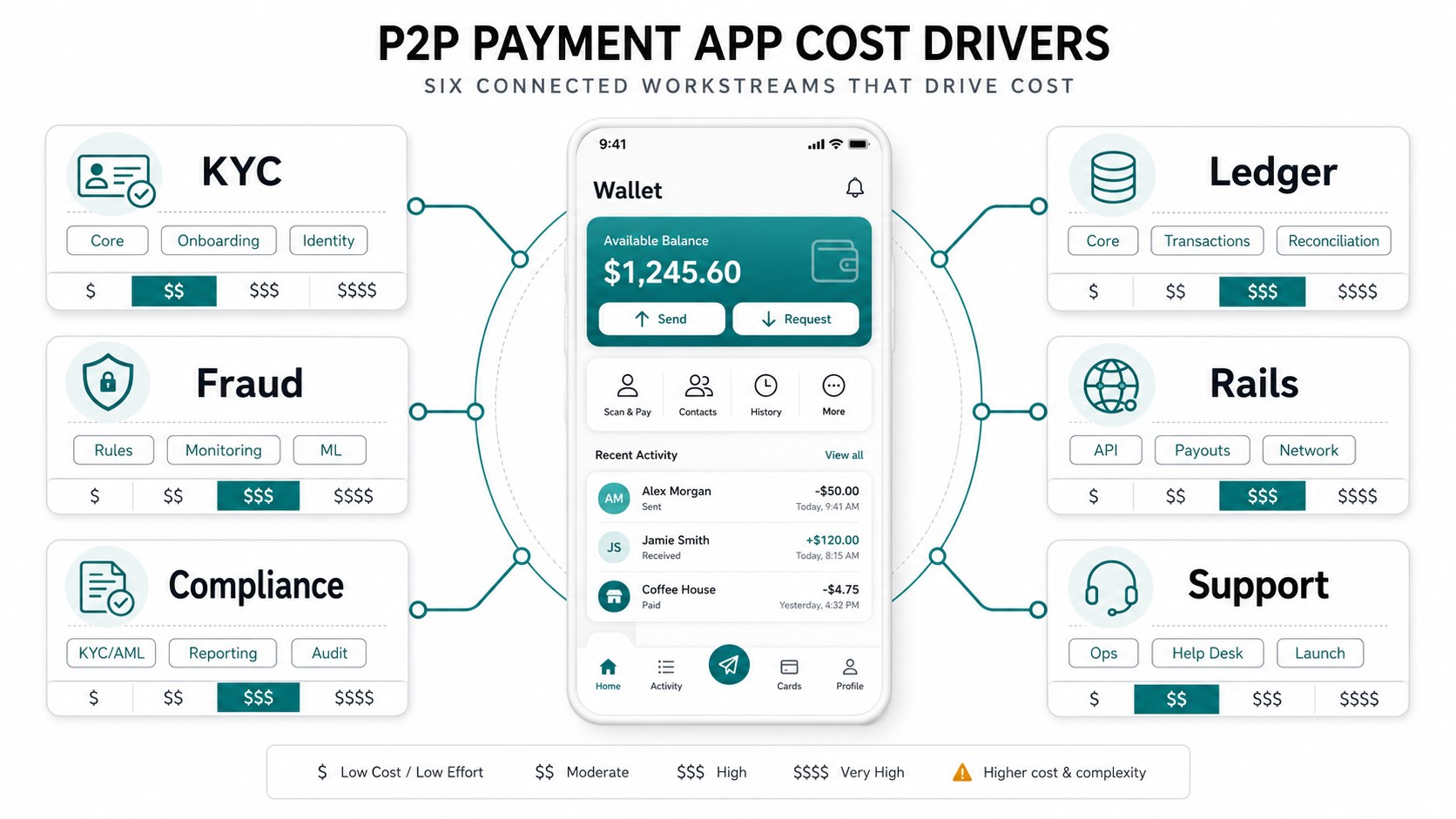

A P2P payment app usually costs far more than a basic mobile app because the expensive work sits behind the screens: identity checks, wallet ledger design, payment rail integrations, fraud controls, reconciliation, dispute workflows, security testing, and compliance operations. A focused transfer MVP can often be planned in the $90,000-$180,000 range when it uses licensed payment infrastructure and avoids stored-value complexity. A stronger wallet product with KYC, admin risk tooling, instant payouts, notifications, and support workflows is more commonly a $180,000-$350,000 build. A multi-market or bank-grade platform with custom ledger rules, advanced fraud operations, multiple rails, and compliance reporting can move past $350,000 before licensing, audits, reserves, and ongoing operations.
The right question is not “How much does an app like Venmo cost?” It is “Which money movement model are we allowed to operate, what must we own, and what should we integrate?” A quote that prices only login, contacts, send money, and transaction history will miss the work that decides whether the product can be trusted in production.
This guide breaks the budget into the decisions that actually change scope. Use it to shape a first release, brief engineering partners, pressure-test licensing and provider assumptions, and decide when a focused MVP development plan is safer than funding a full fintech platform upfront.
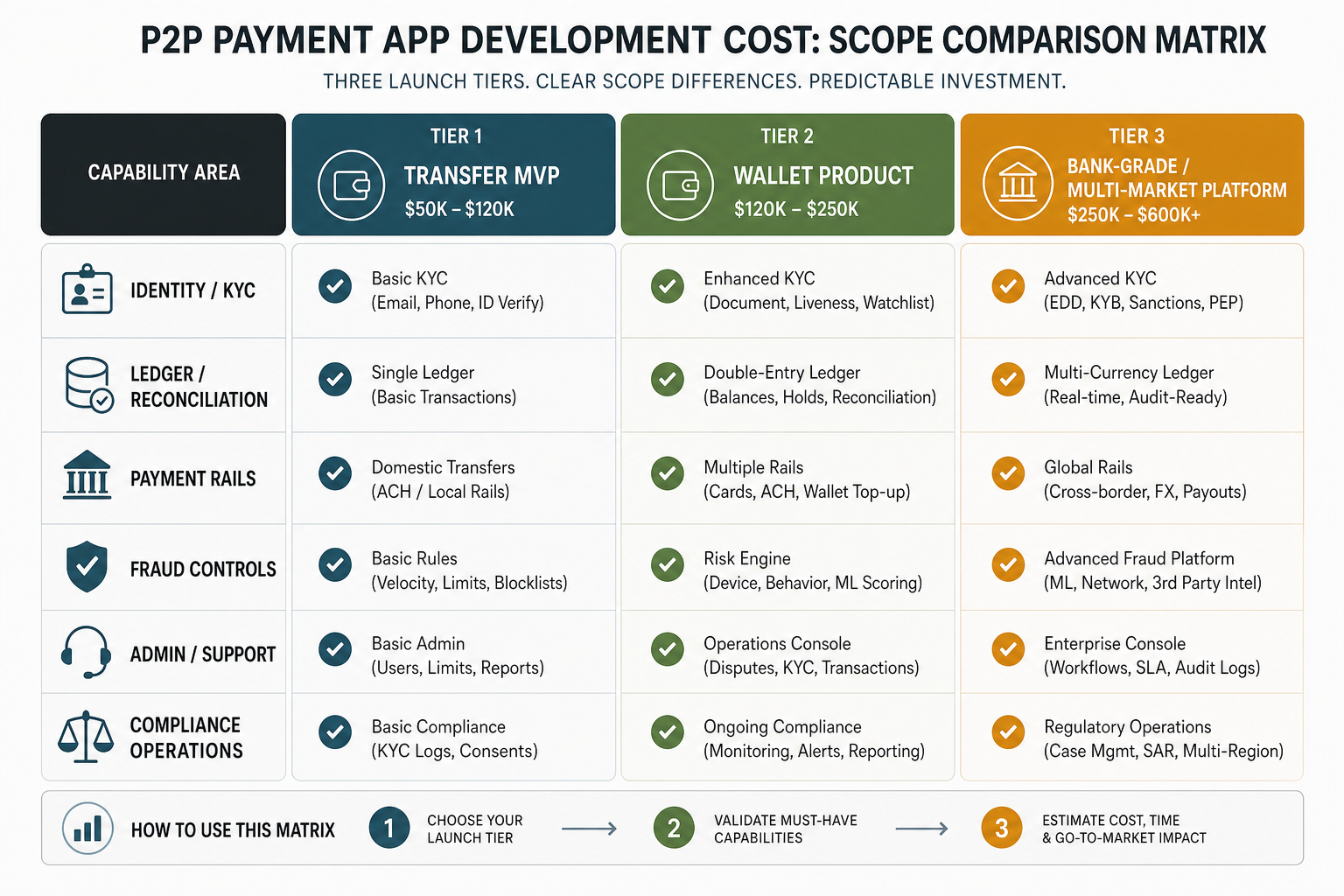
Quick Cost Ranges For P2P Payment App Development
P2P payment app development cost depends on whether you are building a thin experience on top of a payment provider, a managed wallet product, or a regulated money movement platform. The ranges below are planning bands, not fixed quotes. They assume a professional product team, production security practices, admin tooling, QA, and a deployable backend.
| Scope | Typical Cost Band | What It Usually Includes | Main Budget Risk |
|---|---|---|---|
| Prototype or clickable demo | $20,000-$50,000 | Product discovery, core flows, UX prototype, technical architecture, compliance assumptions, estimate package | Looks complete but does not move real money |
| Provider-led transfer MVP | $90,000-$180,000 | iOS/Android or cross-platform app, onboarding, provider-hosted identity/payment flows, send/request money, basic admin, notifications, analytics | Provider limitations and unclear compliance ownership |
| Wallet MVP with stronger controls | $180,000-$350,000 | Wallet balance views, transaction ledger, KYC/KYB hooks, fraud flags, support dashboard, reconciliation reports, card/bank funding, instant payout options | Ledger accuracy, edge cases, fraud workflow, and operational support |
| Advanced P2P payment platform | $350,000-$750,000+ | Multiple rails, custom risk scoring, limits engine, disputes, compliance reporting, multi-region configuration, audit logs, partner APIs, high-availability architecture | Licensing, audits, integrations, scale, and ongoing compliance operations |
If you are still defining release-one scope, start with the Custom Software Cost Estimator and then use the MVP Scope Builder to separate must-have payment flows from later-phase wallet features.
What Drives P2P Payment App Cost?
The visible app experience is only one part of the budget. The highest-risk work happens where product, finance operations, security, and compliance meet.
1. Money Movement Model
A simple provider-led model routes onboarding, bank linking, compliance checks, and transfers through a licensed platform. That can reduce build cost and launch risk, but it limits custom behavior. A more owned model may require deeper payment rail integration, stronger ledger design, and more operational responsibility. If the product stores value, enables wallet balances, supports marketplace payouts, or crosses jurisdictions, the scope changes quickly.
Stripe's Treasury and Connect documentation is a useful example of how identity verification, KYC/KYB checks, fraud review, and connected account onboarding are part of the platform architecture, not cosmetic screens. FinCEN's MSB registration guidance is also a reminder that payment activity can create federal and state-level obligations depending on the business model. This is why legal and compliance review belongs in discovery, not in the final sprint.
2. KYC, KYB, And Onboarding Friction
Identity verification can be light for a closed pilot and much stricter for a production wallet. Budget changes when the app needs document capture, biometric checks, sanctions screening, address verification, business verification, exception handling, manual review queues, and retry flows. The user experience must explain why verification is needed without making legitimate users abandon onboarding.
A cheaper MVP can use provider-hosted KYC screens. A more controlled product may need custom onboarding, risk tiers, progressive limits, and admin review tools. The second option costs more because it creates product, backend, compliance, and support work.
3. Wallet Ledger And Reconciliation
Every P2P app needs a source of truth for transactions. A ledger is not the same as a transaction list. A real ledger must handle pending, completed, failed, reversed, refunded, disputed, and timed-out states. It must reconcile provider events, user-visible balances, fees, refunds, chargebacks, and support corrections.
This is where many estimates become unrealistic. The app may appear simple, but money state is unforgiving. If a user sees a balance that does not match provider records, trust breaks. If support cannot trace a transfer, operations slow down. If engineering cannot replay webhook events safely, incident recovery gets expensive.
4. Fraud Controls And Limits
P2P payments attract account takeover, mule activity, stolen cards, refund abuse, social engineering, and synthetic identity risk. A basic launch may use provider risk tooling plus simple velocity limits. A stronger product needs risk scoring, device signals, transfer limits, suspicious-pattern alerts, manual review, account holds, blocked recipients, and audit trails.
Fraud controls affect both product cost and operating cost. Someone must review edge cases, approve exceptions, communicate with users, and tune rules after launch. If fraud workflow is omitted from MVP scope, it usually returns as urgent rework after the first abuse pattern appears.
5. Payment Rails And Funding Methods
Bank account linking, debit cards, card funding, ACH transfers, real-time payments, UPI-style local rails, wallets, instant payouts, and cross-border transfers all have different integration, compliance, fee, settlement, and failure behavior. The more rails you support, the more state management and testing you need.
NextPage's guide to payment gateway integration architecture is relevant here because production-grade payment work connects gateway events, refunds, reconciliation, analytics, and customer support. P2P money movement needs the same discipline, plus stronger user-to-user risk controls.
6. Admin, Support, And Audit Operations
Admin tooling is often underestimated because it is not part of the consumer-facing app demo. A real payment product needs dashboards for users, transfers, verification status, risk flags, disputes, refunds, limits, blocked accounts, audit logs, and support notes. It also needs role-based access control so internal teams cannot accidentally expose or change sensitive data.
For a regulated or high-trust product, admin work is not optional. It is how the company investigates incidents, supports customers, and proves what happened.
What Should Be In A P2P Payment MVP?
A good P2P payment MVP should prove the transfer loop, trust model, and operating workflow without pretending to be a full banking product. The first release should be narrow enough to validate demand but complete enough to avoid unsafe shortcuts.
| MVP Area | Include In Release One | Defer Until Later |
|---|---|---|
| User onboarding | Phone/email login, secure authentication, profile basics, provider-led identity verification where needed | Complex business onboarding, multi-user business accounts, custom document workflows |
| Payments | One primary funding method, send/request money, transaction status, receipts, notifications | Multiple countries, multiple currencies, crypto rails, complex split payments |
| Ledger | Clear transaction states, provider event sync, balance display if wallet is in scope, reconciliation export | Custom accounting modules, advanced settlement routing, partner APIs |
| Risk | Velocity limits, blocked users, provider fraud signals, admin review queue, audit logs | Machine-learning risk engine, custom graph analysis, automated dispute arbitration |
| Admin | User lookup, transfer lookup, KYC status, support notes, basic reporting, role-based access | Full compliance case management, custom BI dashboards, multi-region policy engine |
For most funded startups, release one should integrate more than it invents. Own the product experience, business rules, and data model. Integrate regulated infrastructure where possible until transaction volume, economics, and compliance maturity justify deeper ownership.
Cost Breakdown By Workstream
The percentages below are useful when reviewing vendor quotes. If a quote gives a single flat number with no compliance, ledger, fraud, support, or QA line items, ask for a second version.
| Workstream | Typical Share Of Budget | What To Check In The Estimate |
|---|---|---|
| Discovery and architecture | 8%-12% | Money movement model, compliance assumptions, provider selection, MVP scope, risk register |
| UX/UI and product design | 10%-15% | Onboarding clarity, transfer confidence, error states, receipts, support journeys |
| Mobile app development | 18%-28% | Platform choice, authentication, transfer flows, notifications, accessibility, analytics |
| Backend and ledger | 20%-30% | Transaction state machine, event handling, reconciliation, admin APIs, audit logs |
| Payment/KYC integrations | 12%-22% | Provider SDKs, webhooks, retry behavior, verification status mapping, failure handling |
| Fraud, admin, and support | 10%-18% | Limits, review queues, blocked accounts, support search, operational notes, roles |
| QA, security, launch | 12%-20% | Security testing, regression suite, transaction scenarios, app store review, production monitoring |
NextPage's fintech app development cost guide goes deeper on how compliance, security, architecture, and outsourcing choices affect fintech budgets beyond P2P payments.
Build Vs. Integrate Decisions That Change The Budget
The fastest way to reduce risk is to decide what your team must own and what should be delegated to specialized infrastructure.
Use Provider KYC First Unless It Blocks The Product
Provider-led KYC is usually the right MVP choice because it reduces compliance surface area and gets the product to market sooner. Custom KYC becomes worth considering when conversion, risk segmentation, business verification, or multi-provider routing becomes strategic.
Do Not Fake Ledger Discipline
Even when a provider handles movement of funds, your product still needs accurate transaction state. Build a clean internal ledger model early, even if it starts narrow. Retrofitting ledger discipline after users and support tickets exist is far more expensive than designing it correctly during MVP.
Start With One Primary Rail
Multiple rails create multiple failure modes. Start with the rail that best fits the first market and use case. Add faster payouts, card funding, cross-border transfers, or secondary rails after the product proves demand and the operations team understands support volume.
Treat Admin As Part Of The Product
Payment support cannot depend on database queries or engineering intervention. A lean admin console saves money after launch because operations teams can resolve routine issues without opening engineering tickets. That is why NextPage usually treats admin and support workflows as core custom software, not a back-office extra. For broader planning, see our custom software development cost guide and custom software development company checklist.
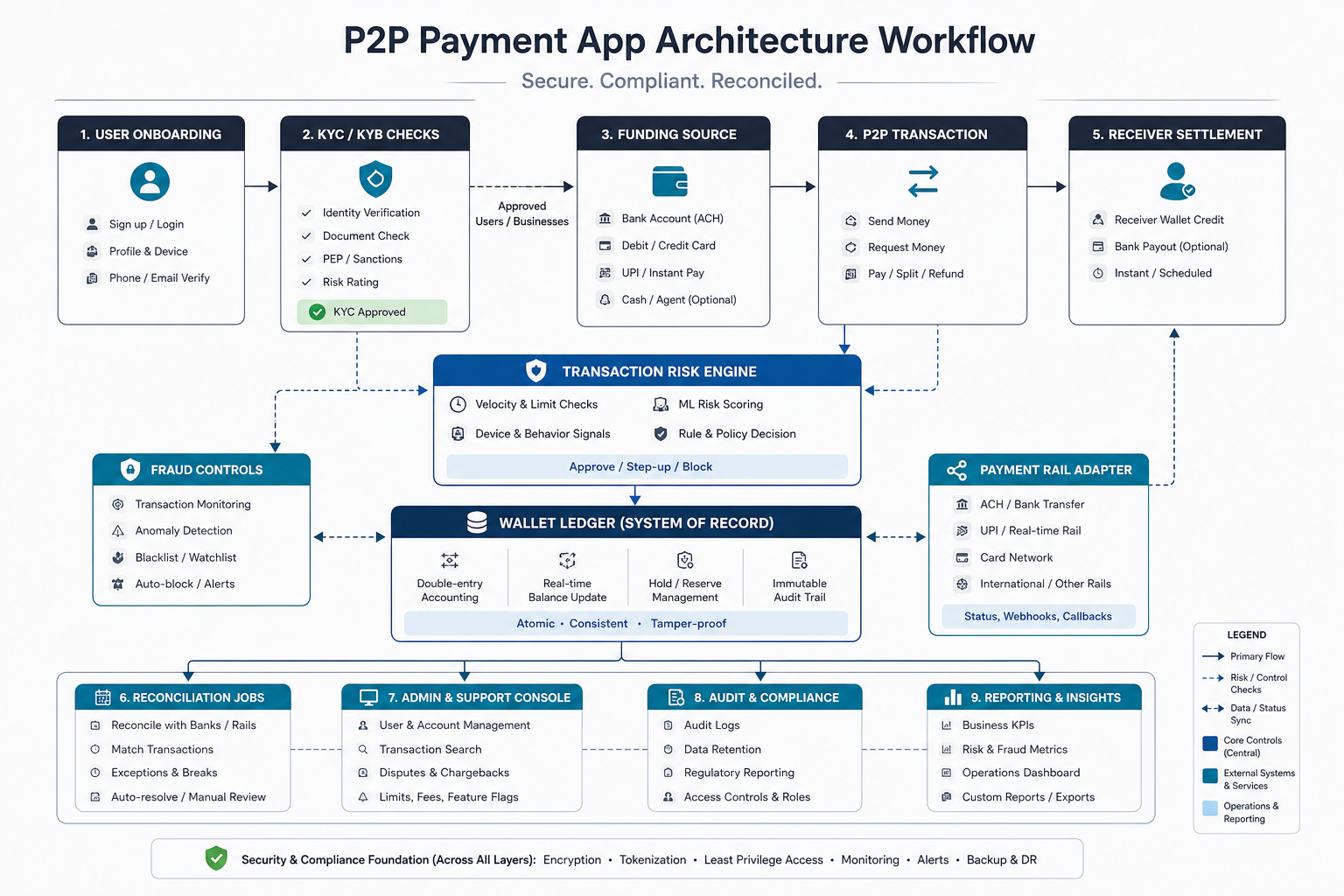
A Practical P2P Payment Architecture Plan
A production P2P payment app should be designed as a set of controlled systems, not a screen-by-screen mobile build.
- Client apps: iOS, Android, or cross-platform app with secure authentication, transfer flows, receipts, notifications, and accessible error handling.
- API layer: authenticated backend APIs for users, contacts, transfers, limits, profile state, admin operations, and provider webhooks.
- Ledger service: transaction state machine, idempotency keys, balance logic, reconciliation exports, and replay-safe event processing.
- Provider integrations: KYC, payment rails, bank linking, cards, payouts, fraud signals, and webhook event handling.
- Risk layer: velocity limits, suspicious activity rules, account holds, manual review queues, and audit logs.
- Admin console: role-based internal tools for support, compliance review, transaction search, user management, and reporting.
- Observability: alerts for failed webhooks, transfer delays, provider errors, reconciliation mismatches, fraud spikes, and support backlog.
This is also where an experienced mobile app development company matters. The app experience must feel simple while the backend handles regulated complexity. For wallet-heavy products, NextPage's eWallet app development services page explains how stored value, transaction products, and secure fintech workflows fit into a broader build.
How Long Does P2P Payment App Development Take?
A realistic MVP timeline is usually 4-8 months after discovery, depending on provider readiness and compliance scope.
| Phase | Typical Duration | Output |
|---|---|---|
| Discovery and compliance framing | 2-4 weeks | Business model, market assumptions, release-one scope, provider shortlist, risk register |
| UX and architecture | 3-6 weeks | User flows, admin flows, data model, ledger design, integration plan, clickable prototype |
| MVP build | 10-18 weeks | Mobile app, backend, provider integrations, admin console, notifications, analytics |
| QA and security hardening | 4-8 weeks | Regression tests, transaction scenario testing, security review, app store readiness |
| Pilot and launch | 2-6 weeks | Limited release, operational monitoring, support scripts, fraud tuning, rollout plan |
Compressed timelines are possible only when the payment model is narrow, provider integrations are proven, compliance assumptions are clear, and the MVP avoids custom risk infrastructure. If licensing, banking partnerships, or custom ledger behavior are unresolved, the timeline should show those as dependencies instead of hiding them inside development.
Hidden Costs To Budget After Launch
The first production release is not the end of spending. P2P payment products need ongoing investment because users, fraud patterns, provider rules, app stores, and compliance expectations keep changing.
- Provider and payment fees: account verification, bank linking, card funding, ACH, instant payouts, chargebacks, disputes, and data services.
- Security work: penetration testing, dependency updates, mobile app hardening, secret rotation, incident drills, and audit evidence.
- Compliance operations: legal review, policy updates, reporting workflows, user verification exceptions, record retention, and training.
- Fraud operations: manual review time, rule tuning, false-positive handling, blocked-account appeals, and monitoring tools.
- Support operations: refund requests, failed transfer explanations, identity verification support, and user education.
- Product iteration: onboarding improvements, new rails, limit changes, business accounts, referrals, rewards, and analytics.
Budgeting only for build cost creates a fragile launch. A better plan reserves monthly product, engineering, support, and compliance capacity for operational learning after the first real users arrive. For U.S.-facing money-services models, teams should also validate whether federal MSB registration, state licensing, bank sponsorship, or provider-of-record coverage changes the launch budget before engineering treats a payment rail as approved.
How To Control P2P Payment App Development Cost
The best way to control cost is not to remove security or compliance. It is to narrow the first money movement model and prove it thoroughly.
- Choose one first market. Do not design for every jurisdiction, payment rail, and currency before the first use case is validated.
- Use licensed infrastructure where possible. Payment and KYC providers can reduce early build risk when their limits match your product model.
- Define transaction states before UI polish. The product team should agree what users see for pending, failed, reversed, disputed, and held transfers.
- Build admin workflows early. Support and risk teams need tools before launch, not after the first incident.
- Separate MVP from future wallet ambition. Stored value, instant payouts, business accounts, rewards, and cross-border support can be sequenced.
- Test unhappy paths. Failed bank links, duplicate webhooks, expired KYC, fraud holds, provider downtime, and chargebacks are part of the product.
- Keep compliance assumptions visible. Every estimate should state what the software team handles and what requires legal, licensing, banking, or provider support.
2026 Launch-Readiness Gate For P2P Payment Apps
Before a P2P payment app moves from estimate to production build, the team should pass a launch-readiness gate that proves the payment model, rail selection, risk operations, and evidence trail are realistic. This matters more in 2026 because instant-payment expectations are rising, provider coverage keeps changing, and compliance ownership can shift depending on whether the product is an agent, program manager, wallet operator, marketplace, or money transmitter.
| Gate | Decision To Make Before Build | Budget Signal |
|---|---|---|
| Provider-of-record model | Confirm who owns KYC/KYB, sanctions screening, suspicious-activity review, transaction monitoring, user disclosures, and record retention. | If ownership is unclear, discovery and legal/compliance review must be funded before sprint estimates are trusted. |
| Rail and settlement model | Choose whether release one uses ACH, cards, instant payouts, RTP, FedNow access through a bank/provider, stored value, or a narrower provider-led transfer loop. | More rails mean more failure states, reconciliation work, support scripts, and test scenarios. |
| Ledger and reconciliation evidence | Define how pending, settled, failed, reversed, held, refunded, and disputed transfers are recorded and replayed from provider events. | A real ledger, webhook replay, and reconciliation exports cost more than a transaction list but reduce incident risk. |
| Fraud operations | Set transfer limits, velocity rules, device/account signals, manual review queues, blocked-recipient rules, appeal paths, and escalation ownership. | Provider fraud tools reduce scope, but admin review and support workflows still need product and engineering time. |
| Security and release evidence | Plan mobile threat modeling, API authorization tests, secrets handling, payment webhook tests, audit logs, and regression coverage for money movement states. | Use a release gate with security and QA evidence before launch; do not treat this as optional hardening after users are live. |
As of August 18, 2026, teams should treat payment-app launch readiness as an evidence plan, not only a feature checklist. PCI SSC still lists PCI DSS v4.0.1 in the document library, NIST SP 800-63 Revision 4 remains the current digital identity guideline suite, and OWASP MASVS remains the mobile security verification baseline for sensitive iOS and Android flows. FedNow Q2 2026 volume statistics still show 4,997,811 settled payments, and RTP still reports 142 million transactions worth $576 billion in Q2 2026 with a $10 million transaction limit. RBI PPI guidance still separates minimum-detail wallets from full-KYC wallet use cases, while FinCEN MSB registration remains a recurring obligation with two-year renewal. Instant-payment availability still depends on bank/provider access, while MSB, money-transmitter, wallet, or provider-of-record obligations require business-model review before an estimate treats money movement as approved.
For high-trust wallet products, pair the payment build plan with mobile app security hardening services and independent mobile app testing services before exposing real balances, instant payouts, or dispute workflows. That extra budget is easier to plan upfront than after a failed webhook, account-takeover pattern, or reconciliation mismatch reaches support.
When Does A Custom P2P Payment App Make Sense?
A custom build makes sense when payments are central to your product strategy, the user experience needs to be differentiated, or your workflow cannot be supported well by off-the-shelf wallet products. It is especially relevant when you need custom risk rules, marketplace payout behavior, branded wallet experiences, wallet operations platform patterns, operational dashboards, partner APIs, or deep integration with an existing fintech ecosystem.
A custom build may be premature when the business has not validated the payment use case, does not know which licenses or provider partners apply, or mostly needs a basic transfer flow that an existing platform can provide. In that case, discovery and a smaller prototype are better first investments than a full wallet build.
How NextPage Plans A P2P Payment App Build
NextPage starts by mapping the business model, money movement assumptions, first market, provider options, transaction states, risk controls, and support workflows. Then we separate the build into product experience, backend/ledger, integrations, admin operations, QA/security, and launch readiness. The result is a scope that can be estimated, reduced, or expanded without losing the controls a payment product needs.
For early planning, run the Custom Software Cost Estimator with fintech, mobile app, integration, and admin complexity selected. If the first release feels too broad, use the MVP Scope Builder to split must-have payment flows from later-phase wallet features. When you are ready to plan a build, NextPage can help with custom software development, fintech mobile architecture, provider integration, and launch-ready admin workflows.