
Choosing a payment gateway is no longer just a fee comparison. For an ecommerce store, marketplace, SaaS product, booking platform, or mobile app, the right gateway affects checkout conversion, payment success rate, refund handling, subscriptions, settlement speed, reconciliation, fraud risk, and how quickly your engineering team can launch.
This updated guide replaces the old 2020 list with a 2026 payment gateway selection framework for India-focused businesses. Use it to shortlist providers, compare tradeoffs, and plan the integration work before you commit to a gateway contract.
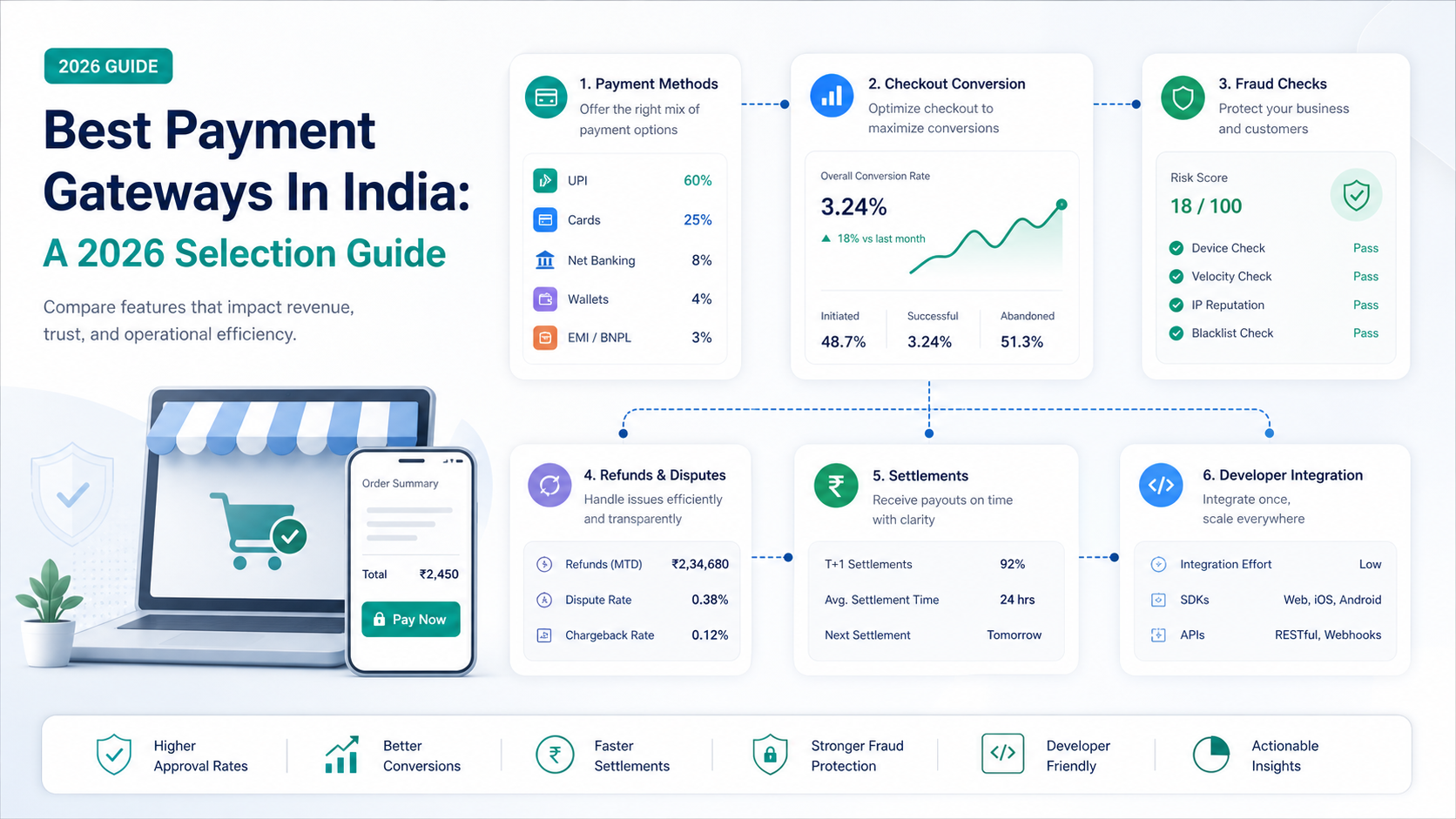
Quick Answer: Best Payment Gateways In India
For many India-first ecommerce and app businesses, the practical shortlist starts with Razorpay, Cashfree Payments, PayU, CCAvenue, PhonePe Payment Gateway, Easebuzz, Instamojo, and BillDesk. Stripe and PayPal are often considered when international cards, global SaaS billing, or cross-border buyer trust are important, subject to account eligibility, supported use cases, and pricing.
There is no universal best payment gateway. A D2C brand may prioritize UPI success rates, checkout UX, fast refunds, and Shopify or WooCommerce support. A SaaS product may prioritize subscriptions, webhooks, invoicing, tax workflows, and international cards. A marketplace may need split settlements, vendor payouts, KYC workflows, and reconciliation. A regulated or high-value business should prioritize compliance review, risk controls, dispute handling, and audit trails.
What Changed Since The 2020 Payment Gateway List
The original article listed ten gateways with basic transaction fees. That approach is not enough for current product planning. UPI is now a default customer expectation in India, payment links and no-code checkout are common, recurring payments require mandate-aware flows, and many gateways bundle payment pages, subscriptions, payouts, fraud checks, invoices, and reconciliation.
Pricing also changes often. Public pages may show standard rates, limited-period offers, GST rules, enterprise discounts, international-card surcharges, refund fees, chargeback fees, and payment-method-specific terms. Treat the rates you see on gateway websites as a starting point, then verify the final quote for your business model, monthly volume, geography, and risk category before launch.
Payment Gateway Shortlist For 2026
Use this shortlist as a product-planning starting point, not as a one-size-fits-all ranking.
| Gateway | Where It Often Fits | What To Check Before Choosing |
|---|---|---|
| Razorpay | India-first ecommerce, apps, subscriptions, payment links, and businesses that want a broad payments suite. | Current domestic and international pricing, supported business category, subscriptions, settlements, support response, and dashboard/reporting needs. |
| Cashfree Payments | Businesses comparing domestic payment pricing, payouts, payment links, UPI-heavy checkout, and fast onboarding. | Promotional-rate eligibility, UPI mix requirements, refund fees, payouts, risk rules, and enterprise pricing at higher volume. |
| PayU | Established Indian businesses that need a mature gateway, broad payment coverage, and payment links or checkout integrations. | Final commercial quote, supported payment methods, integration path, reconciliation exports, and support expectations. |
| CCAvenue | Merchants that need long-running gateway coverage, multiple payment options, and Indian ecommerce support. | Setup or annual charges, payment method coverage, checkout UX, settlement timelines, and technical documentation fit. |
| PhonePe Payment Gateway | UPI-forward Indian checkout, consumer-facing apps, and businesses that value PhonePe ecosystem familiarity. | Payment method coverage beyond UPI, settlement terms, refunds, plugin support, and fit for subscriptions or marketplaces. |
| Easebuzz | SMBs, education, services, collections, and businesses that need payment links, forms, and operational payment workflows. | Product fit, payment modes, reconciliation needs, pricing slabs, and customer-support expectations. |
| Instamojo | Small businesses, creators, simple payment links, digital products, and lightweight online selling. | Scale limits, checkout customization, settlement cycles, platform fees, and whether you need a full gateway API. |
| BillDesk | Bill payments, enterprise collections, utilities, BFSI, and high-scale payment collection use cases. | Enterprise onboarding, integration complexity, commercial terms, reconciliation, and support model. |
| Stripe | Global SaaS, developer-first checkout, international cards, subscriptions, and businesses with supported account eligibility. | India account availability, supported currencies, international fees, tax/invoice needs, disputes, and refund economics. |
| PayPal | Cross-border trust, international buyers, wallet payments, and businesses selling to markets where PayPal is common. | Currency conversion, cross-border fees, buyer/seller protection rules, checkout UX, and settlement workflow. |
Payment Gateway Comparison Matrix
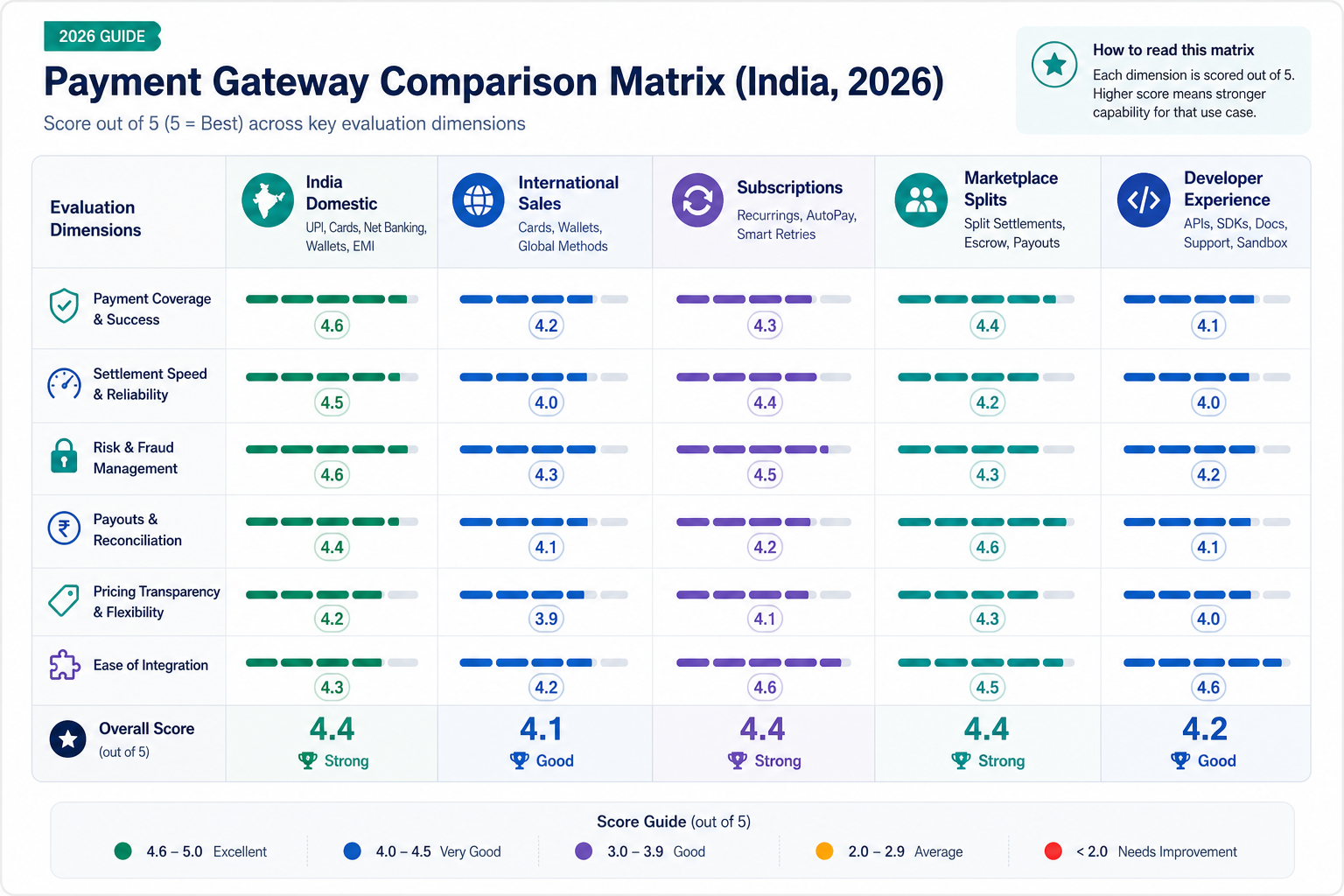
Before asking for commercial quotes, map your use case against five dimensions: India domestic payments, international sales, subscriptions or mandates, marketplace split settlements, and developer experience. A gateway that is excellent for UPI-heavy D2C checkout may not be the best fit for a subscription SaaS product or a vendor marketplace.
If you are building a commerce product from scratch, align the payment decision with the wider product scope. NextPage's ecommerce app development work typically treats checkout as part of the full order, inventory, refund, notification, and analytics flow instead of a standalone plugin decision.
How To Choose A Payment Gateway
Start with the customer payment methods you must support. For India, that often means UPI, credit cards, debit cards, net banking, wallets, EMI, pay later, and sometimes cash-on-delivery coordination. For international sales, check foreign cards, supported currencies, cross-border settlement, fraud rules, and tax or invoice workflows.
Then evaluate checkout conversion. Ask each provider how it handles saved methods, payment retries, OTP failures, UPI intent and collect flows, mobile redirection, browser fallback, and failed payment recovery. A lower transaction fee can lose money if the success rate, retry flow, or customer experience is weaker.
Finally, check operations. Refunds, partial refunds, chargebacks, settlements, payout reports, order-level reconciliation, webhook reliability, and support response times matter every week after launch. These details are often more important than the headline fee.
Payment Gateway Integration Architecture
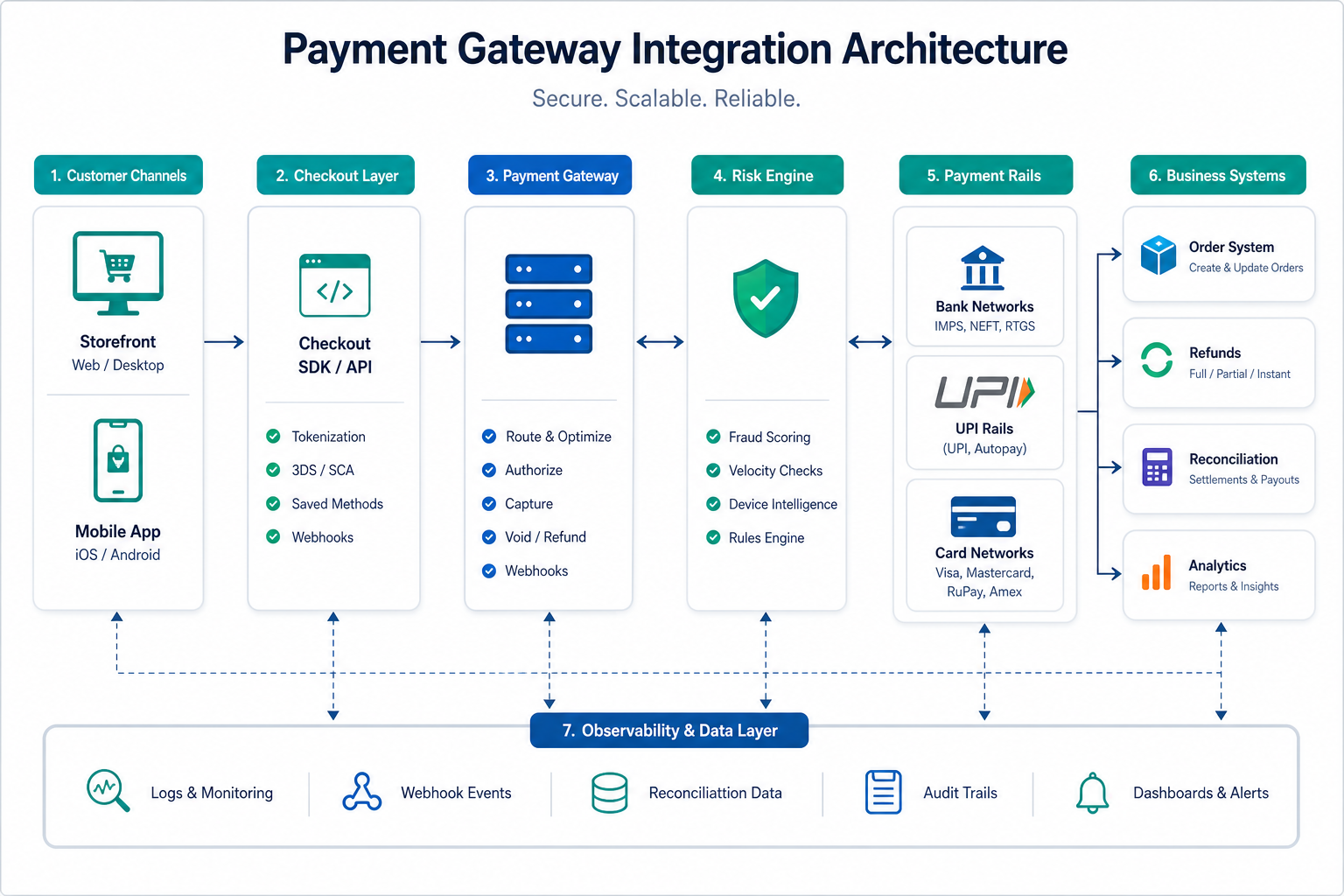
A production-grade payment integration usually has more moving parts than a checkout button. The storefront or mobile app opens a checkout SDK or hosted payment page. The backend creates the order, signs payment requests, stores gateway references, listens to webhooks, verifies payment status server-side, updates inventory and invoices, and sends confirmation messages.
For mobile products, payment must also survive app backgrounding, network changes, UPI app handoff, browser redirects, and delayed callbacks. This is where strong mobile app development discipline matters: payment state should be recoverable, observable, and testable across devices.
Pricing, Fees, And Contract Checklist
Do not compare gateways only by the first percentage shown on a pricing page. Build a small fee model that includes payment-method mix, GST on gateway fees, international-card surcharges, currency conversion, refund fees, chargeback fees, settlement timing, payout fees, subscription or mandate charges, plugin costs, and any setup or annual fees.
For example, Razorpay's public India pricing page currently presents standard payment acceptance starting at 2% plus applicable GST for many transactions, while Cashfree has promoted limited-period domestic payment gateway pricing for eligible new merchants. Stripe, PayPal, PayU, CCAvenue, PhonePe, and others publish or quote different terms based on country, payment method, volume, and business type. Verify the live provider pages and your final contract before implementation.
If you want a quick software budget before gateway quote collection, use NextPage's Custom Software Cost Estimator. If you are unsure whether to build custom checkout workflows or use an off-the-shelf commerce platform, the Build vs Buy Decision Tool can help frame the tradeoff.
Security, Compliance, And Risk Controls
Payment security should be designed around least exposure. Prefer hosted checkout, tokenization, gateway SDKs, and server-side verification so your application does not unnecessarily handle sensitive card data. Confirm PCI-DSS responsibilities, KYC requirements, restricted business categories, fraud controls, webhook signing, IP allowlisting, audit logs, and role-based dashboard access.
Risk controls also need operational ownership. Decide who reviews disputes, who approves refunds, how suspected fraud is flagged, and how support teams identify payment status without exposing sensitive data. For businesses with unusual risk, regulated workflows, or high average order values, involve the gateway risk team before engineering begins.
Implementation Plan For Ecommerce And App Teams
- Define payment scenarios: list one-time orders, subscriptions, partial payments, refunds, cash-on-delivery coordination, international orders, and marketplace payouts.
- Shortlist gateways: compare fit by payment modes, pricing, settlement, support, plugin/API quality, compliance, and business-category approval.
- Design order state: separate created, attempted, authorized, paid, failed, refunded, partially refunded, disputed, and cancelled states.
- Integrate server-side verification: never trust only client callbacks; verify signatures, webhook payloads, and gateway status from your backend.
- Test failure paths: simulate failed payments, delayed webhooks, duplicate callbacks, abandoned checkout, refund errors, and reconciliation mismatches.
- Monitor after launch: track success rate by payment method, failed reasons, refund turnaround, chargebacks, settlement delays, and support tickets.
For a broader product roadmap, NextPage's ecommerce mobile app guide explains why payment gateway integration is only one part of the customer journey. Service businesses can also learn from appointment and booking flows where secure payment integration must connect scheduling, confirmation, reminders, and refunds.
Common Payment Gateway Mistakes
The most common mistake is choosing the cheapest published rate without testing success rate, support, and reconciliation. Other mistakes include relying only on client-side payment success, not handling duplicate webhooks, ignoring partial refunds, leaving failed payments out of analytics, skipping mobile redirection tests, and failing to document settlement and chargeback workflows.
Another mistake is treating the gateway as permanent. Keep gateway references abstracted enough that you can add a second provider, route specific payment methods, or migrate later if pricing, support, or success rate changes. This is especially important for high-volume ecommerce and marketplace platforms built through custom software development.
Final Recommendation
Pick a payment gateway by use case, not by brand recognition alone. For India-first ecommerce, compare Razorpay, Cashfree, PayU, CCAvenue, PhonePe Payment Gateway, Easebuzz, Instamojo, and BillDesk against your payment mix and operating needs. For international or SaaS payments, also assess Stripe and PayPal where they fit your account eligibility and buyer geography.
The best payment gateway for your business is the one that improves checkout completion, keeps operations clean, supports your compliance needs, and gives your team reliable integration tools. Verify live pricing, test real checkout flows, and design order state carefully before launch.