
Quick Answer
A CMMS primarily organizes maintenance work. An EAM manages the broader lifecycle and performance of enterprise assets. A CAFM focuses on facilities, spaces, occupancy, service delivery, and the built environment. Many products overlap, so choose from the decisions and workflows you need—not the acronym printed on the homepage.
If the operating model crosses all three, define a system owner for each record and decide whether to configure, integrate, or build a custom facility management platform.
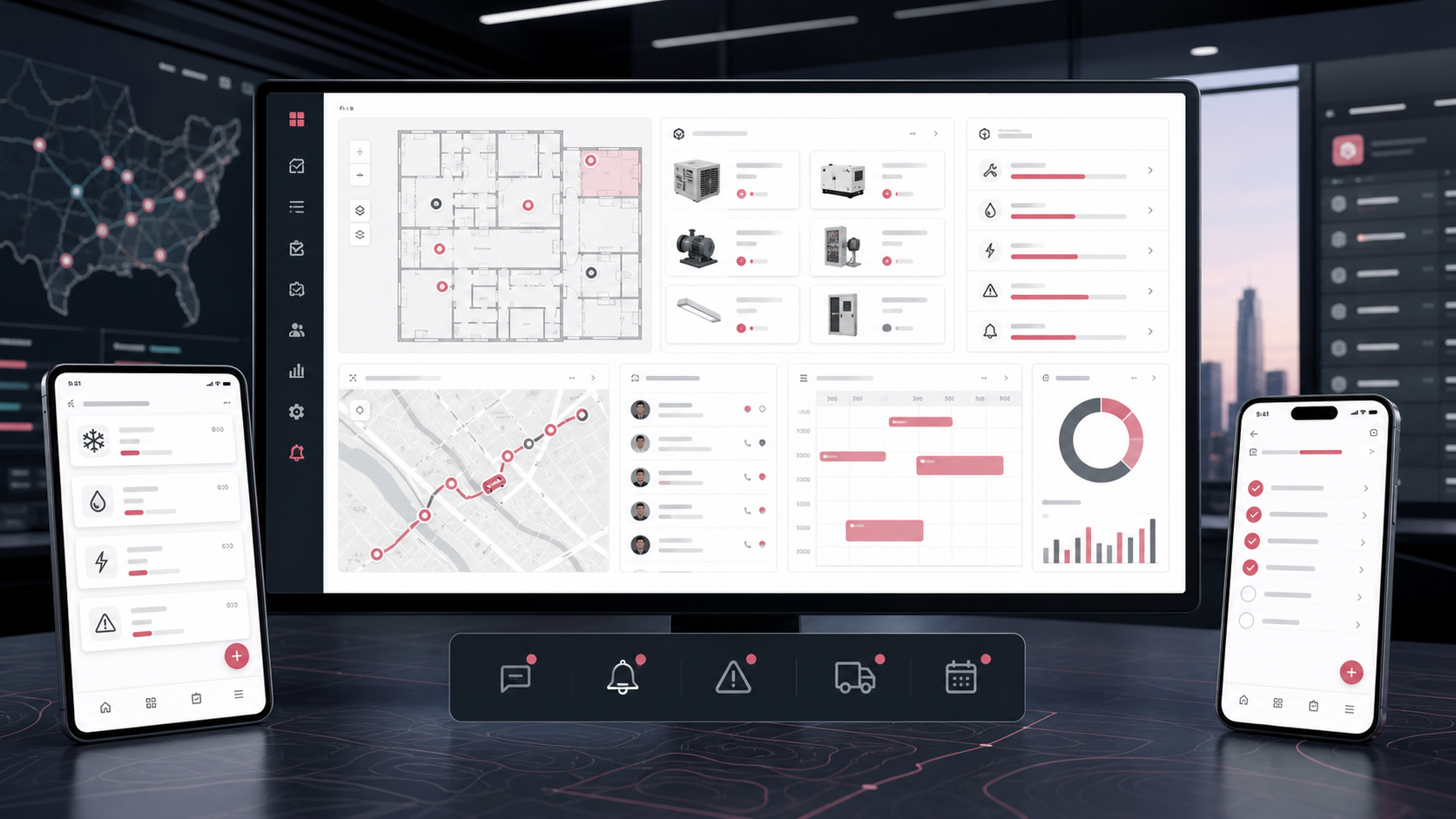
CMMS vs EAM vs CAFM Comparison
| Dimension | CMMS | EAM | CAFM |
|---|---|---|---|
| Primary focus | Maintenance execution | Asset lifecycle and performance | Facilities, spaces, and services |
| Core records | Work orders, schedules, parts, labour | Assets, costs, risk, condition, lifecycle | Buildings, floors, rooms, occupancy, requests |
| Typical buyer | Maintenance manager | Asset or reliability leader | Facility, workplace, or property leader |
| Strongest question | What maintenance work is due? | How should this asset perform across its life? | How are spaces and facility services operating? |
When A CMMS Fits
Choose a CMMS when the urgent problem is planning and completing maintenance. Typical capabilities include asset registers, preventive schedules, work requests, work orders, technicians, priorities, parts, downtime, meter readings, labour, vendor work, mobile completion, and maintenance reporting.
A CMMS is often the right first system for teams leaving paper or spreadsheets. It may be insufficient when capital planning, depreciation, procurement, broad custody, complex space management, leases, or portfolio-level asset risk are central.
When An EAM Fits
Choose EAM when assets are strategically important across acquisition, operation, service, risk, financial context, transfer, and retirement. EAM programmes frequently cross maintenance, procurement, inventory, compliance, reliability, projects, and finance.
An EAM can be heavier to implement because taxonomy, hierarchy, condition, cost, criticality, and lifecycle governance must remain consistent. For a tailored lifecycle product, review asset management software development.
When A CAFM Fits
Choose CAFM when buildings and spaces are central: floor plans, room inventory, occupancy, moves, reservations, leases, facility requests, vendors, inspections, compliance evidence, and service reporting. CAFM is particularly useful when operators need to understand where work happens and how the built environment is used.
Some CAFM products include maintenance, and some CMMS products model locations well. The decision is whether space and facility service data—or maintenance execution—is the organising centre.
Where The Categories Overlap
All three may store assets, locations, vendors, documents, inspections, work orders, dashboards, and mobile updates. Product labels have expanded over time, so create a capability matrix from your actual workflows. Ask who creates each record, who approves it, what downstream decision depends on it, and which system owns the truth.
A connected product can blend these patterns. The OpsLink case study shows spaces, assets, maintenance, inspections, vendors, calendars, fleet data, and field execution in one NDA-safe platform story.
A Selection Framework
- Name the operating problem. Reduce missed maintenance, govern asset lifecycle, improve space use, coordinate vendors, or replace fragmented field work.
- Map the authoritative data. Decide ownership for asset, location, person, supplier, work, cost, and document records.
- Score workflow depth. Include exceptions, approvals, deadlines, mobile evidence, offline conditions, and audit requirements.
- Test integrations. Verify ERP, identity, finance, IoT, telematics, GIS, document, and messaging access.
- Plan adoption. Labels, devices, data cleanup, training, support, and governance often determine whether the system succeeds.
When Custom Software Makes Sense
Start with configuration when a product covers most workflows. Integrate when specialist systems should remain authoritative. Build custom software when your service model, multi-party permissions, facility hierarchy, field experience, asset transactions, customer portal, or product differentiation cannot be represented safely in packaged tools.
A custom layer does not need to replace everything. It can unify selected workflows while established systems retain finance, maintenance, or property records. A staged architecture makes ownership and failure handling explicit.
FAQs
What is the main difference between CMMS, EAM, and CAFM?
CMMS centres on maintenance execution, EAM on the full lifecycle and performance of assets, and CAFM on facilities, spaces, occupancy, and facility services.
Can one system be a CMMS, EAM, and CAFM?
A product can cover capabilities from all three categories. Verify workflow depth and data ownership instead of assuming broad labels mean equal capability.
Is EAM always more advanced than CMMS?
EAM is broader, not automatically better. A maintenance team may get faster value from a focused CMMS when enterprise lifecycle and financial scope are unnecessary.
When should we build custom facility operations software?
Consider custom software when packaged configuration cannot support your workflows, roles, service network, integrations, customer experience, or product differentiation.