
Automotive parts eCommerce platform cost usually starts around $55,000-$110,000 for a focused catalog MVP, $120,000-$280,000 for a dealer-ready ordering portal, and $300,000-$650,000+ for an ERP-integrated, multi-channel parts commerce platform. The budget changes less because of the storefront design and more because of fitment data, VIN or year-make-model search, catalog normalization, dealer pricing rules, inventory accuracy, payment terms, shipping exceptions, returns, and ERP workflows.
A generic eCommerce build can sell simple SKUs. An automotive parts platform has to answer a harder question before checkout: will this part fit this exact vehicle, account, repair workflow, price tier, and fulfillment path? That is why cost planning should start with the operating model, not only the shopping cart.
If you are scoping a parts portal now, use NextPage's Custom Software Cost Estimator and MVP Scope Builder to separate launch-critical workflow from later integrations before asking a team for a fixed quote.
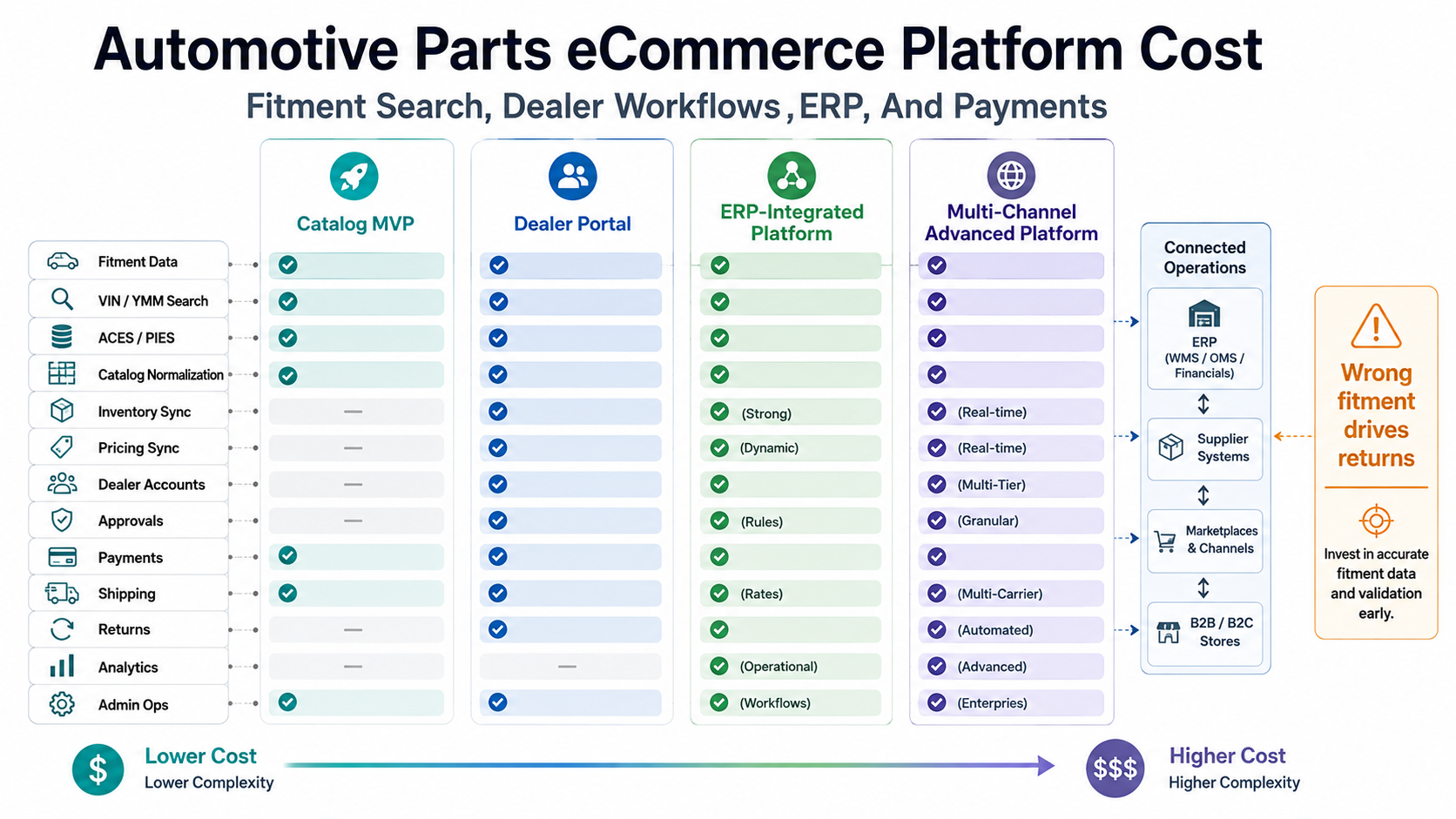
Automotive Parts eCommerce Platform Cost Ranges
Use these ranges as planning bands. The real estimate depends on SKU count, product data quality, fitment coverage, buyer types, inventory systems, ERP access, marketplace channels, and how much exception handling your staff needs inside the platform.
| Build Type | Planning Budget | Best Fit | Main Cost Risk |
|---|---|---|---|
| Catalog MVP | $55,000-$110,000 | One brand, one catalog source, basic product search, manual fitment review, standard checkout, simple admin, and limited integrations. | Launching without a plan for fitment accuracy, returns, and inventory updates. |
| Dealer Ordering Portal | $120,000-$280,000 | B2B accounts, dealer-specific pricing, quote requests, reorder workflows, approval states, saved vehicles, and selected ERP or inventory sync. | Underestimating account rules, price books, credit terms, backorders, and staff override paths. |
| ERP-Integrated Parts Platform | $300,000-$650,000+ | Large distributors, OEM parts sellers, aftermarket networks, multi-location inventory, ACES/PIES workflows, VIN/YMM fitment, payments, tax, shipping, returns, and reporting. | Treating ERP, catalog, order, pricing, and fulfillment data as simple one-way syncs. |
| Multi-Channel Advanced Platform | $650,000+ | Marketplace feeds, Amazon/eBay Motors workflows, multiple warehouse systems, dealer sales tools, analytics, personalized recommendations, and international fulfillment. | Trying to automate every channel before the core catalog and order loop is stable. |
These bands are broader than normal storefront estimates because automotive parts commerce is data-heavy. Hedges & Company notes that auto parts websites can run from $25,000-$75,000 and high-end custom Adobe Commerce or BigCommerce builds can exceed $150,000. Auto Care's joint eCommerce outlook also points to sustained online aftermarket growth through direct channels and marketplaces, which makes channel scope a real cost decision. Those signals are useful starting points, but complex dealer workflows and integrations can push a custom platform well beyond website-only cost.
Why Auto Parts Commerce Costs More Than A Normal Store
The expensive part is not displaying a product card. The expensive part is making the product card trustworthy. Auto parts buyers search by vehicle, part number, interchange, brand, trim, engine, position, compatibility notes, stock, delivery date, and account terms. A wrong match creates returns, support calls, damaged trust, and sometimes operational risk for repair shops or fleets.
Specialist vendors repeatedly highlight the same requirements: VIN lookup, year-make-model filters, ACES/PIES data, B2B dealer portals, ERP integration, distributor feeds, marketplace listing, and order import. Those are not decorative features. They are the systems that keep a parts buyer from ordering the wrong item or a sales rep from retyping the same order into the ERP. As of August 6, 2026, the Auto Care Association's current standards release is ACES 5.0 and PIES 8.0, so teams should budget for maintained standards compatibility, reference-database updates, and catalog QA instead of treating fitment as a one-time import.
That is why an automotive build should be estimated like a B2B marketplace MVP cost problem and a B2B eCommerce portal roadmap problem as much as a storefront project. The software has buyer roles, seller or distributor rules, search quality, account pricing, payments, approvals, inventory promises, and fulfillment exceptions.
The Cost Drivers To Scope First
Fitment and catalog data. This is the first budget swing. Year-make-model filters are simpler than VIN decoding, but both require normalized vehicle data, compatibility rules, product attributes, exclusions, notes, and ongoing updates. ACES and PIES support can reduce chaos, but only if the source data is clean and your team has a governance process for new parts, supersessions, and substitutions.
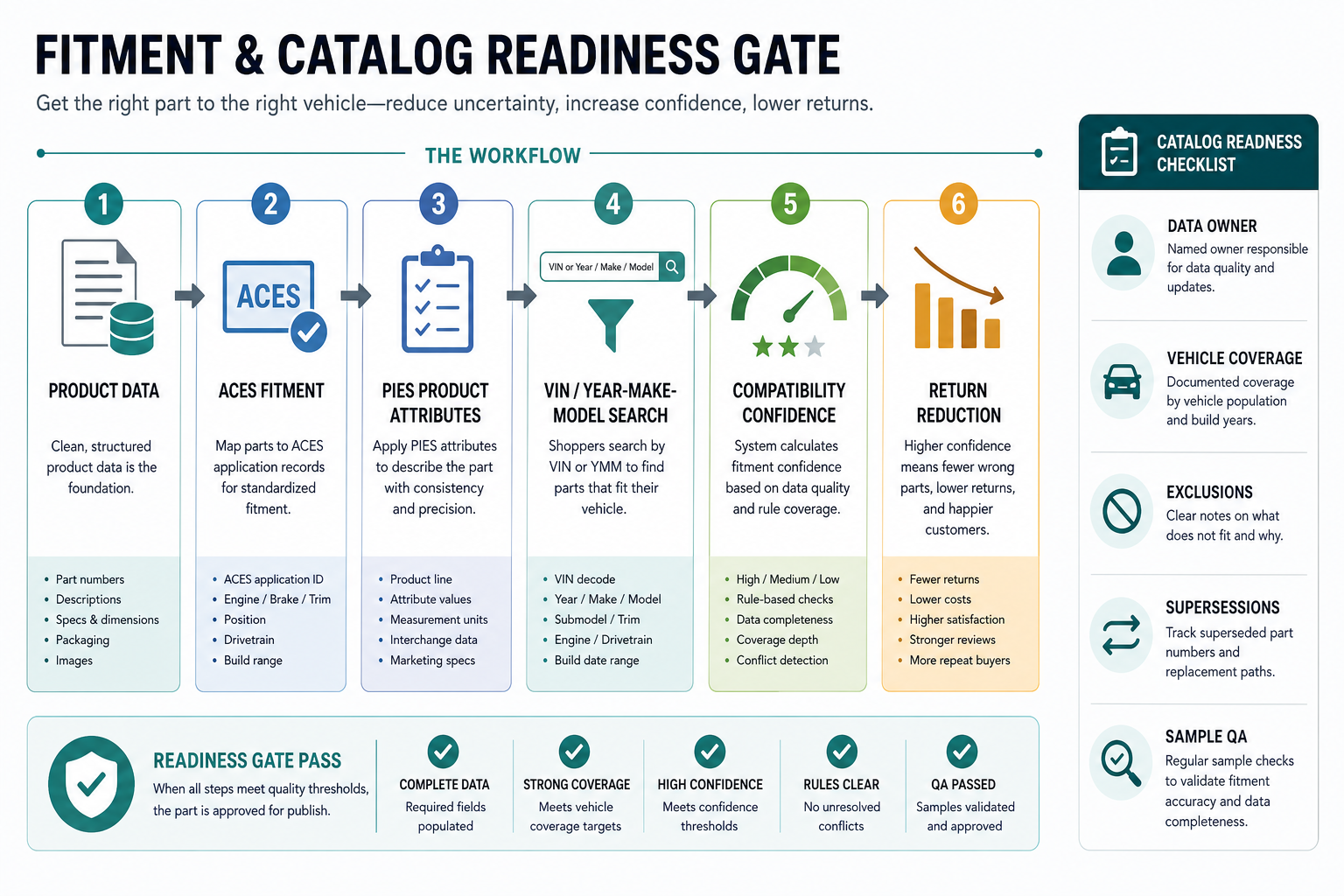
Search and product discovery. Automotive buyers use part numbers, OEM numbers, symptoms, vehicle details, category trees, diagrams, and brand names. A basic keyword search can launch an MVP, but serious catalogs need faceted search, fitment-aware filters, synonym handling, interchange logic, saved vehicles, and "garage" workflows.
Dealer and B2B workflows. Dealer portals often need contract pricing, credit limits, approvals, quote-to-order flows, bulk ordering, reorder lists, tax exemption, account managers, sales rep visibility, and private catalog rules. These workflows are where a portal becomes a business system, not just a website.
ERP, inventory, and order sync. ERP integration is often the true cost center. NextPage's ERP integration cost guide explains why sync direction, data objects, API quality, retries, reporting, and ownership affect budget. For auto parts, ERP sync may include products, inventory, warehouses, customer accounts, price books, orders, invoices, credits, returns, and shipment status. If the ERP also needs new role-specific screens or exception queues, compare the integration scope with custom ERP development services before pricing it as a simple connector.
Payments, shipping, and returns. A B2C cart may need cards, wallets, tax, shipping rates, and return labels. A dealer platform may also need terms, purchase orders, deposits, split shipments, freight rules, hazardous items, core charges, warranty returns, restocking fees, and manual review queues.
What Belongs In The First MVP?
A useful MVP proves that buyers can find the right part, see a credible price and availability promise, place an order, and let operations fulfill it without retyping or detective work. That does not require every integration on day one, but it does require a clean operating loop.
| Area | MVP Scope | Move Later When |
|---|---|---|
| Catalog | Priority categories, normalized attributes, product pages, manual review for edge cases. | The team is still cleaning long-tail SKUs or supplier data. |
| Fitment | YMM lookup for supported vehicles, clear compatibility notes, no-fitment fallback workflow. | VIN decoding, interchange, diagrams, or AI search are not yet required for launch proof. |
| Dealer Accounts | Login, account pricing, quote requests, saved carts, reorder lists, approval states. | Complex credit rules, territory rules, and sales rep dashboards can wait. |
| Inventory | One source of stock truth, scheduled sync, out-of-stock messaging, manual override queue. | Multi-warehouse allocation and real-time ATP are not required yet. |
| Orders | Checkout, payment or PO capture, order status, admin review, email notifications. | Marketplace order imports and advanced returns can wait until volume proves the need. |
For many teams, a staged web app development or eCommerce web app development services approach works better than a large all-at-once platform. Build the ordering loop first, then add integrations and channel automation where staff time, return rates, or revenue leakage justify the spend.
Integration Tiers That Change The Estimate
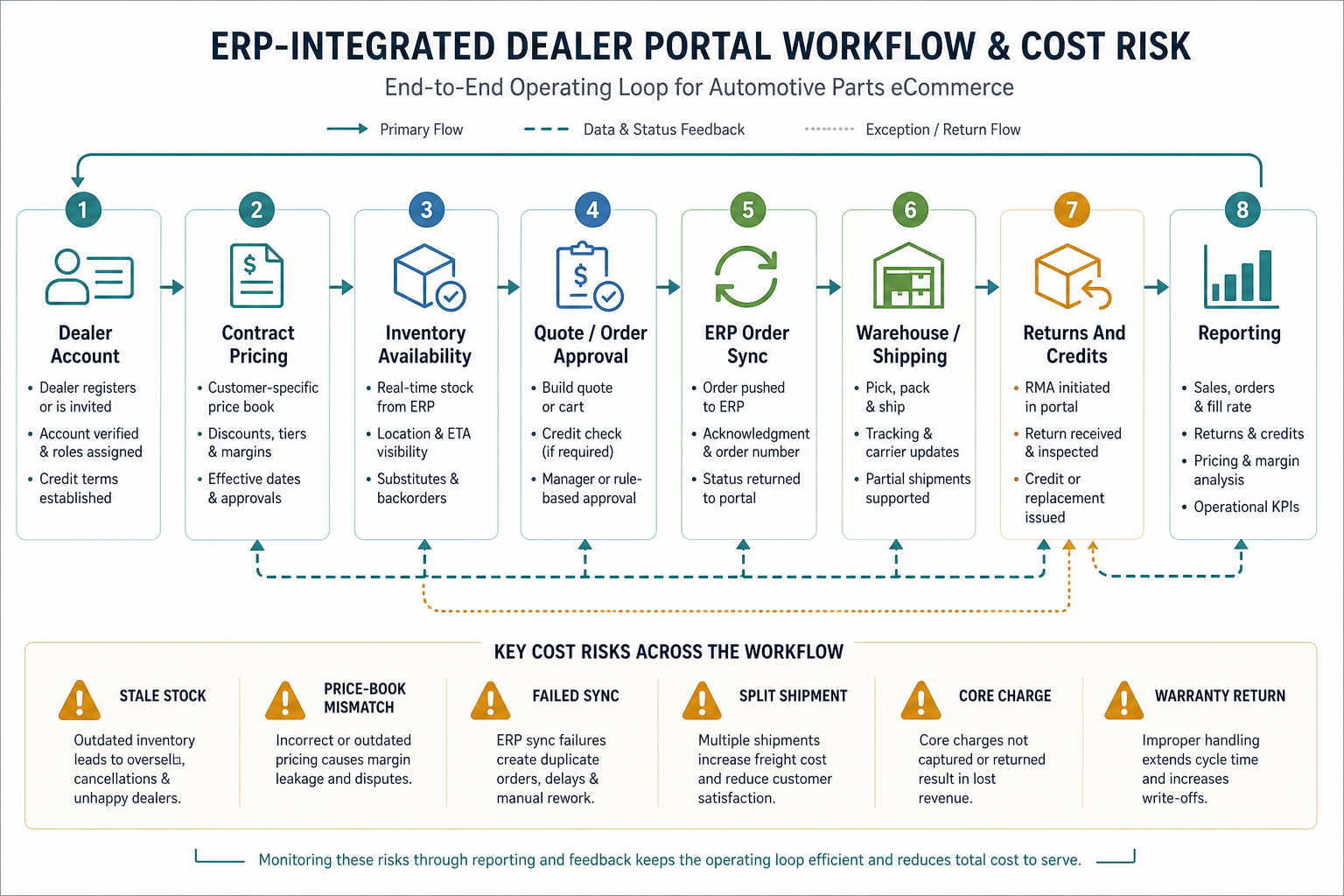
Integration scope should be ranked by business risk. A nightly product import is not the same as a two-way ERP order sync. A payment gateway is not the same as dealer terms and invoice reconciliation. A shipping-rate API is not the same as freight, split shipments, cores, warranty returns, and backorder handling.
| Integration Tier | Typical Work | Budget Impact |
|---|---|---|
| Basic Data Import | CSV/API product import, category mapping, image import, manual exception reports. | Low to medium. |
| Operational Sync | Inventory, price, customer account, order, invoice, and shipment sync with retries. | Medium to high. |
| Automated Commerce Network | Marketplaces, dealer portals, ERP, WMS, shipping, tax, payment terms, returns, analytics. | High. |
| Intelligence Layer | Demand forecasting, personalized search, recommendations, margin analytics, fraud/risk signals. | High, only after core data is reliable. |
Inventory deserves special attention. NextPage's inventory management software development cost guide makes the same point in a broader operations context: cost follows business rules behind stock movement, not the screen that displays stock counts. The same logic appears in retail automation cost work, where returns, stock promises, and channel operations decide whether automation actually reduces manual work.
Buy, Customize, Or Build Custom?
Specialized auto parts platforms can be a strong fit when your workflows match their assumptions. X-Cart, Web Shop Manager, and other automotive-focused platforms advertise native fitment, dealer, and catalog capabilities that general commerce platforms often lack. A configured platform can reduce time to launch when your catalog model, buyer workflow, and integrations fit the product.
Custom software becomes more compelling when your operating model is the differentiator: unique dealer pricing, quote workflows, B2B account rules, multi-location inventory logic, unusual catalog enrichment, private supplier feeds, proprietary fulfillment rules, or deep ERP dependency. In those cases, the platform is not only a sales channel. It is part of your operations system.
NextPage's custom software development work usually starts with a scope decision: what should be configured, what should be integrated, and what should be custom because it protects margin, speed, accuracy, or customer experience.
Estimation Checklist For Parts Distributors
- How many SKUs and vehicle applications must be reliable at launch?
- Which source owns product, fitment, price, customer, inventory, order, invoice, and return data?
- Do buyers search by keyword, category, part number, YMM, VIN, diagrams, or saved vehicles?
- Which buyer types matter first: consumers, dealers, installers, fleets, wholesalers, or internal reps?
- Which dealer rules must launch: contract pricing, credit terms, approvals, tax exemptions, quotes, or bulk ordering?
- How will the system handle out-of-stock items, superseded parts, substitute parts, backorders, and core charges?
- Which integrations are required for launch, and which can stay manual for the pilot?
- What return reasons will be tracked so fitment and catalog quality improve over time?
- What reporting does leadership need: margin, search failures, lost sales, returns, stockouts, channel revenue, or rep activity?
A Practical Build Roadmap
Phase 1: catalog and workflow discovery. Audit catalog sources, fitment data, SKU counts, vehicle coverage, buyer types, dealer pricing, ERP objects, inventory accuracy, order paths, returns, and support workload. Decide which workflow proves value first.
Phase 2: architecture and prototype. Design the product model, fitment model, account model, order states, integration contracts, admin workflows, and error queues. Prototype search, product detail, quote/order, and admin review screens with real users.
Phase 3: MVP build. Implement the launch catalog, search, fitment workflow, account pricing, checkout or quote flow, admin review, selected integrations, reporting, and support tools. Test wrong-fit, out-of-stock, backorder, substitution, payment, and return scenarios.
Phase 4: controlled rollout. Launch with a focused catalog, dealer group, region, or channel. Measure search success, fitment confidence, conversion, manual edits, return reasons, fulfillment cycle time, and support tickets.
Phase 5: scale and automate. Add deeper ERP/WMS sync, marketplace channels, real-time inventory, advanced dealer dashboards, recommendations, analytics, and automation only after the first operating loop is reliable.
How NextPage Helps
NextPage helps distributors, marketplace founders, and operations teams scope automotive parts commerce around real business rules. We map the catalog and fitment model, design the buyer and dealer workflows, identify integration risk, build secure web portals, connect ERP and payment systems, and launch with measurable operating controls.
A practical first engagement is a scope and estimate review. Bring your catalog sources, sample fitment data, ERP details, dealer rules, order workflow, channel plan, and current support/returns pain. The output should be an MVP boundary, phased roadmap, integration risk register, cost range, and release plan your team can defend. For a broader budget lens, compare this with NextPage's custom software development cost guide.
For related planning, compare this guide with NextPage's eCommerce app development cost guide and the automotive parts eCommerce platform roadmap before deciding whether to buy, configure, or build custom.