
A practical B2B marketplace MVP usually costs more than a simple ecommerce site because it has to prove two sides of a commercial workflow at once: suppliers can onboard, publish usable catalog data, respond to buyers, and get paid; buyers can search, request quotes, place orders, track fulfillment, and trust the platform. The leanest credible version is not a pile of storefront screens. It is one complete transaction loop with enough admin control to fix exceptions quickly.
For 2026 planning, a narrow B2B marketplace prototype may fit a $25,000-$50,000 discovery and clickable-product budget. A real MVP with supplier onboarding, buyer accounts, catalog/search, quote or order flow, admin tools, notifications, and one or two integrations often lands around $70,000-$180,000. A scaled B2B platform with contract pricing, approval chains, ERP/CRM/logistics sync, payment terms, analytics, security, and support workflows can move beyond $250,000. The right estimate depends on how much operational complexity you need on day one.
If you are still deciding what belongs in release one, start with NextPage's MVP Scope Builder. It helps separate launch-critical marketplace workflows from phase-two automation so the first build validates liquidity instead of trying to imitate a mature procurement platform.
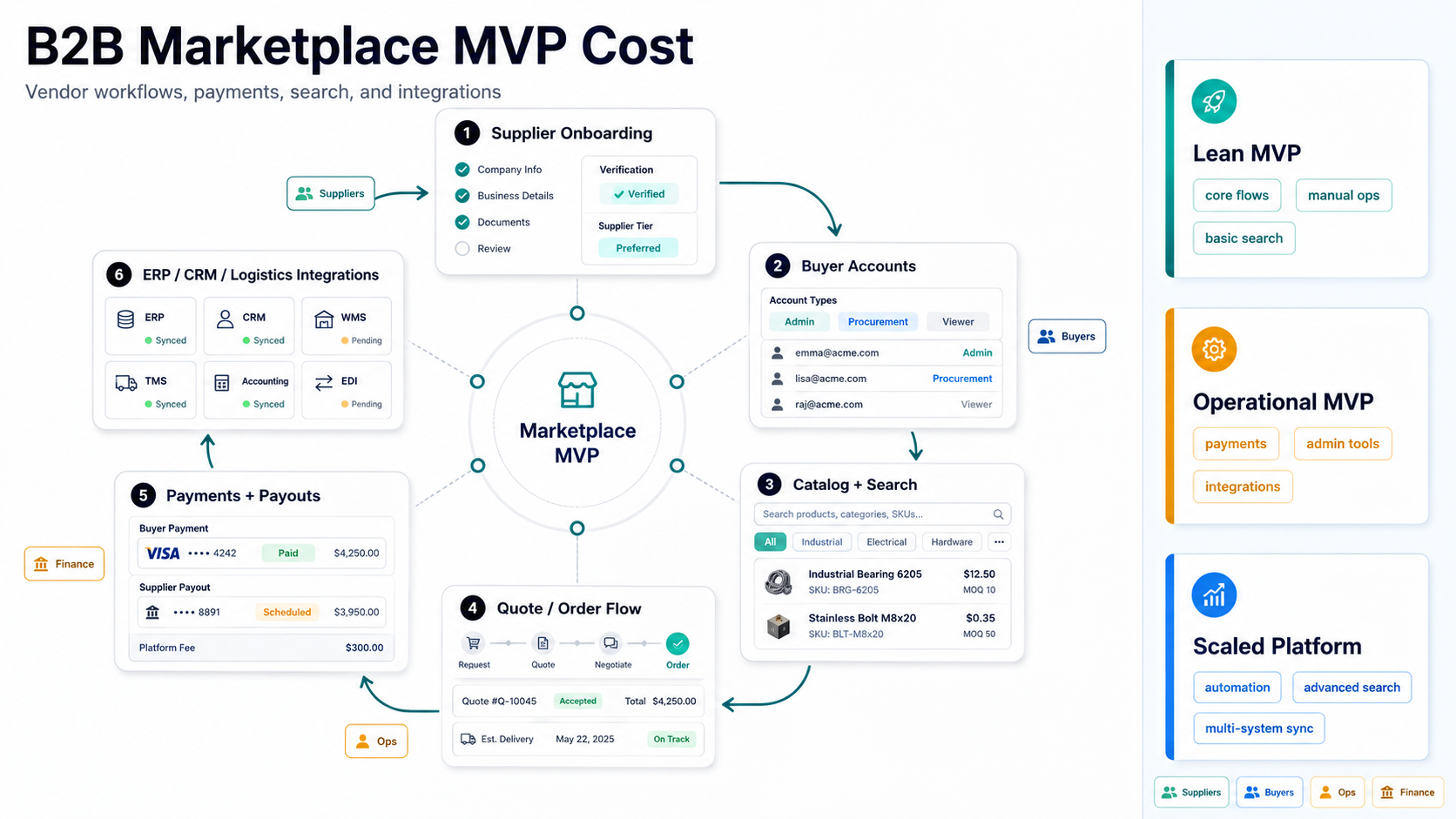
Quick Answer: B2B Marketplace MVP Cost
B2B marketplace MVP cost depends on vendor count, buyer role complexity, catalog structure, quote and order rules, payment model, fulfillment workflow, integrations, security, and admin tooling. A basic buyer/supplier MVP is cheaper than a procurement marketplace with contract pricing, RFQ workflows, negotiated payment terms, ERP sync, and logistics exceptions.
| Build Type | Planning Budget | What It Should Prove |
|---|---|---|
| Discovery prototype | $25,000-$50,000 | Market model, user roles, supplier onboarding flow, buyer journey, clickable prototype, integration inventory, and cost model. |
| Lean marketplace MVP | $70,000-$120,000 | Supplier profiles, buyer accounts, catalog listings, basic search, inquiry or quote flow, admin review, notifications, and analytics basics. |
| Operational MVP | $120,000-$220,000 | RFQ or ordering, approvals, payment setup, vendor verification, role permissions, reporting, support tools, and selected integrations. |
| Scaled B2B platform | $250,000+ | Contract pricing, ERP/CRM/logistics sync, payment terms, tax rules, audit trails, advanced analytics, security hardening, and support operations. |
These are planning bands, not fixed quotes. Good MVP scoping narrows the first release around one vertical, one supplier segment, one buyer journey, and one revenue model. Broad marketplace ambition can stay in the roadmap; the first release needs enough trust and operational tooling to learn whether buyers and suppliers will transact.
What Drives B2B Marketplace MVP Cost?
The biggest cost driver is not the number of pages. It is how many commercial rules the marketplace must enforce. A B2C-style marketplace can often start with listings, cart, checkout, ratings, and basic seller dashboards. A B2B marketplace may need company accounts, buyer teams, procurement roles, quote requests, negotiated pricing, MOQ rules, taxes, invoices, credit terms, partial fulfillment, freight logic, compliance checks, and integrations with systems that already run the business.
That is why the estimate should start with the operating loop. Can a qualified supplier join, list enough products or services, receive a buyer request, respond with a quote, convert it into an order, fulfill it, get paid, and resolve an exception? If that loop is broken, extra filters and dashboards will not save the MVP.
NextPage's custom software development cost guide and marketplace app development cost breakdown use the same principle: cost follows workflow complexity, integration depth, user-role count, security, and support expectations. For B2B marketplaces, those variables are concentrated in vendor operations and buyer trust.
MVP Vs Phase-Two Scope Matrix
A focused marketplace MVP should include enough functionality to validate supply, demand, and transaction reliability. It should not include every enterprise workflow that a mature marketplace might need after revenue and operating patterns are clearer.
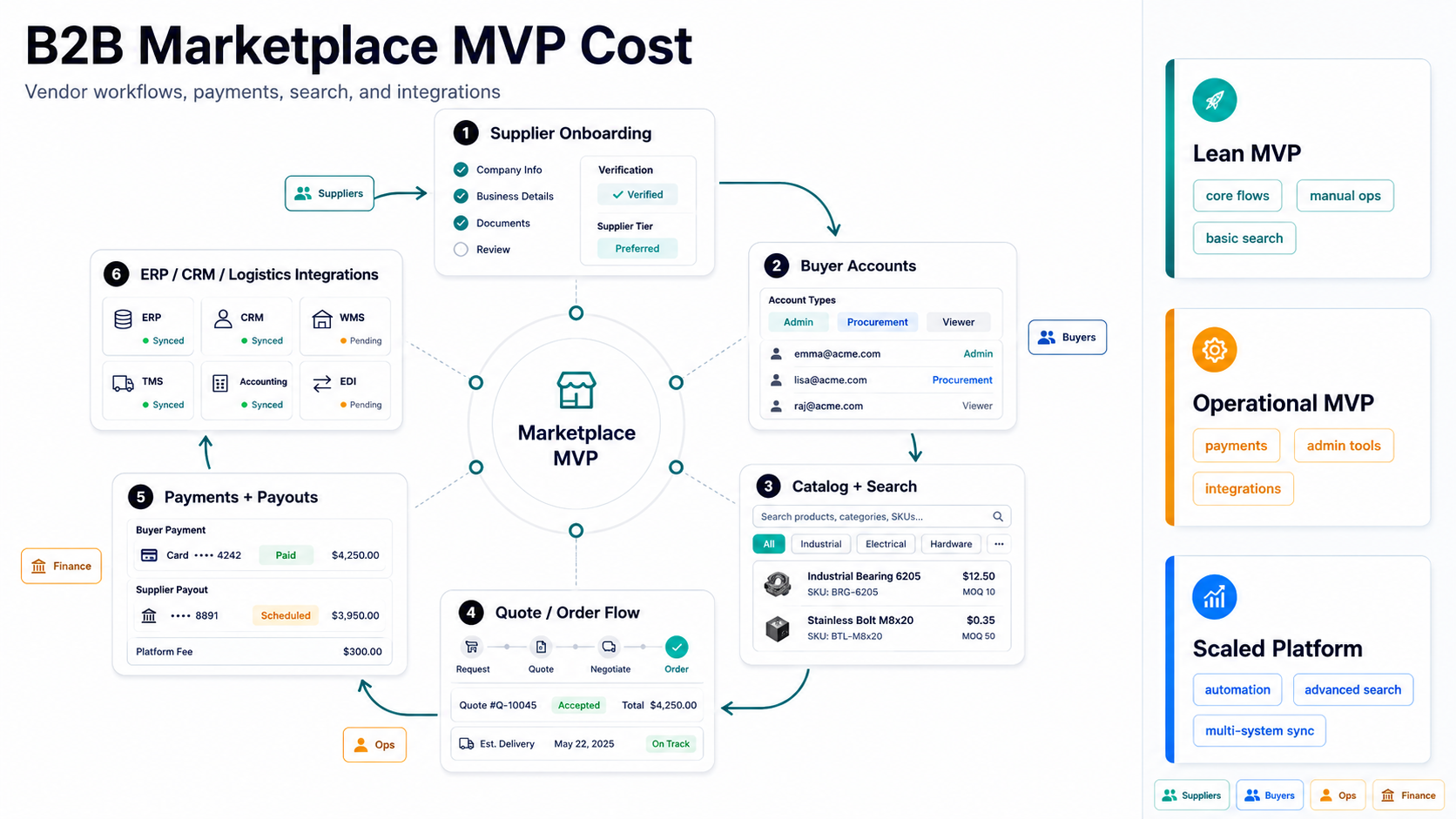
| Area | Lean MVP | Phase Two Or Scaled Platform |
|---|---|---|
| Vendor onboarding | Manual review, company profile, product upload, basic verification. | Automated KYC/KYB, document checks, tax forms, approval queues, risk scoring. |
| Buyer accounts | Company account, user invites, saved inquiries. | Department roles, approval chains, budgets, procurement policies. |
| Catalog and search | Core categories, structured listing fields, keyword and filters. | Attribute normalization, recommendations, AI search, faceted search at scale. |
| Quote/order flow | RFQ or simple order request with admin visibility. | Multi-round negotiation, contract pricing, purchase orders, partial fulfillment. |
| Payments | Payment intent, invoice request, or manual settlement tracking. | Payout automation, credit terms, tax rules, refunds, reconciliation, disputes. |
| Integrations | One critical CRM, ERP, payment, or logistics handoff. | Bidirectional ERP, CRM, WMS, accounting, freight, and analytics sync. |
The MVP should feel operationally complete even if it is narrow. A buyer should not need a spreadsheet beside the platform to understand supplier options. A supplier should not need manual email chaos to respond. Admins should see enough detail to fix bad listings, stalled quotes, payment issues, and support requests.
Vendor Onboarding Is A Cost And Liquidity Lever
Supplier onboarding determines whether the marketplace has useful inventory or just empty categories. The MVP needs a registration flow, company profile, category fit, listing or service upload, review status, and a way for admins to approve or reject submissions. In many B2B markets, the harder work is data quality: product attributes, certifications, MOQ rules, service regions, lead times, pricing visibility, and documentation.
Automating every onboarding check at launch is rarely necessary. What matters is that the first suppliers can be reviewed consistently and corrected quickly. A manual or semi-manual admin workflow can be enough for the first release if it produces clean catalog data and does not block supplier activation. Later, the platform can add automated business verification, tax forms, compliance checks, and self-serve bulk upload.
This is one place where B2B differs from consumer marketplaces. The supplier's ERP, catalog file, inventory feed, or sales team may be the true source of product truth. If the MVP needs that sync on day one, budget rises. If the first release can start with curated suppliers and a controlled catalog, cost and risk fall. Teams planning contract pricing, buyer account hierarchies, and ERP handoffs should also compare the scope against NextPage's B2B eCommerce portal development roadmap before deciding whether the first release is a marketplace, a portal, or a hybrid.
Buyer Workflows: Search, RFQ, Quotes, And Orders
Buyer workflows should be designed around the decision the marketplace helps the buyer make. Some B2B marketplaces help buyers discover suppliers. Others compare catalog items, request quotes, reorder standard products, book services, or route procurement requests internally. Each pattern changes the MVP.
A discovery marketplace can start with search, filters, supplier pages, inquiry forms, and admin follow-up. An RFQ marketplace needs structured request forms, attachments, supplier matching, response tracking, buyer notifications, and admin oversight. A transactional marketplace needs carts or order requests, payment handling, fulfillment status, cancellation rules, refunds, and support flows. If the release is commerce-heavy, NextPage's eCommerce app development cost guide can help pressure-test checkout, catalog, inventory, and admin assumptions. Do not mix discovery, RFQ, and transaction models unless the budget and operations team can support them.
For broader web platform planning, compare these choices with NextPage's web app development cost guide and web app development service page. Marketplace web apps cost more when they add permissions, dashboards, workflow automation, integrations, analytics, and exception handling.
Payments, Payouts, And Fulfillment Can Change The Estimate
Payments are often underestimated. A simple lead-generation marketplace may not need in-platform payments at launch. A transactional marketplace may need card payments, bank transfers, invoices, escrow-like holds, split payouts, refunds, disputes, tax handling, receipts, and reconciliation. B2B marketplaces may also need payment terms, purchase orders, credit checks, or offline settlement tracking.
Fulfillment also changes scope. Digital services may need milestones and approvals. Physical goods may need shipment creation, freight quotes, partial delivery, carrier updates, returns, damaged goods workflows, and warehouse handoffs. If logistics must integrate with supplier systems or third-party providers, budget for API discovery, edge cases, testing, and support tooling.
NextPage's Airbnb-like marketplace development cost article is useful here because trust, payments, roles, availability, and marketplace support patterns show up across different marketplace models. B2B has different nouns, but the same principle holds: trust workflows are product features, not afterthoughts.
ERP, CRM, Logistics, And Analytics Integrations
Integrations are the point where a marketplace stops being a website and starts becoming business infrastructure. ERP integration can sync products, inventory, orders, invoices, and account data. CRM integration can sync leads, buyer accounts, seller relationships, and sales activity. Logistics integration can produce rates, labels, tracking updates, and delivery status. Analytics integration can connect acquisition, supplier activation, quote conversion, order value, and support workload.
The first release should include only integrations that are required to validate the marketplace. If suppliers can manually upload a controlled catalog for the first ten vendors, do not build a full ERP sync prematurely. If admin-assisted settlement is acceptable for pilot transactions, do not rush payout automation before the business model is stable. If a CRM handoff is essential for sales follow-up, make that integration reliable instead of adding five weaker integrations.
The body of work should include authentication, sandbox access, field mapping, error handling, retry behavior, audit logs, data ownership, support ownership, and post-launch monitoring. Those items are not glamorous, but they decide whether the MVP can survive real buyer and supplier behavior.
A Practical B2B Marketplace MVP Roadmap
Phase 1: marketplace discovery. Define the vertical, supplier profile, buyer job, revenue model, marketplace rules, first transaction loop, admin responsibilities, and integration inventory. Produce a prototype and cost model before fixed build commitments.
Phase 2: curated supply and buyer workflow. Build supplier onboarding, company profiles, listing or service data, buyer registration, search, inquiry or RFQ flow, admin review, notifications, and basic analytics. Validate whether buyers can find and trust suppliers.
Phase 3: transaction support. Add quote/order management, payment or settlement tracking, fulfillment status, support tooling, and the first critical integration. Keep exceptions visible to admins instead of hiding them in email.
Phase 4: operational scale. Add bulk catalog tools, richer permissions, contract pricing, ERP/CRM/logistics sync, payout automation, reporting, audit trails, and stronger security controls. Scale only after the MVP has proven buyer demand and supplier responsiveness.
If your marketplace is closer to a SaaS operating platform than a lead-generation site, NextPage's SaaS development services page can help frame architecture, tenant roles, subscription logic, analytics, support, and long-term maintainability.
Pilot Acceptance Gates Before Phase-Two Spend
A B2B marketplace MVP should not graduate into a bigger integration or automation program just because the first build shipped. Treat the pilot as a commercial evidence gate. Before funding phase two, confirm that suppliers can complete onboarding without heavy hand-holding, buyers can find the right products or services, quote or order requests contain enough structured data, admins can resolve exceptions quickly, and the first integration does not create reconciliation work that cancels out the marketplace value.
| Gate | Healthy Signal | Phase-Two Decision |
|---|---|---|
| Supplier activation | Target suppliers publish complete profiles, catalog data, lead times, compliance documents, and service regions with limited admin cleanup. | Add bulk import, self-serve validation, taxonomy mapping, or ERP catalog sync only after the manual process exposes repeatable patterns. |
| Buyer conversion | Buyers search, compare, shortlist, and submit RFQs or orders without leaving the platform for basic qualification data. | Invest in faceted search, saved buying lists, recommendations, approval chains, or procurement integrations when buyer behavior proves demand. |
| Transaction reliability | Quotes, order requests, payment status, fulfillment steps, and support cases are visible to admins without spreadsheet reconciliation. | Automate payouts, invoicing, logistics, and dispute workflows after the transaction loop is predictable enough to encode. |
| Operating economics | The team can see supplier response rate, buyer activation, quote-to-order conversion, average order value, support load, and integration failure patterns. | Scale marketplace features when the data shows which side of the marketplace is constraining growth. |
This gate-based approach keeps the MVP tied to buyer and supplier evidence. It also gives a cleaner brief to a MVP development company or SaaS delivery team because every phase-two feature has a measurable reason to exist.
How NextPage Can Help
NextPage helps teams scope, design, and build B2B marketplaces around the workflows that decide commercial traction: supplier onboarding, buyer search, RFQ and quote flows, payments, fulfillment, admin controls, analytics, and integrations. A practical engagement starts with discovery, a release-one scope model, architecture, and a build plan that avoids overbuilding before marketplace liquidity is proven.
Use the MVP Scope Builder for first-release planning, then pressure-test cost with the Custom Software Cost Estimator. When you need a custom delivery team, NextPage's MVP development company and custom software development services can turn the validated scope into a production marketplace.