
Quick Answer: How Should You Choose A Software Outsourcing Partner For AI Projects?
Choose a software outsourcing partner for AI projects by evaluating more than hourly rates, case studies, and team size. The right partner should prove they can own production software outcomes while handling AI-specific risks: data readiness, model evaluation, prompt and retrieval controls, security, IP terms, release quality, and human review for risky workflow actions.
A strong AI-capable outsourcing partner can explain which delivery model fits your situation, how senior engineering oversight works, what parts of the architecture your team will own, how model outputs will be tested, and what evidence you will receive before each release. A weak partner sells "AI developers" without showing how they prevent hallucinations, data leakage, brittle integrations, runaway model cost, or vendor lock-in.
Use this guide when you are comparing vendors for an AI-enabled SaaS product, internal tool, modernization program, RAG knowledge assistant, workflow automation, or product engineering roadmap. If you want a delivery path tied to India-based teams, NextPage's software outsourcing India service page is the main next step after you shortlist requirements.
Why AI Changes The Outsourcing Partner Selection Process
Traditional software outsourcing questions still matter: can the team ship reliable software, communicate clearly, protect IP, work in your time zone overlap, and scale without losing quality? AI projects add another layer. The partner may touch sensitive data, design model prompts, connect business systems to agents, tune retrieval, evaluate outputs, and make decisions that affect customers or employees.
That means vendor selection cannot stop at "Do you have Python developers?" or "Have you used OpenAI?" The better question is whether the partner can turn AI into controlled product behavior. Can they define what the model is allowed to do? Can they test answers against gold examples? Can they explain fallback behavior when retrieval fails? Can they log model and tool calls? Can they keep humans in the loop where risk is high?
The 2026 outsourcing market is also more crowded. Competitor guides commonly discuss cost savings, talent access, engagement models, and communication. Those topics are useful, but they miss the current buying risk: AI can make a software team faster, but it can also make bad architecture, poor QA, and unclear ownership fail faster. Your evaluation should separate AI-assisted delivery discipline from AI buzzwords.
2026 Source Status: What To Verify Before You Trust An AI Outsourcing Partner
For 2026 vendor selection, treat AI governance claims as evidence requests, not sales language. NIST's AI Risk Management Framework and Generative AI Profile keep the buyer's focus on governed context, measurable risks, monitoring, and lifecycle controls. OWASP's LLM risk work adds the application-security lens: prompt injection, sensitive information disclosure, supply-chain exposure, excessive agency, weak output handling, and vector or embedding weaknesses all become outsourcing due-diligence topics when an external team designs prompts, retrieval, tools, or agent workflows.
Ask each shortlisted partner to map those controls to your first release. The useful answer is not "we follow best practices." It is a concrete operating model: who approves data access, where prompts and model configuration are versioned, how eval sets are maintained, which tool actions require human approval, how logs are retained, which incidents trigger rollback, and how model/vendor changes are reviewed before production. If the partner cannot show this before the pilot, keep the scope advisory or use a narrower implementation role.
| 2026 Due-Diligence Check | Evidence To Request | Decision Signal |
|---|---|---|
| AI risk framework alignment | Risk register tied to NIST AI RMF or an equivalent governance model | Strong partners can explain context, measurement, monitoring, and ownership in plain delivery terms. |
| LLM application security | Prompt-injection, data-leakage, supply-chain, excessive-agency, and output-handling tests | Security is designed into the AI workflow, not added after a demo works. |
| Data and model ownership | Contract language for prompts, eval data, generated assets, embeddings, logs, and model configuration | The buyer can maintain, audit, or migrate the system after handover. |
| Human review and autonomy limits | Approval matrix for recommendations, tool calls, writes, customer-facing actions, and exception handling | The first release has clear stop conditions instead of vague promises of automation. |
| Operational monitoring | Dashboards or runbooks for quality drift, cost spikes, latency, retrieval misses, and incident response | The partner is ready for production support, not only prototype delivery. |
The AI Outsourcing Partner Evaluation Scorecard
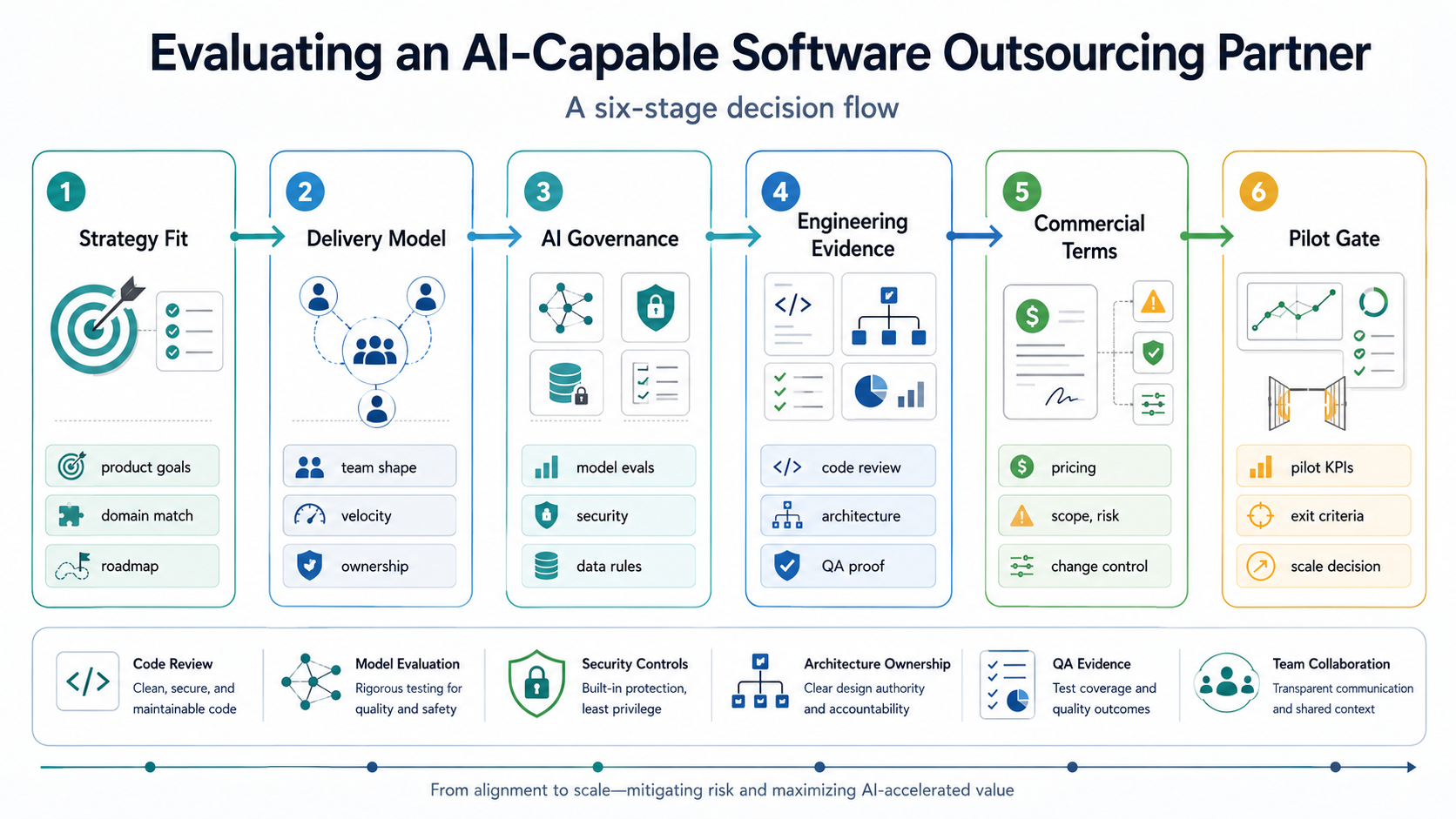
Score each vendor from 1 to 5 across the areas below. A good partner does not need a perfect score everywhere, but the gaps should be visible before you sign. For AI-heavy projects, low governance, weak testing, and unclear ownership should carry more weight than a lower hourly rate.
| Evaluation Area | What To Ask | Strong Signal | Risk Signal |
|---|---|---|---|
| Strategy Fit | Do they understand the business workflow, product goal, and AI use case? | They challenge assumptions, narrow the first release, and define measurable outcomes. | They accept every idea as a feature request without discovery. |
| Delivery Model | Will you use staff augmentation, dedicated team, managed delivery, or product co-delivery? | The model explains roles, ceremonies, ownership, escalation, and handoff. | The proposal lists resumes but not delivery responsibilities. |
| AI Governance | How will they control data access, prompts, retrieval, model behavior, and human review? | They provide approval paths, audit logs, risk categories, and evaluation gates. | They describe AI as a plug-in feature with no operating controls. |
| Engineering Evidence | Can they show architecture decisions, test strategy, code review, DevOps, and release quality? | You see sample artifacts, quality gates, and senior review patterns. | You only see screenshots or generic portfolio pages. |
| Commercial Terms | Are IP, data rights, model/vendor dependency, change control, and support terms clear? | Contracts cover ownership, confidentiality, exit, support, and change budgets. | Terms are vague around generated assets, prompts, data, and handover. |
| Pilot Gate | Can they propose a narrow pilot with success criteria before scaling? | The pilot has acceptance criteria, cost range, timeline, and scale/stop decision. | The partner pushes a large team before validating the workflow. |
If you are still deciding between team shapes, compare this scorecard with NextPage's guide to software development outsourcing to India. That post covers models and cost ranges; this one focuses on the AI-specific partner evaluation layer.
Choose The Right Delivery Model Before Comparing Vendors
A vendor can be excellent in one model and wrong for another. Before you evaluate companies, decide what you want the partner to own.
| Model | Best For | Client Ownership Needed | AI Project Watchout |
|---|---|---|---|
| Staff augmentation | Adding engineers to an existing product team | Product management, architecture, QA, delivery management | Works only if your internal team can govern AI design and testing. |
| Dedicated team | Ongoing product delivery with stable roles | Roadmap, priorities, business decisions, senior technical counterpart | Needs clear evaluation and security rituals, not just sprint velocity. |
| Managed delivery | Building a defined product slice or platform module | Outcome definition, acceptance criteria, domain review | Scope must include AI risk controls, data work, and post-launch support. |
| Product co-delivery | AI-enabled products where business and engineering decisions are tightly coupled | Shared discovery, feedback, governance, and roadmap tradeoffs | Requires strong trust, transparent architecture, and frequent executive alignment. |
For many AI projects, a dedicated team or product co-delivery model is safer than pure staff augmentation. AI work often crosses product, data, UX, backend, infrastructure, QA, and compliance. If your internal team cannot provide senior architecture and AI governance, a resume-only staffing model will leave important decisions unmanaged.
Use staff augmentation when you already have technical leadership, delivery process, and evaluation discipline. Use managed delivery when you can define a bounded outcome. Use a dedicated team when the roadmap will evolve and you need continuity. Use product co-delivery when the software partner must help discover the right AI workflow, build the product slice, and support learning after launch. If the internal debate is still about capacity versus managed ownership, compare the tradeoffs in NextPage's staff augmentation vs managed dedicated team decision guide before vendor calls.
AI Governance Due Diligence: What The Partner Must Prove
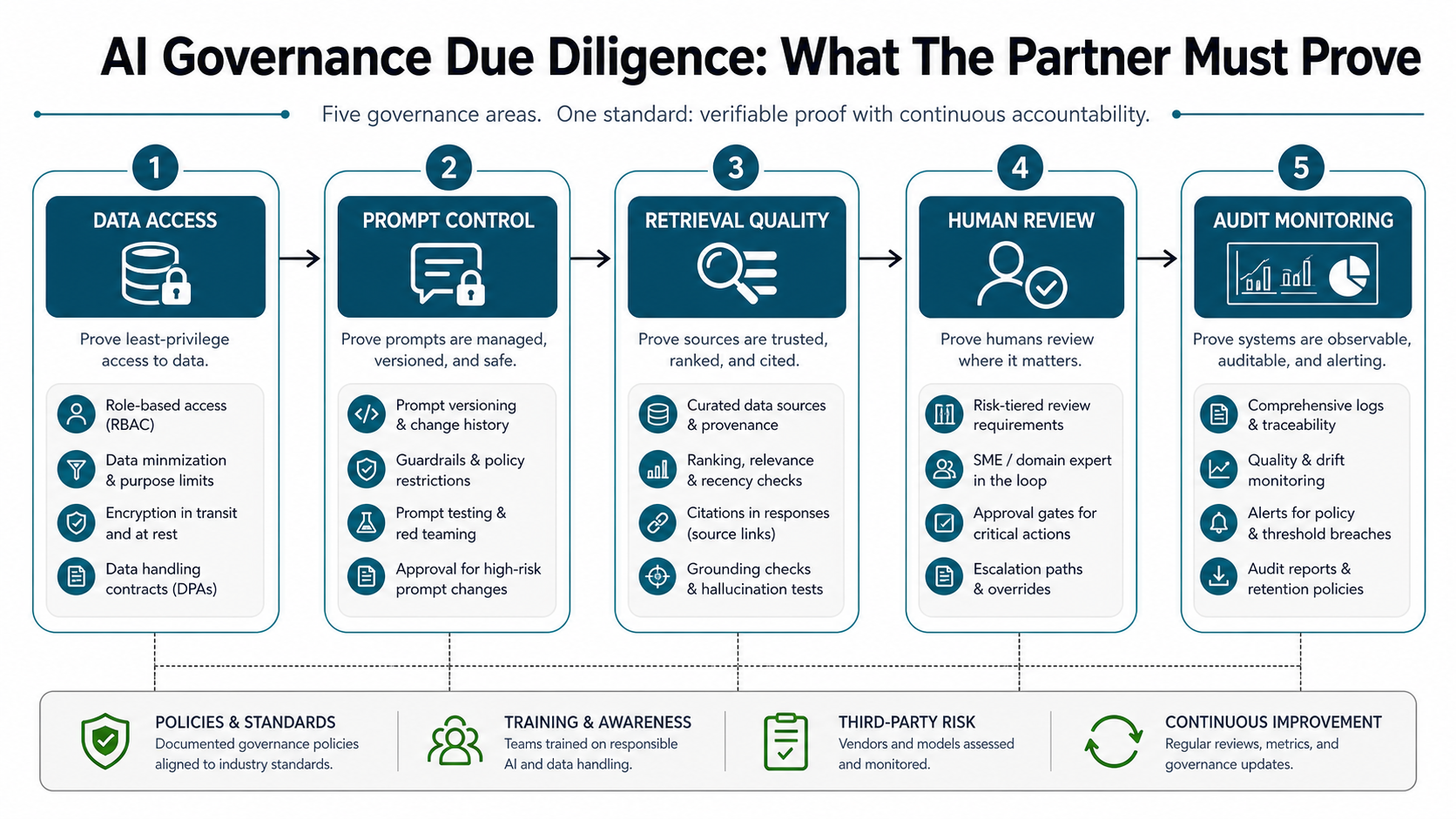
AI governance is not only a compliance topic. For outsourced software delivery, it is the set of controls that keeps a vendor from turning a prototype into unmanaged production risk. Ask for evidence in five areas.
| Governance Area | Proof To Request | Why It Matters |
|---|---|---|
| Data Access | Data inventory, permission model, masking approach, retention rules | Prevents exposing sensitive customer, employee, or operational data. |
| Model And Prompt Control | Prompt/version history, model selection rationale, fallback behavior | Keeps behavior explainable when models or prompts change. |
| Retrieval Quality | Source ranking, citation policy, stale-data handling, retrieval tests | Reduces unsupported answers in RAG and knowledge workflows. |
| Human Review | Approval rules, escalation paths, confidence thresholds, blocked actions | Prevents automated actions where risk is high or confidence is low. |
| Audit And Monitoring | Logs, cost alerts, tool-call traces, output quality dashboards | Lets your team investigate failures and control operating cost. |
For regulated or infrastructure-sensitive work, you may need a deeper governance plan. NextPage's AI governance checklist for critical infrastructure software shows the kind of risk framing that higher-stakes projects require.
Engineering Evidence Beats Portfolio Screenshots
Portfolio screenshots are weak evidence for AI projects. They show that a vendor can present work, not that the system is maintainable, secure, or measurable. Ask for delivery artifacts that show how the partner thinks.
- Architecture decision records or sample technical designs.
- API contract examples and integration diagrams.
- Model evaluation plans, test cases, or quality rubrics.
- QA strategy for deterministic software plus probabilistic AI outputs.
- Observability examples for latency, cost, errors, retrieval misses, and tool calls.
- Code review and branch protection practices.
- Release checklists, rollback plans, and incident response ownership.
- Examples of knowledge transfer and documentation from prior handovers.
A serious partner will not expose a client's confidential code, but they should be able to show sanitized artifacts, templates, or a walkthrough of their delivery system. If the only evidence is "we have built AI apps," keep probing.
For custom builds that include AI features, these questions belong next to normal software engineering diligence. NextPage's custom software development work treats AI as part of a production product system: UX, APIs, data, testing, deployment, monitoring, and support.
RFP Questions For AI-Capable Outsourcing Partners
Use these questions in the first serious vendor conversation. The goal is not to make procurement heavier. It is to force clear answers before the relationship becomes expensive to change.
| Category | Question | Good Answer Includes |
|---|---|---|
| Use Case Fit | Which parts of this product should not use AI in the first release? | Risk boundaries, deterministic alternatives, and phased rollout logic. |
| Data | What data access do you need, and how will you avoid over-collection? | Minimum data set, masking, retention, permissioning, and data owner review. |
| Architecture | Where will prompts, retrieval, tools, and model configuration live? | Versioning, environment separation, ownership, and deployment path. |
| Evaluation | How will we know the AI behavior is good enough before launch? | Gold examples, test sets, success metrics, failure categories, and review cadence. |
| Security | How do you handle secrets, access, dependency risk, and prompt injection? | Role-based access, secret management, scanning, logging, and abuse cases. |
| Commercials | Who owns prompts, generated assets, code, documentation, and model configuration? | Explicit ownership and handover terms. |
| Support | What happens if model cost spikes or output quality drops after launch? | Monitoring, alerts, rollback, incident owner, and optimization backlog. |
Ask vendors to answer with artifacts, not only promises. A two-page implementation memo is often more revealing than a polished sales deck. It shows whether the partner can reason through your problem, state assumptions, and identify risk before writing code.
Commercial Terms That Matter More In AI Projects
AI projects make contract details more important because the work often includes code, prompts, evaluation data, generated content, embeddings, logs, model configurations, and third-party services. Clarify ownership and exit terms before the first sprint.
- IP ownership: Define ownership of source code, prompts, system instructions, evaluation sets, synthetic data, documentation, generated assets, and infrastructure configuration.
- Data use: State whether project data can be used for training, debugging, benchmarking, or vendor marketing. Default to no unless explicitly approved.
- Model/vendor dependency: Name the model providers, fallback options, and migration expectations if pricing, terms, or quality changes.
- Security obligations: Include access control, secrets handling, dependency scanning, audit logs, incident notification, and subcontractor rules.
- Change control: AI scope can expand quickly. Require clear change budgets for new data sources, tools, workflows, and autonomy levels.
- Handover: Require architecture docs, runbooks, environment notes, prompt/version history, and test/evaluation artifacts.
If a vendor avoids these terms, the risk is not only legal. It is operational. You may end up with a working demo that your internal team cannot safely maintain, audit, or move away from later.
Red Flags When Evaluating A Software Outsourcing Partner For AI
Red flags usually appear before the contract. They show up in how the partner scopes, prices, and explains the work.
- They quote a large AI build without asking about data access, user roles, workflows, or acceptance criteria.
- They cannot explain how they test AI outputs beyond manual review.
- They sell one model or platform as the answer to every problem.
- They promise full autonomy before proving a recommendation or approval workflow.
- They avoid architecture ownership and say the team will "figure it out in sprints."
- They do not separate prototype, pilot, production, and support budgets.
- They cannot name the senior reviewer responsible for AI architecture and release quality.
- They treat security, privacy, and compliance as post-launch tasks.
Some vendors can still be useful for narrow implementation work, even if they are not right for full AI product ownership. The key is to match the vendor's role to its maturity. Do not give strategic ownership to a team that can only supply capacity.
Run A Pilot Gate Before Scaling The Team
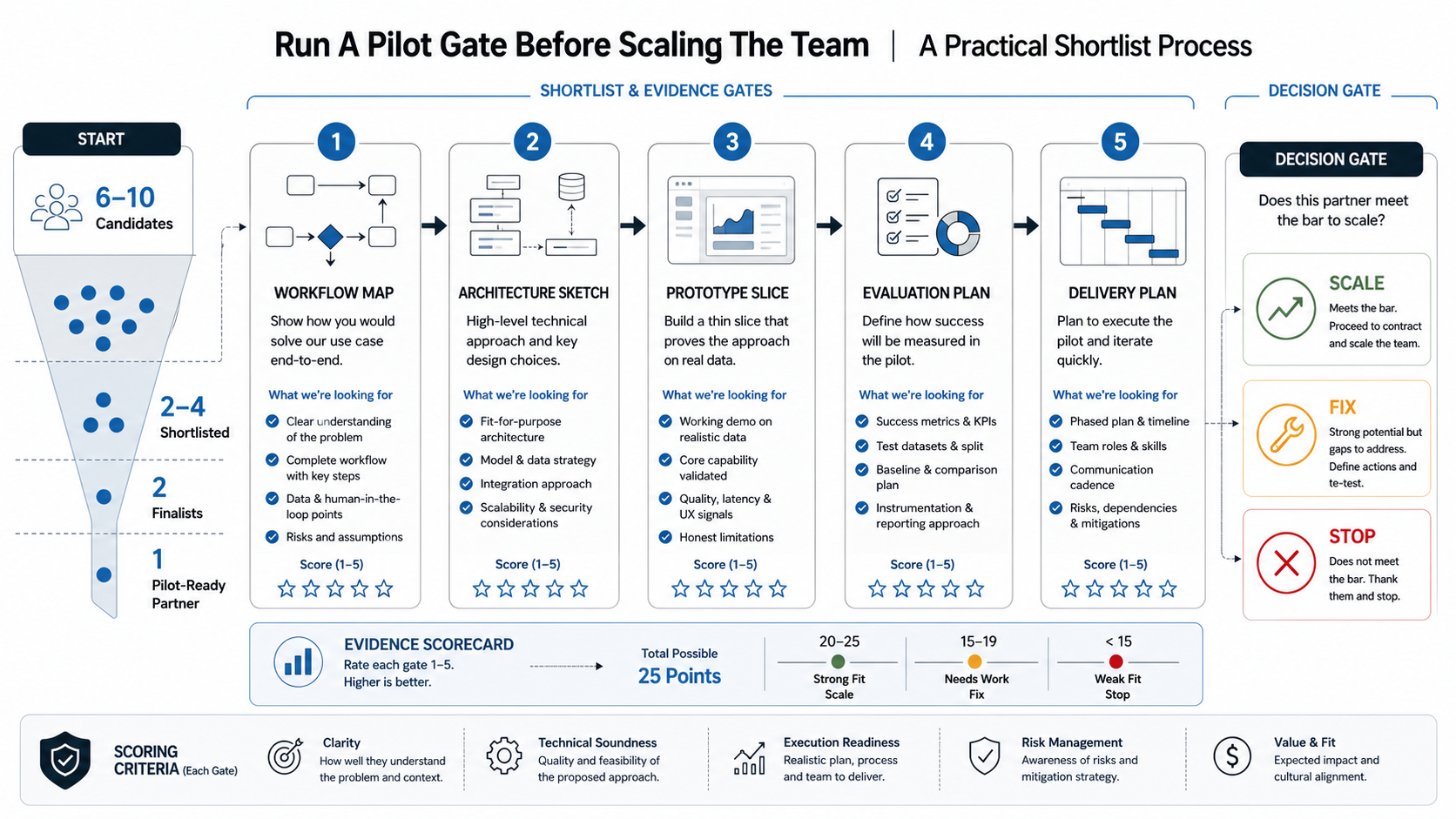
The safest way to choose between serious vendors is a paid discovery or pilot slice with clear acceptance criteria. This should be small enough to finish quickly but realistic enough to expose integration, data, and quality issues.
| Pilot Output | What It Should Prove |
|---|---|
| Workflow Map | The partner understands the business process, users, exceptions, and success metric. |
| Architecture Sketch | The technical path covers data, APIs, AI components, security, and deployment. |
| Prototype Slice | A narrow flow works with representative data or realistic fixtures. |
| Evaluation Plan | The team can define expected outputs, failure modes, and launch gates. |
| Delivery Plan | Roles, timeline, cost range, risks, and ownership are explicit. |
A good pilot creates evidence for both sides. You learn whether the partner can think and communicate. The partner learns whether the problem is ready to build. If the pilot reveals data gaps or risky assumptions, that is not failure. It is useful discovery before a larger budget is committed.
A Practical Shortlist Process
Start with 6-10 potential partners, then reduce quickly using evidence. The process below works for founders, CTOs, product leaders, and procurement teams that need a defensible decision without spending months on vendor theater.
- Define the outcome: Write the business workflow, user roles, target metric, must-have integrations, sensitive data categories, and launch constraints.
- Pick the delivery model: Decide whether you need staff augmentation, dedicated team, managed delivery, or co-delivery.
- Filter by relevant experience: Look for similar product complexity, data sensitivity, AI workflow type, and integration depth.
- Ask for artifacts: Request sanitized architecture, QA, evaluation, support, and handover examples.
- Run structured calls: Ask every vendor the same RFP questions so comparisons are fair.
- Score governance and delivery: Weight AI governance, senior oversight, and evidence higher than generic hourly rate.
- Run a pilot gate: Pay for a narrow discovery or prototype slice before scaling.
- Finalize terms: Lock IP, data, model, support, change control, and exit terms.
For team-size and monthly budget planning, the Dedicated India Team Cost Calculator can help model the roles you may need before vendor calls become too sales-driven.
How NextPage Helps Evaluate And Build With AI-Capable Outsourcing Teams
NextPage helps companies turn AI software ideas into scoped, buildable, and supportable product plans. For outsourcing engagements, we help define the delivery model, senior oversight, architecture ownership, data access, AI evaluation, security controls, roadmap, and release gates before scaling the team.
That work can sit inside broader IT outsourcing services, a dedicated India team, or a focused product build through AI development services. For workflow automation and agentic systems, our AI automation services focus on measurable business processes rather than demos without operational ownership.
The right next step is a short evaluation call with your use case, current systems, data constraints, expected launch timeline, and internal ownership model. The output should be a practical partner-selection scorecard, pilot scope, and delivery model recommendation.