
An AI agent API readiness checklist should answer one question before any pilot: can this workflow let an agent take useful action without creating invisible operational, security, or compliance risk? A production-ready API for agentic workflows is not just documented and reachable. It has clear business action boundaries, reliable schemas, scoped identities, idempotent operations, audit events, failure states, test data, monitoring, and human approval gates.
Most enterprise APIs were built for applications, integrations, dashboards, or human-triggered automation. AI agents add a different pressure. They can interpret a goal, plan several steps, call tools, retry after errors, and update systems under supervision. That makes API readiness a product, platform, security, and operations decision, not only an engineering checklist.
If you are deciding whether a workflow is ready, start with NextPage's AI Agent Readiness Assessment. If the candidate workflow is still unclear, the Workflow Automation Opportunity Finder can help rank repeatable processes before you spend budget on an agent build. Use this guide to review the API layer behind the workflow before implementation starts.
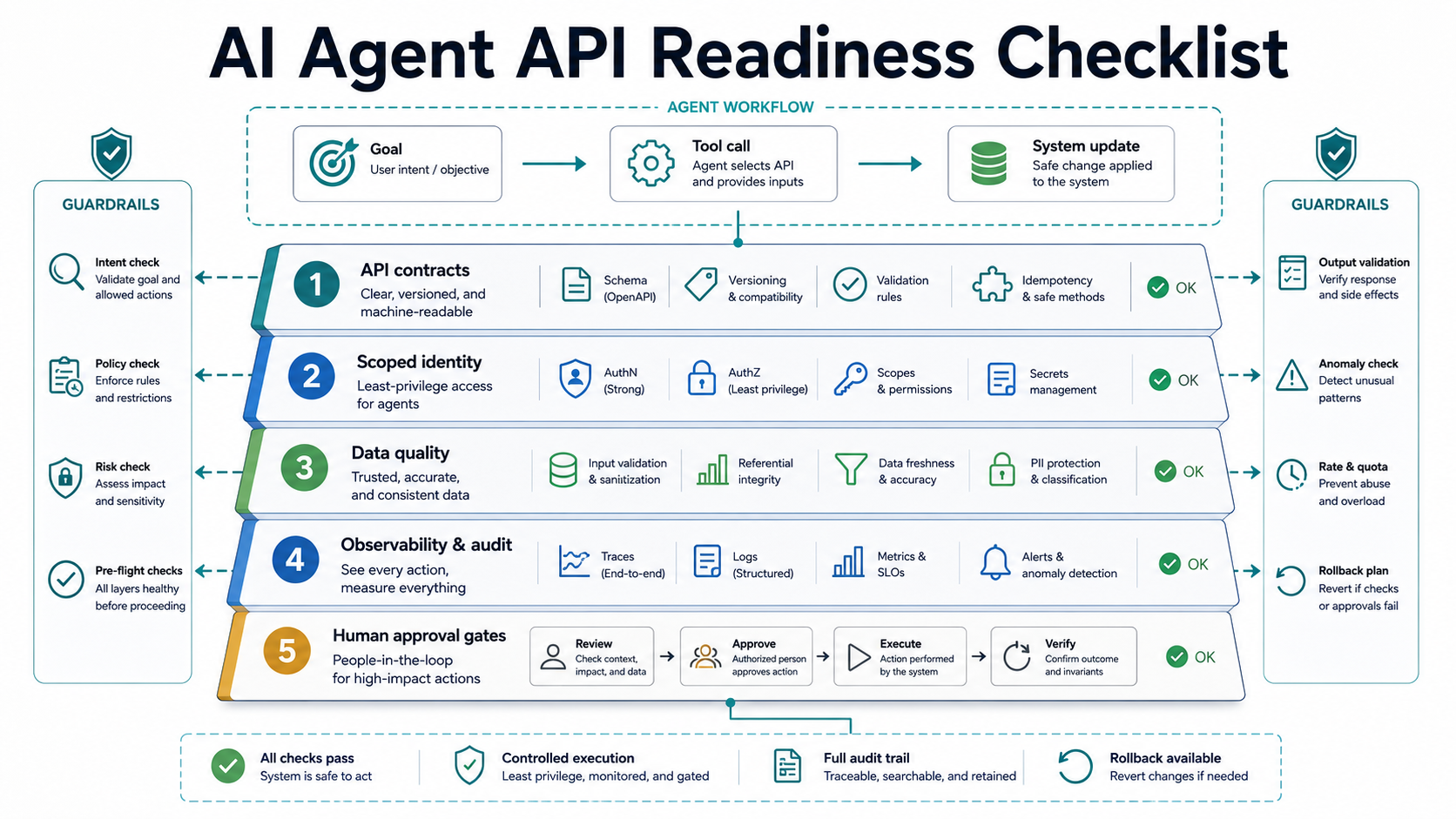
Quick Answer: What Makes An API Ready For AI Agents?
An API is ready for AI agents when a team can prove what actions the agent may take, which identity it uses, what data it can access, how every tool call is logged, how failures are handled, which decisions require human approval, and how the pilot can be paused or rolled back. In 2026, that proof also needs to cover tool protocol authorization, session boundaries, trace capture, eval evidence, guardrail outcomes, and agentic threat controls. If those controls are missing, the agent may still work in a demo, but it is not ready for business-critical workflows.
| Readiness Area | Proof To Look For | Red Flag |
|---|---|---|
| API contracts | Versioned schemas, idempotency, error semantics, and action boundaries. | The agent must infer business rules from vague endpoint names. |
| Identity and access | Dedicated agent identity, scoped permissions, approval rules, and revocation path. | The agent uses a shared human account or broad admin token. |
| Data quality | Named owners, freshness targets, consent rules, and retrieval limits. | Conflicting records make the agent choose between systems silently. |
| Observability | Tool-call traces, prompt context, policy checks, latency, cost, and outcome logs. | Teams can see the final action but not the agent path that caused it. |
| Human control | Review thresholds, escalation queues, rollback playbooks, and pilot metrics. | Every edge case becomes either full autonomy or manual firefighting. |
2026 Source Status: Tool Calling, Context, And Agentic Risk Controls
Current agent guidance makes API readiness less about whether a model can call a function and more about whether the surrounding system can constrain, observe, and recover from tool use. OpenAI's current function-calling guidance still centers tool access on explicit JSON schemas and application-owned execution. Anthropic's agent engineering guidance emphasizes that tool definitions deserve the same design attention as prompts, because agents rely on tool descriptions, parameters, and returned context to decide what to do next.
Risk guidance has also become more concrete. NIST AI RMF and the Generative AI Profile keep the operating loop grounded in govern, map, measure, and manage evidence. OWASP's 2026 Agentic Applications work makes planning, tool use, identity, supply chain, memory, inter-agent communication, cascading failure, and misplaced human trust first-class review areas. For an API team, that means readiness evidence should include scoped tool catalogs, permission revocation, tenant/session isolation, trace capture, eval results, rollback paths, and a named owner for every agent-callable action.
| 2026 Signal | API Readiness Implication | Evidence To Keep |
|---|---|---|
| Structured tool calling | Tool schemas, descriptions, and validation rules are part of the API contract. | Versioned schemas, strict input validation, rejected-call logs, and tool-owner review. |
| Context engineering | Agents need bounded context, not unrestricted system data. | Allowed retrieval sources, freshness rules, redaction, and source attribution. |
| Agentic threat models | Tool misuse, excessive autonomy, and identity weakness need explicit controls. | Scopes, approval thresholds, anomaly alerts, incident contacts, and rollback drills. |
| Risk-management evidence | Readiness should be measurable before rollout and rechecked after workflow changes. | Eval suites, pilot metrics, control owners, exception logs, and release-gate decisions. |
Start With The Workflow Boundary
Do not begin by asking whether an API exists. Start by defining the workflow the agent should support. A narrow workflow such as classifying inbound support tickets, checking entitlement, drafting a response, and routing exceptions is easier to govern than a broad goal like improve customer support. The API checklist should be attached to a specific job, trigger, user role, business record, and decision outcome.
For each workflow, write the allowed actions in plain language before reviewing endpoints. Can the agent read records, create drafts, update statuses, send messages, issue refunds, change account settings, approve orders, or only recommend the next step? If product, security, operations, and engineering cannot agree on that boundary, the API is not ready for autonomous action.
This is where NextPage's enterprise AI readiness checklist fits with the API layer. Enterprise readiness defines the business and governance context; API readiness proves whether the systems underneath can enforce it.
Check API Contracts For Agent Behavior
Agent-facing APIs need stronger contracts than simple internal integrations. The agent may chain calls, retry after partial failures, ask for clarifying context, or stop for approval. Contracts should define required fields, optional fields, validation rules, status transitions, idempotency keys, rate limits, pagination, error codes, timeout behavior, and fallback states.
Every write action should be idempotent or protected by a duplicate-detection rule. If an agent creates a ticket, quote, purchase request, refund draft, account note, or workflow task, a retry should not create duplicates. If an action can affect money, compliance, customer communication, or operational inventory, the API should support a draft or pending approval state before final commitment.
API documentation should also explain business meaning, not only request and response shapes. Agents need tool descriptions that match real workflow semantics. A vague endpoint like updateStatus is risky when the underlying statuses trigger notifications, billing, SLA clocks, or downstream automations. The same contract work should sit inside a broader API development roadmap so agent-facing endpoints inherit clear ownership, versioning, authentication, monitoring, and integration decisions.
Add A Tool Protocol And Authorization Review
Many agent pilots now connect to business systems through tool registries, function calls, MCP-style servers, or internal orchestration layers. Treat that tool layer as part of API readiness. The checklist should define who can publish a tool, which client or agent can call it, how scopes are granted, whether consent is required, how sessions are isolated, which headers or tenant identifiers route requests, and how cached tool lists are refreshed when permissions change.
Do not expose every useful endpoint as an agent tool. Start with a small tool surface that has stable schemas, explicit descriptions, least-privilege scopes, rate limits, input validation, output filtering, and clear refusal behavior. If a tool can send messages, move money, update customer records, change entitlements, or trigger downstream automations, require a pending state, approval policy, or compensating rollback path.
The tool protocol review should also cover supply-chain and configuration risk. If older internal services need adapter layers, policy mediation, or safer tool contracts first, pair this checklist with a focused API modernization for AI agents plan before exposing business actions to an agent. Validate the server owner, deployment path, prompt/tool descriptions, authentication mode, logging policy, and incident contact before adding a tool to an agent workspace. OWASP's agentic guidance makes this especially important because tool misuse, identity weakness, cascading failures, and misplaced human trust are now core agentic application risks.
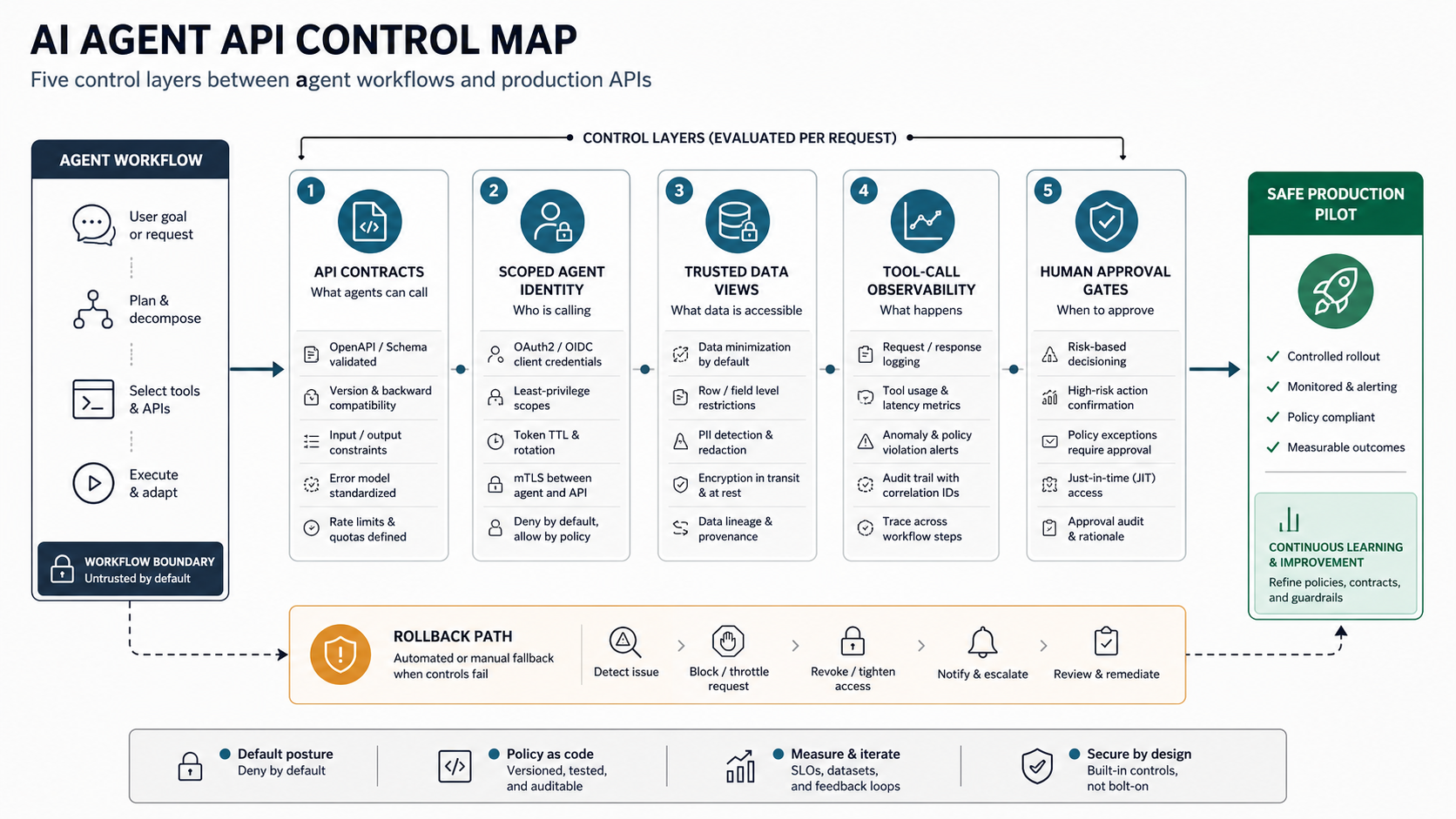
Use Scoped Agent Identity Instead Of Borrowed Access
An AI agent should not operate through a broad shared token or a human administrator account. It needs a dedicated identity with the smallest useful permission set. Security teams should know how that identity is provisioned, authenticated, rotated, reviewed, constrained, monitored, and deprovisioned.
Agent scopes should map to business actions. Reading a customer profile, generating a draft email, updating a CRM stage, creating a refund request, and sending a production notification are different permissions. Some can be autonomous. Others should require human approval, dual control, or a feature flag. If the platform only supports all-or-nothing access, build an integration layer before connecting the agent directly. For a deeper security review, use the AI agent identity governance checklist to define non-human identities, scoped access, audit logs, and incident response before production rollout.
For teams planning wider workflow automation, NextPage's AI automation services work usually starts by mapping identities, systems, approval steps, and exception paths before implementation.
Validate Data Quality, Freshness, And Consent
An agent can only make good API decisions when the underlying data is trustworthy enough for the workflow. Readiness checks should identify the system of record, data owner, freshness target, known gaps, field-level sensitivity, consent rules, retention requirements, and conflict-resolution logic. If the agent sees customer status from one system, contract terms from another, and payment risk from a third, the API layer should make conflicts explicit instead of hiding them.
Use retrieval limits and purpose-specific views. An agent that only needs order status should not receive full customer history, raw notes, payment data, or unrelated PII. If a workflow needs retrieval-augmented generation, define which documents are allowed, how chunks are filtered, how stale content is removed, and how the agent cites or records the source used for a decision.
The API readiness review should also capture edge cases. What happens when a required field is blank, a record is duplicated, a customer has multiple accounts, an entitlement expired yesterday, or a consent flag conflicts with a support request? These are not model problems. They are workflow and data-contract problems.
Instrument Tool Calls, Decisions, And Audit Trails
Observability is the difference between a promising demo and a controllable production agent. Teams should be able to trace the user request, prompt context, retrieved data, tool call, API response, policy check, guardrail result, eval status, model output, human approval, final action, and business outcome. Modern agent frameworks increasingly treat tracing and guardrails as production primitives, not optional debugging aids. Without that chain, incident review becomes guesswork.
At minimum, log the agent identity, workflow ID, user or account context, tool name, request metadata, response status, validation result, policy decision, latency, token or model cost, and final state. Sensitive values should be redacted or tokenized, but the event structure should remain useful for debugging and audit.
NextPage's AI agent observability checklist goes deeper on traces, eval gates, guardrails, and rollback. For API readiness, the key point is simple: every meaningful action needs evidence that a reviewer can understand later.
Design Human Approval Gates Before Expanding Autonomy
Human-in-the-loop controls should not be bolted on after a risky pilot. Define approval gates before the first production workflow. Decide which actions are always draft-only, which actions can execute under a confidence or risk threshold, which require manager approval, and which are prohibited until another system control exists.
Approval UX matters. If reviewers receive vague summaries, they will rubber-stamp or reject everything. A useful review item should show the proposed action, source evidence, affected record, policy checks, risk reason, confidence signals, and rollback path. The API should support a pending state so the agent can prepare work without committing it.
Good approval gates also create training data. Approved, edited, and rejected actions reveal where the workflow is ready for more autonomy and where the API, data, or policy layer still needs work.
Test With Sandboxes, Evals, And Failure Cases
Agent pilots fail when teams only test the happy path. API readiness requires a sandbox with realistic data, permission boundaries, seeded edge cases, and safe write endpoints, especially now that agentic testing failures increasingly center on boundary escape, tool misuse, and over-privileged execution rather than only answer quality. The eval set should include normal requests, ambiguous requests, malicious prompts, stale records, duplicate records, missing fields, slow endpoints, permission denials, and downstream system failures.
Test for behavior, not only response quality. Does the agent ask for clarification when needed? Does it stop when permission is missing? Does it avoid retry storms? Does it preserve idempotency? Does it create a draft instead of committing a risky action? Does it escalate when policy confidence is low? Does it keep audit evidence when the user abandons the flow? Does it fail closed when a tool server, policy check, retrieval source, or approval queue is unavailable?
Map the eval set to the risk profile of the workflow. A low-risk draft assistant may need accuracy, latency, and escalation checks. A workflow that can update accounts, approve exceptions, or notify customers needs adversarial prompt tests, authorization bypass tests, tool-output validation, rollback drills, and human review sampling. NIST AI RMF language is useful here: map the risk, measure behavior under realistic conditions, manage controls before rollout, and keep governance evidence current as the workflow changes.
If the agent coordinates several systems, review the architecture like an integration product. NextPage's AI integration platform development guide is a useful companion for workflows that need orchestration, retries, observability, and human escalation across SaaS, data, and internal tools.
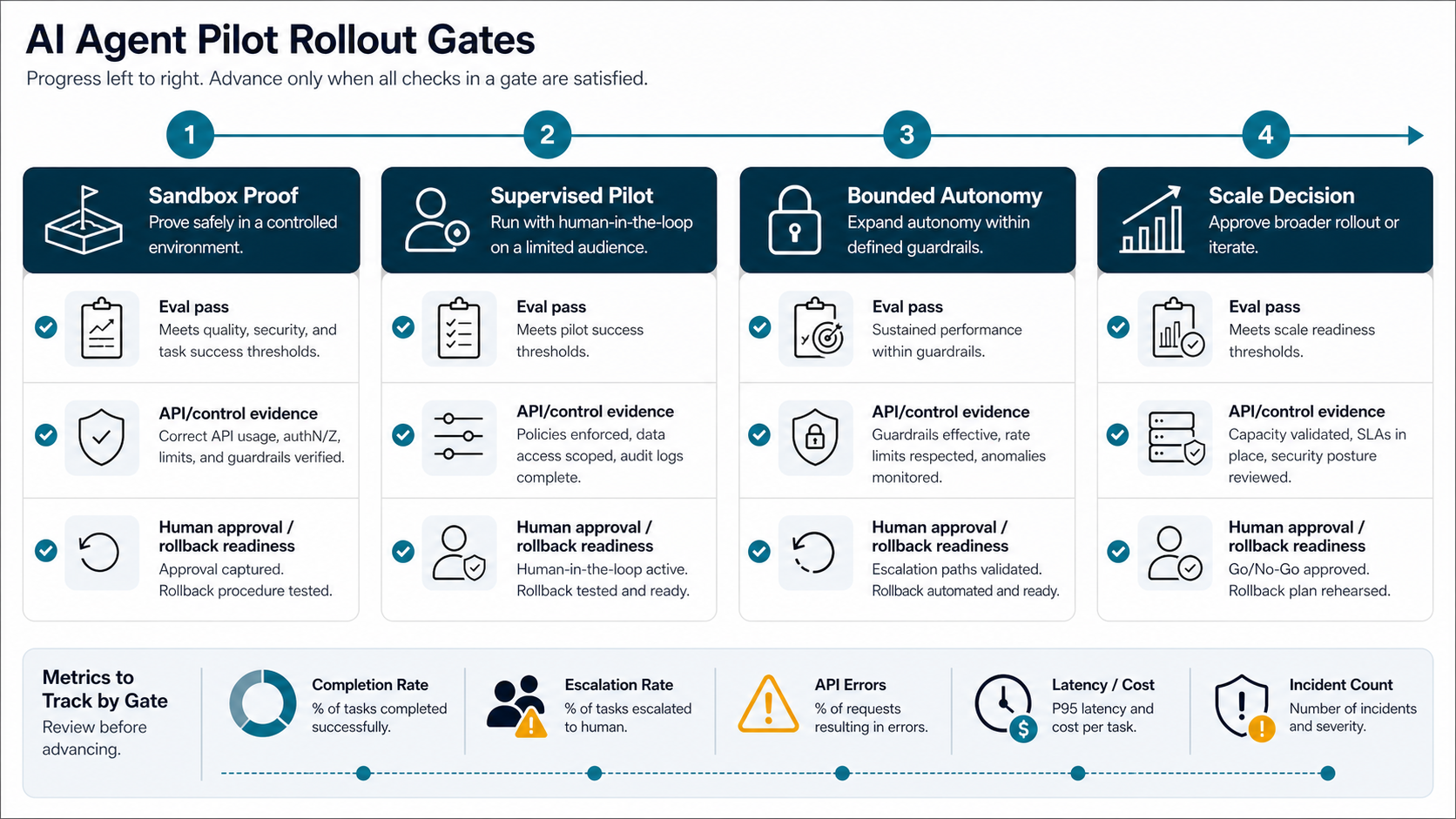
Pilot Rollout Checklist
- Choose one workflow with measurable business value and bounded action risk.
- Name the system of record, data owner, API owner, tool-server owner, security owner, and operations owner.
- Document every allowed read, draft, update, send, approve, and escalate action.
- Create scoped agent identities instead of using broad human tokens.
- Review tool protocol authorization, session boundaries, tenant routing, tool-list caching, and revocation behavior.
- Require idempotency, versioned contracts, meaningful error states, and duplicate protection for write actions.
- Define human approval thresholds before production testing.
- Instrument prompt context, retrieval, tool calls, policy checks, guardrail results, API responses, and final actions.
- Build eval sets from real workflow edge cases, not only synthetic happy paths.
- Set pilot metrics for completion rate, escalation rate, review edits, API errors, latency, cost, and incident count.
- Use feature flags, cohort limits, and rollback playbooks before expanding autonomy.
How NextPage Can Help
NextPage helps teams turn AI agent ideas into controlled workflow software. A practical engagement usually starts with a readiness review: workflow selection, API contract review, identity and permissions mapping, data quality checks, integration architecture, observability requirements, eval design, and rollout gates.
From there, our AI development services and API engineering team can build the agent integration layer, approval UX, monitoring events, and production workflow controls. If the API layer needs modernization first, our custom software development team can create the middleware, dashboards, and internal tools needed to make the workflow safe enough for automation.