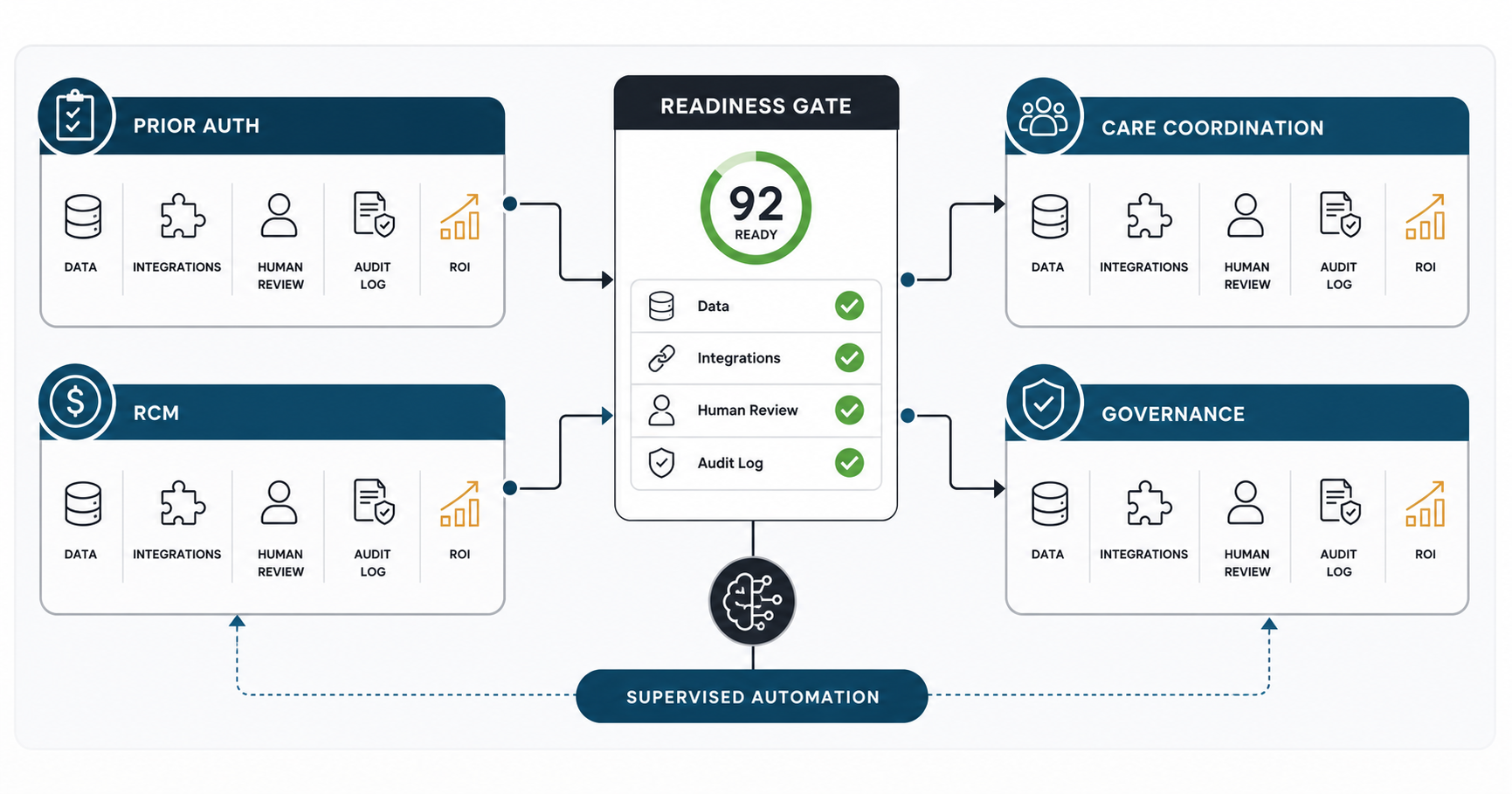

Quick Answer: What Makes A Healthcare AI Agent Workflow Ready?
A healthcare AI agent workflow is ready when the team can name the business owner, source systems, allowed actions, human-review points, audit trail, rollback path, and success metrics before the agent touches production data. Prior authorization, revenue cycle management, care coordination, and governance can all benefit from agents, but each workflow needs a different autonomy boundary.
The practical test is not "can an LLM answer this?" The better test is "can the agent safely read the right data, take a limited action, explain why, escalate exceptions, and prove what happened afterward?" If the answer is unclear, start with a copilot or shadow-mode workflow before allowing write-back into an EHR, RCM platform, payer portal, CRM, or patient communication channel.
This guide is for healthcare operators, healthtech founders, CIOs, RCM leaders, and care coordination teams deciding which AI-agent workflows are ready now, which need data cleanup, and which should stay human-led. A focused AI Agent Readiness Assessment can turn this checklist into a scoped pilot backlog.
Why Readiness Matters Now
Agentic AI has moved from demo decks into serious healthcare planning. Snowflake frames the executive question around which workflows fit agentic AI, how impact will be measured, how sensitive data is governed, and how model performance is monitored. HHS has also emphasized practical, measurable impact for AI across healthcare, while ONC's HTI-1 rule makes algorithm transparency a live concern for certified health IT and clinical decision-support environments.
That combination changes the implementation bar. Healthcare leaders are no longer just asking whether agents can summarize notes or answer patient questions. They are asking whether agents can operate across messy workflows where payer rules change, EHR data is incomplete, PHI access must be minimized, and a wrong action can affect care access, reimbursement, staff trust, or regulatory exposure.
Recent healthcare-agent research reinforces that caution. The CHI-Bench study found realistic prior authorization, utilization management, and care management tasks require policy-dense reasoning, multi-role handoffs, and multi-turn interactions; its best tested agent resolved only a minority of tasks. Treat that as a readiness signal: begin with scoped, supervised workflows and prove reliability before expanding autonomy.
The strongest readiness work happens before vendor selection. Teams should identify where the agent can remove manual search, classification, drafting, queue management, and follow-up while keeping humans in control of clinical judgment, payment decisions, entitlement decisions, and sensitive patient communication.
Healthcare AI Agent Readiness Scorecard
Use a scorecard before choosing a model, platform, or build partner. A high-pain workflow is not automatically a good first pilot. It must also have reliable data, clear policies, measurable outcomes, and a review pattern that staff will actually use.
| Readiness Dimension | Ready Signal | Delay Signal | Owner To Involve |
|---|---|---|---|
| Workflow Volume | Repeated daily, visible backlog, measurable cycle time | Rare exceptions with no baseline | Operations lead |
| Data Access | Structured fields, document sources, APIs, known system owners | Manual screenshots, shared logins, missing or conflicting records | IT and data owner |
| Rules And Policies | Documented payer, care, billing, or routing rules | Rules live in senior staff judgment only | Workflow SME |
| Autonomy Boundary | Agent can draft, classify, retrieve, route, or recommend | Agent would make irreversible clinical, financial, or access decisions | Compliance and operations |
| Human Review | Named reviewer, exception queue, approval UI, override reasons | No one owns corrections after launch | Team manager |
| Auditability | Inputs, retrieved sources, action, reviewer, and outcome are logged | No trace from recommendation to action | Security and compliance |
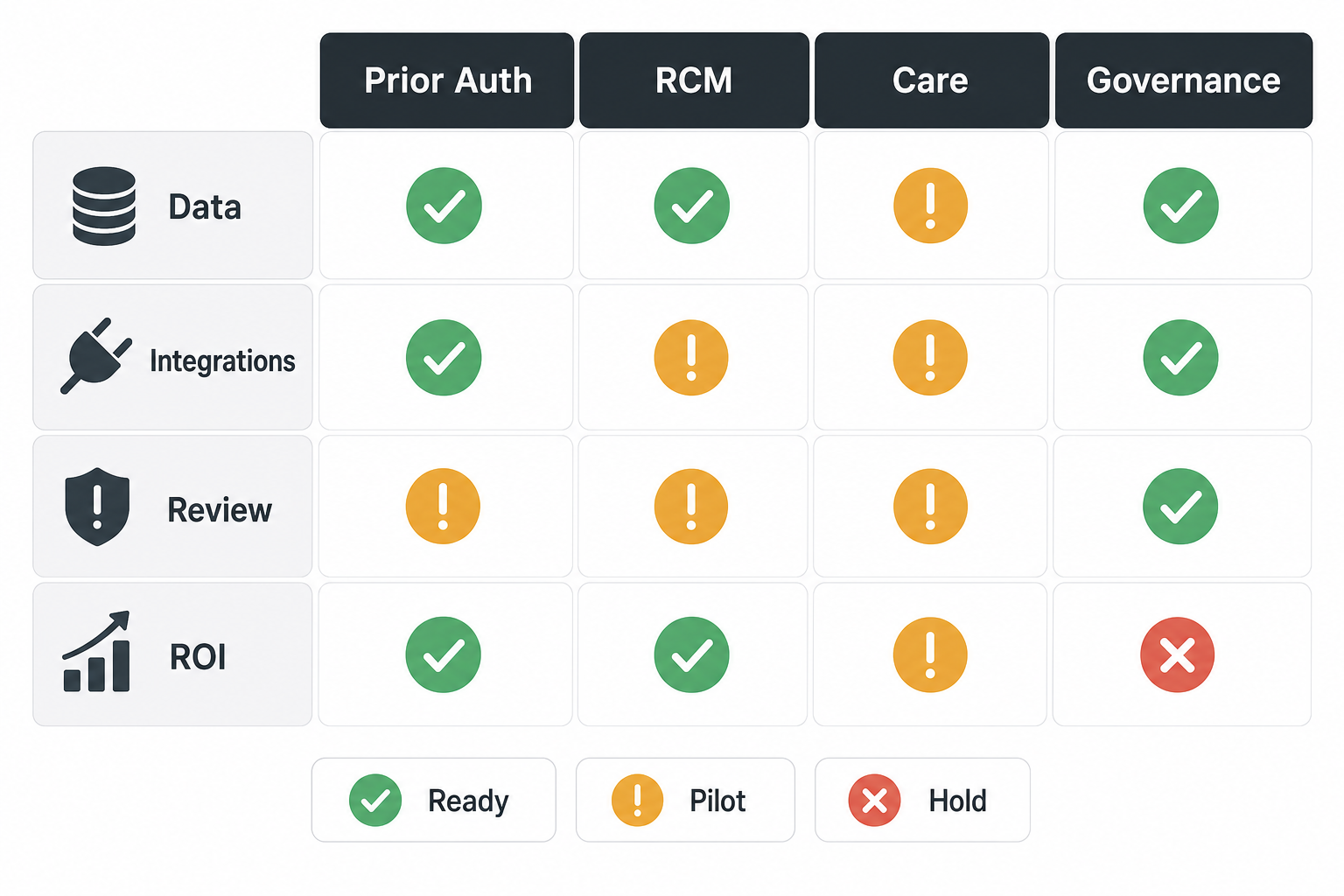
Workflow Fit Matrix: Prior Auth, RCM, Care Coordination, Governance
The best first agent is usually not the flashiest one. It is the workflow where the agent can operate inside a tight loop, with enough volume to prove ROI and enough oversight to reduce risk.
| Workflow | Good First Agent Tasks | Keep Human Approval For | Primary Readiness Question |
|---|---|---|---|
| Prior Authorization | Policy lookup, documentation checklist, evidence matching, missing-info requests, draft packets | Final submission, clinical justification, denial appeal strategy | Can the agent trace each requested document to a payer rule and patient record? |
| Revenue Cycle | Claim status checks, denial queue prioritization, underpayment flags, patient billing summaries, call-note drafts | Balance changes, write-offs, appeal decisions, patient financial commitments | Can the agent reduce touches without creating downstream rework? |
| Care Coordination | Care-gap reminders, referral follow-up, task routing, handoff summaries, visit-prep checklists | Clinical prioritization, escalation of urgent symptoms, changes to care plans | Can the agent identify when a coordination issue becomes clinical risk? |
| Governance | Policy checks, access review, incident triage, audit evidence collection, model monitoring summaries | Risk acceptance, policy exceptions, regulatory reporting | Can the organization prove who approved what and why? |
Cedar's 2026 RCM analysis points to coding, denials, call centers, prior authorization, and patient billing as the operational areas where AI is already reshaping revenue workflows. The lesson for builders is not to automate everything at once. The opportunity is to orchestrate multi-step work and route humans into the moments where judgment matters.
Prior Authorization Readiness
Prior authorization is attractive because the workflow is painful, document-heavy, and full of repetitive checks. It is also risky because payer rules, clinical evidence, patient access, and staff accountability intersect. A readiness review should start with the exact service lines, payers, CPT or procedure families, documentation sources, and escalation categories in scope.
A strong first pilot might let the agent read an order, retrieve payer policy, map required evidence, identify missing chart notes, draft a staff checklist, and assemble a packet for review. It should not silently submit, change clinical rationale, or message patients about coverage without approval. For teams that need help designing the surrounding product experience and integration layer, NextPage's AI development services work covers retrieval, tool orchestration, evaluation, and production controls.
Revenue Cycle Readiness
RCM workflows are often better early candidates than clinical workflows because the inputs and outcomes are easier to measure. Teams can track claim touches, denial rate, days in A/R, appeal completion, underpayment recovery, call handle time, and patient billing resolution. That makes shadow mode valuable: compare agent recommendations against staff decisions before enabling write-back.
The readiness blocker is usually not the model. It is fragmented access across practice-management systems, clearinghouses, payer portals, call notes, EOBs, and internal work queues. Before building, list every system the agent must read, every action it may write, and every exception that must return to staff.
Care Coordination Readiness
Care coordination agents need a stricter boundary because administrative follow-up can quickly become clinical risk. A safe first version can summarize open tasks, remind staff about care gaps, route referrals, prepare handoff summaries, and flag missing documents. It should escalate urgent symptoms, conflicting patient details, sensitive social needs, and anything that changes a care plan.
The existing NextPage article on healthcare AI agent development workflows is a useful companion for mapping patient intake, triage, scheduling, documentation, and RCM. This readiness guide should be used one step earlier: deciding whether each workflow is prepared for an agent at all.
Governance Readiness
IBM's healthcare and life sciences guidance emphasizes trust, fairness, transparency, explainability, data privacy, accountability, governance, human-in-the-loop oversight, audit trails, and open decision logs. Innovaccer's healthcare enterprise evaluation guide similarly stresses regulatory compliance, observability, pilots, human checkpoints, rollback procedures, and risk audits.
Governance should be built into the workflow, not appended after launch. Each agent needs least-privilege access, source attribution, PHI handling rules, retention rules, review queues, cost monitoring, model/version history, evaluation sets, incident categories, and rollback instructions. ONC's algorithm-transparency direction is a reminder that healthcare AI buyers increasingly need evidence about fairness, appropriateness, validity, effectiveness, and safety, not just accuracy claims.
Data And Integration Checklist
- List the system of record for every input and output.
- Confirm whether the agent reads structured fields, documents, transcripts, API responses, or staff notes.
- If the agent depends on clinical or operational records, align the data plan with an EHR integration roadmap before adding write-back permissions.
- Separate read-only actions, draft actions, reversible write-backs, and high-risk write-backs.
- Map role-based access before connecting tools.
- Create a representative test set with normal cases, edge cases, missing data, payer exceptions, urgent clinical language, and patient confusion.
- Define source freshness rules for payer policies, clinical protocols, billing rules, and knowledge-base content.
- Log the retrieved source, prompt/tool version, model output, human decision, final action, and outcome.
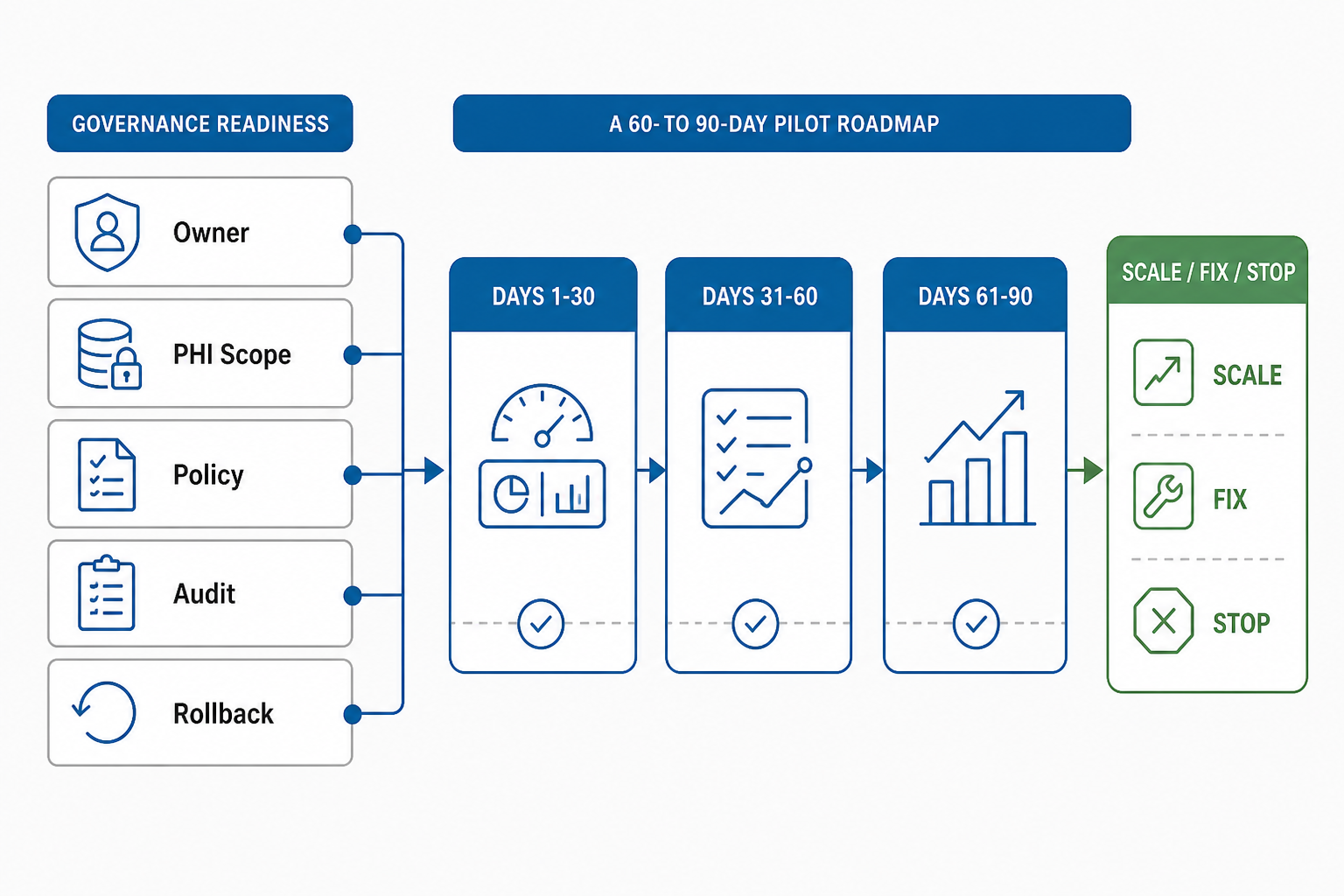
A 60- To 90-Day Pilot Roadmap
| Phase | Timeline | Output | Exit Gate |
|---|---|---|---|
| Workflow Discovery | Weeks 1-2 | Workflow map, source systems, policies, risk register, KPI baseline | Owner, value, data, and review path are confirmed |
| Agent Prototype | Weeks 3-5 | Read-only or draft-only agent, retrieval sources, approval UI, evaluation set | Representative cases produce reviewable output |
| Shadow Mode | Weeks 6-7 | Agent recommendations compared with staff decisions | Error categories and fixes are understood |
| Controlled Pilot | Weeks 8-11 | Limited users, monitored workflow, human approval, audit trail | KPI lift and safety guardrails pass |
| Scale Decision | Week 12 | ROI summary, rollout plan, governance review backed by the AI Automation ROI Calculator | Scale, narrow, harden, or stop |
Build Vs Buy Readiness
Buy when the workflow is standardized, the vendor has mature healthcare integrations, the compliance paperwork is clear, and the team can accept the product's opinionated workflow. Build or customize when the workflow is differentiated, crosses unusual systems, needs proprietary patient or staff experience, or depends on custom rules and reporting.
Many healthcare teams land in the middle. They buy a vertical capability for a commodity step, then use custom orchestration for intake, routing, approval, analytics, and exception handling. NextPage's agentic AI development services can help connect those steps into a measured operating workflow instead of another isolated AI tool.
What To Bring To A Readiness Workshop
A useful readiness workshop needs more than a topic. Bring one target workflow, sample cases, current cycle time, top failure modes, system screenshots or API notes, policy documents, user roles, escalation examples, reporting needs, and a decision maker. If you are still selecting a partner, pair the workshop with a healthcare software development company checklist so compliance, integration, AI, and support questions are covered before procurement. The output should be a build-now, prepare-next, or hold recommendation with a pilot scope and acceptance criteria. Teams that need a first estimate can pressure-test scope with the Custom Software Cost Estimator before committing budget.
For product teams that need to modernize the surrounding systems first, a custom software development track may be the right first step. Agents fail when the workflow around them is too brittle, manual, or undocumented.