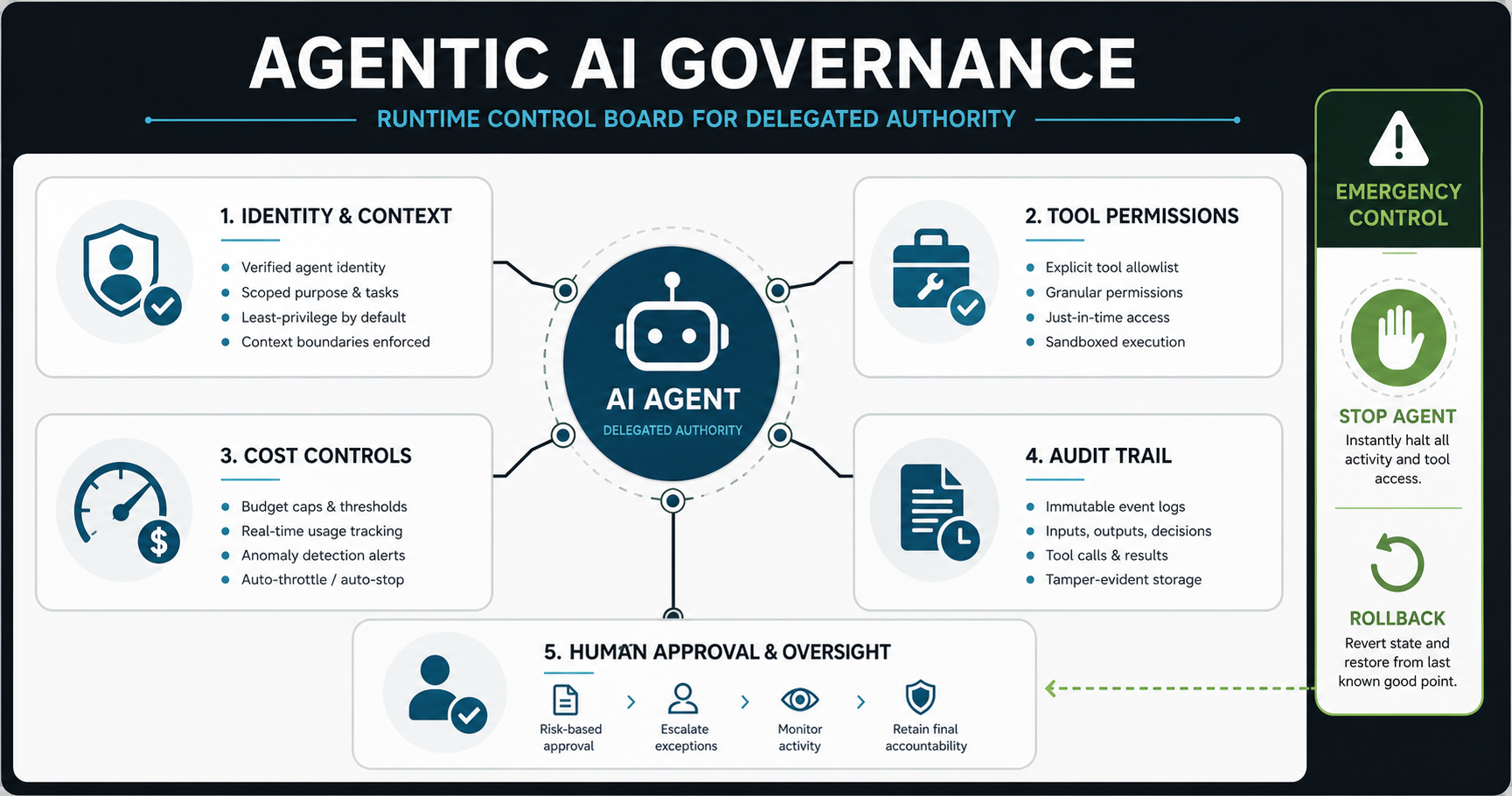

Quick Answer: What Should An Agentic AI Governance Checklist Cover?
An agentic AI governance checklist should prove who owns each agent, what data it can access, which tools it can invoke, what actions need human approval, how cost is capped, how every action is logged, and how teams pause or roll back unsafe behavior. Traditional AI governance asks whether a model is accurate. Agentic AI governance also asks whether the agent is authorized to act right now.
The fastest way to reduce risk is to treat every production agent as delegated authority. Give it a named identity, least-privilege permissions, runtime policy checks, spend limits, audit trails, monitoring, and a clear human escalation path. If a team cannot show these controls, the agent should stay in read-only or shadow mode.
This checklist is for CIOs, CTOs, AI program owners, security leaders, and operations teams moving agent pilots into production. For a broader build plan, pair it with NextPage's agentic AI development services, AI automation services, and the AI Agent Readiness Assessment.
Why Agentic Governance Is Different
Agentic AI systems can plan, call tools, retrieve data, update records, trigger workflows, and coordinate across systems. That makes governance more operational than model governance alone. Gartner's 2026 Hype Cycle for Agentic AI frames the market as fast-moving and uneven in maturity, with leaders needing to assess readiness, governance, security, and cost considerations before adoption timing.
Several current governance guides converge on the same point: the core risk is delegated authority. Box and Palo Alto Networks describe agentic governance as defining what agents can access, which tools they can invoke, which actions they can take, and how those boundaries are continuously verified. DataRobot makes the same distinction: autonomous agents are not constrained like basic automations, so governance must manage autonomy, access, and risk.
The practical implication is that agent governance cannot live only in a policy PDF. It needs a runtime control layer that evaluates proposed actions before dispatch, applies deterministic decisions, records audit evidence, and gives business owners a way to pause or roll back the workflow. That is also why teams should connect governance work to an AI agent implementation roadmap instead of treating it as a one-time security review.
Map Current Guidance To Runtime Controls
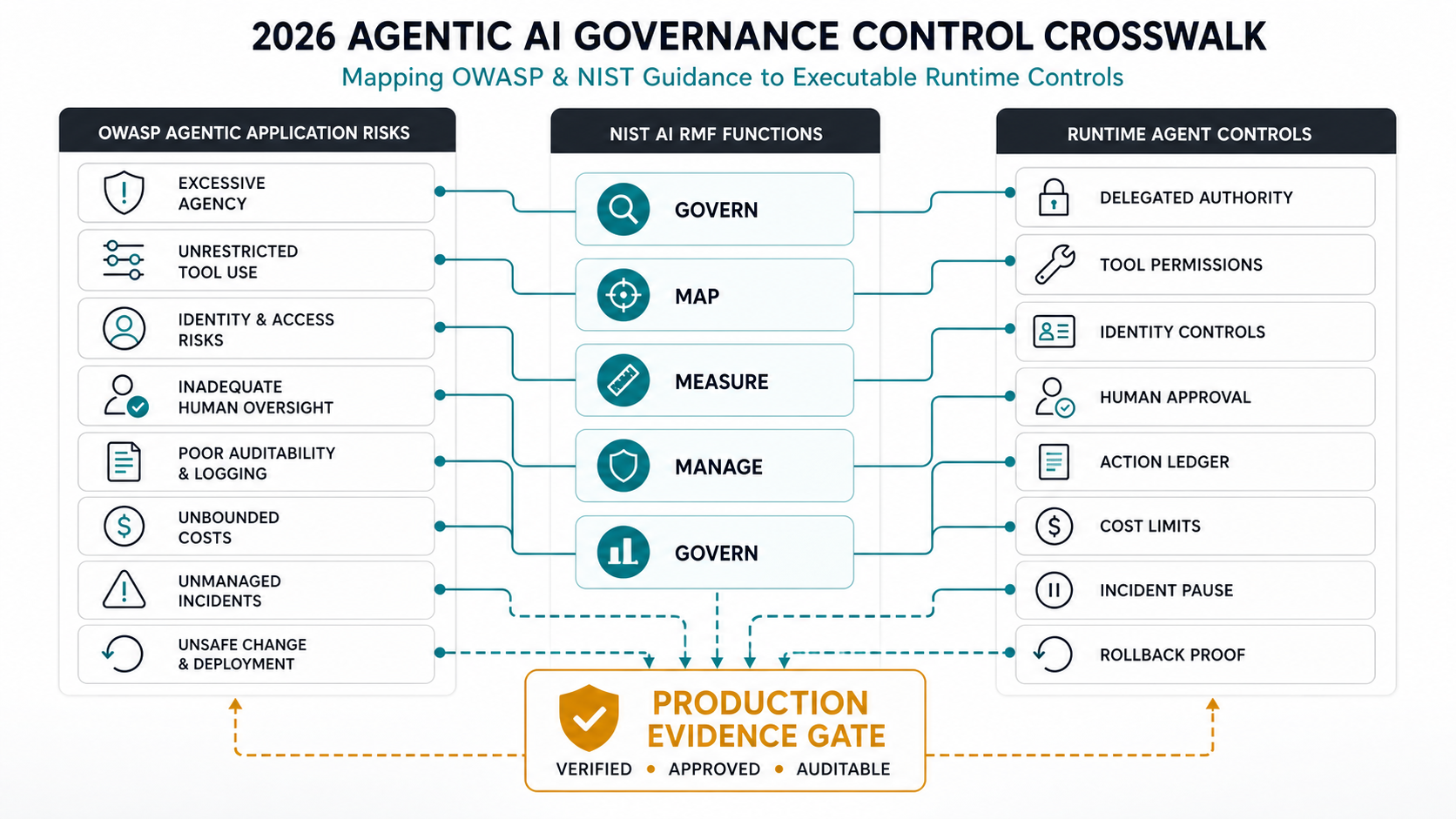
2026 agentic AI governance work should translate standards language into controls that run before and during tool execution. NIST AI RMF gives teams the operating functions: govern, map, measure, and manage. NIST's Generative AI Profile adds risk categories for LLM systems. OWASP's agentic application guidance adds the agent-specific threat model: excessive agency, unrestricted tool use, identity and access risk, weak human oversight, poor auditability, unbounded costs, unmanaged incidents, and unsafe change.
The practical move is to turn those frameworks into a production evidence gate. Before an agent can move from draft mode to controlled write-back, the team should prove scoped identity, tool permissions, data boundaries, approval gates, action ledgers, cost limits, incident pause, and rollback evidence. This is where the governance article connects directly to the AI Agent API Readiness Checklist, the AI Agent Identity Governance Checklist, and the Secure AI Agent Development Checklist.
The Agentic AI Governance Checklist
| Control Area | Pass Criteria | Evidence To Keep |
|---|---|---|
| Ownership | Every agent has business, technical, and risk owners | Owner registry, approval record, support path |
| Identity | Agent uses scoped credentials, not shared human accounts | Identity record, access scope, rotation policy |
| Data Access | Agent reads only sources needed for the workflow | Data map, purpose, retention, sensitive-data notes |
| Tool Permissions | Tool calls are separated by read, draft, reversible write, and high-impact write | Tool inventory, permission matrix, approval gates |
| Human Oversight | High-risk actions require review before execution | Review queue, override reasons, escalation rules |
| Audit Trails | Inputs, retrieved context, tool calls, reviewer, and final action are traceable | Logs, evidence IDs, incident snapshots |
| Cost Controls | Token, tool, workflow, and cloud usage have budgets and alerts | Budget thresholds, usage dashboard, anomaly alerts |
| Incident Response | Teams can pause, roll back, investigate, and notify owners | Runbook, rollback test, incident categories |
Add A Pre-Dispatch Action Decision Model
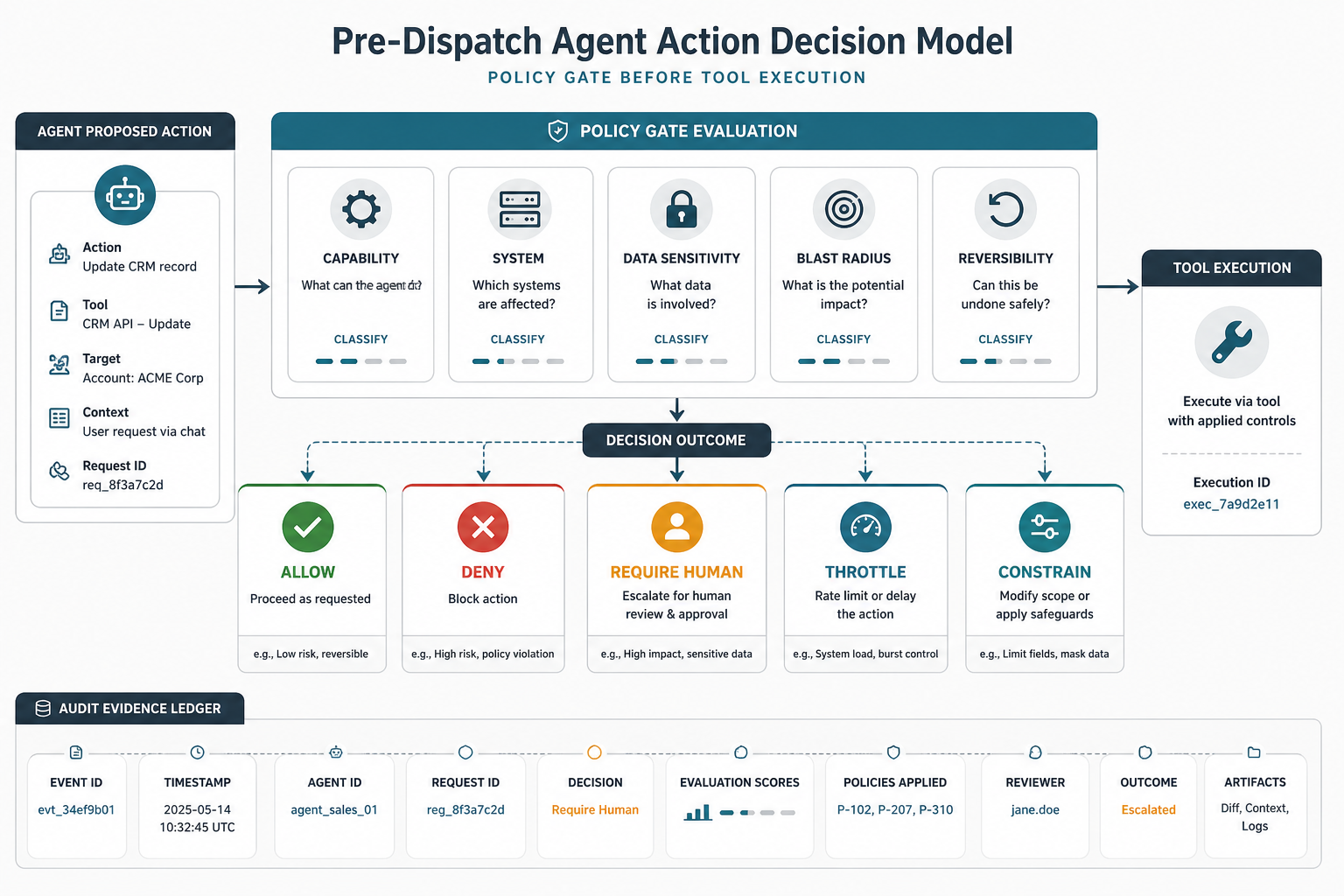
The checklist becomes enforceable when every proposed agent action passes through the same decision vocabulary before tool execution. Classify the action by capability, target system, data sensitivity, blast radius, reversibility, and policy version. Then return one of five outcomes: allow, deny, require human approval, throttle, or constrain the action.
This model keeps high-risk actions out of silent autonomy while still letting low-risk, reversible work move quickly. It also creates consistent evidence for security, compliance, and operations reviews because denials, throttles, approvals, and constrained actions are logged with the same structure as successful tool calls.
Ownership And Agent Inventory
You cannot govern agents you cannot name. Start with an inventory that lists the agent purpose, owner, user group, data sources, tools, permissions, model/provider, environment, business process, risk tier, and review cadence. The inventory should include sanctioned agents, vendor-native agents, internal copilots, automation scripts with LLM calls, and experimental agents that touch production data.
This is where the existing Shadow AI Governance Checklist is a useful companion. Shadow AI focuses on unsanctioned tool use; agentic governance focuses on delegated runtime authority. Teams need both views before scaling.
Identity, Access, And Tool Permissions
Do not reuse human credentials for agents. Each production agent should have a governed identity, scoped credentials, least-privilege data access, and explicit tool permissions. Read-only access, draft creation, reversible updates, and high-impact actions should be separate permission classes. For deeper implementation detail, use the AI agent identity governance checklist to separate non-human identities, secrets, audit logs, and revocation paths.
The permission matrix should answer five questions: what can the agent read, what can it infer, what can it draft, what can it execute, and when must it stop for human approval? Administrative, financial, customer-impacting, security, legal, or data-deletion actions should require stronger review and rollback controls.
Cost And FinOps Controls
Agentic AI cost can spike because agents call models repeatedly, use tools, retry steps, search documents, and coordinate multi-step workflows. Governance should include usage budgets, per-workflow cost ceilings, tool-call limits, latency thresholds, and alerts for abnormal behavior.
Cost control is not only a finance concern. If a runaway agent loops through APIs, generates unnecessary tickets, or calls expensive tools repeatedly, it creates operational and security risk. Put cost telemetry next to quality and safety telemetry so owners can see value and risk together. For token, tool, review, and cloud guardrails, pair this section with the Agentic AI FinOps cost controls guide. When the workflow has measurable time savings, validate assumptions with an AI automation ROI calculator and compare benefits against monitoring, review, and support costs.
Auditability And Observability
An audit trail should show the request, user, agent version, retrieved sources, policy checks, tool calls, outputs, reviewer decisions, final action, and downstream result. MiniOrange and other audit-trail guides describe this traceability as a missing link between experimentation and large-scale enterprise adoption.
Observability should cover more than uptime. Track task success, correction rate, unsafe attempt rate, policy denials, escalation rate, cost per completed workflow, latency, user adoption, and drift in tool usage. Microsoft also emphasizes visibility into agent activity, access patterns, policy compliance, and emerging control gaps as adoption scales. For workflow-level measurement, use the same baseline logic described in the AI workflow automation ROI guide: baseline effort, automated effort, exception rate, and support cost must be visible together.
Human Oversight And Approval Gates
Human oversight needs product design, not a sentence in a policy document. The reviewer should see the input, evidence, proposed action, confidence or risk signal, policy reason, and one-click options to approve, edit, reject, escalate, or pause the agent.
Start with approval gates for all high-impact actions. Move only low-risk, reversible actions toward autonomy after shadow-mode evidence proves the agent is consistent and users trust the workflow. Keep approval thresholds adjustable by workflow, role, customer segment, jurisdiction, and risk tier.
Runtime Monitoring And Incident Response
Governance must hold while the agent is running. Runtime controls should block unauthorized tool calls, detect prompt injection or context poisoning, watch for abnormal cost or activity, and escalate unusual behavior. A good incident runbook defines who can pause the agent, how to revoke credentials, how to inspect logs, how to notify stakeholders, and how to roll back actions.
Security leaders should also test recovery. Run tabletop exercises for a data-access error, incorrect customer action, cost spike, compromised tool credential, hallucinated policy instruction, and reviewer bypass. The secure AI agent development checklist is a useful companion when these exercises expose missing threat modeling, tool sandboxing, or audit controls. If the team cannot rehearse the failure, the agent is not production-ready.
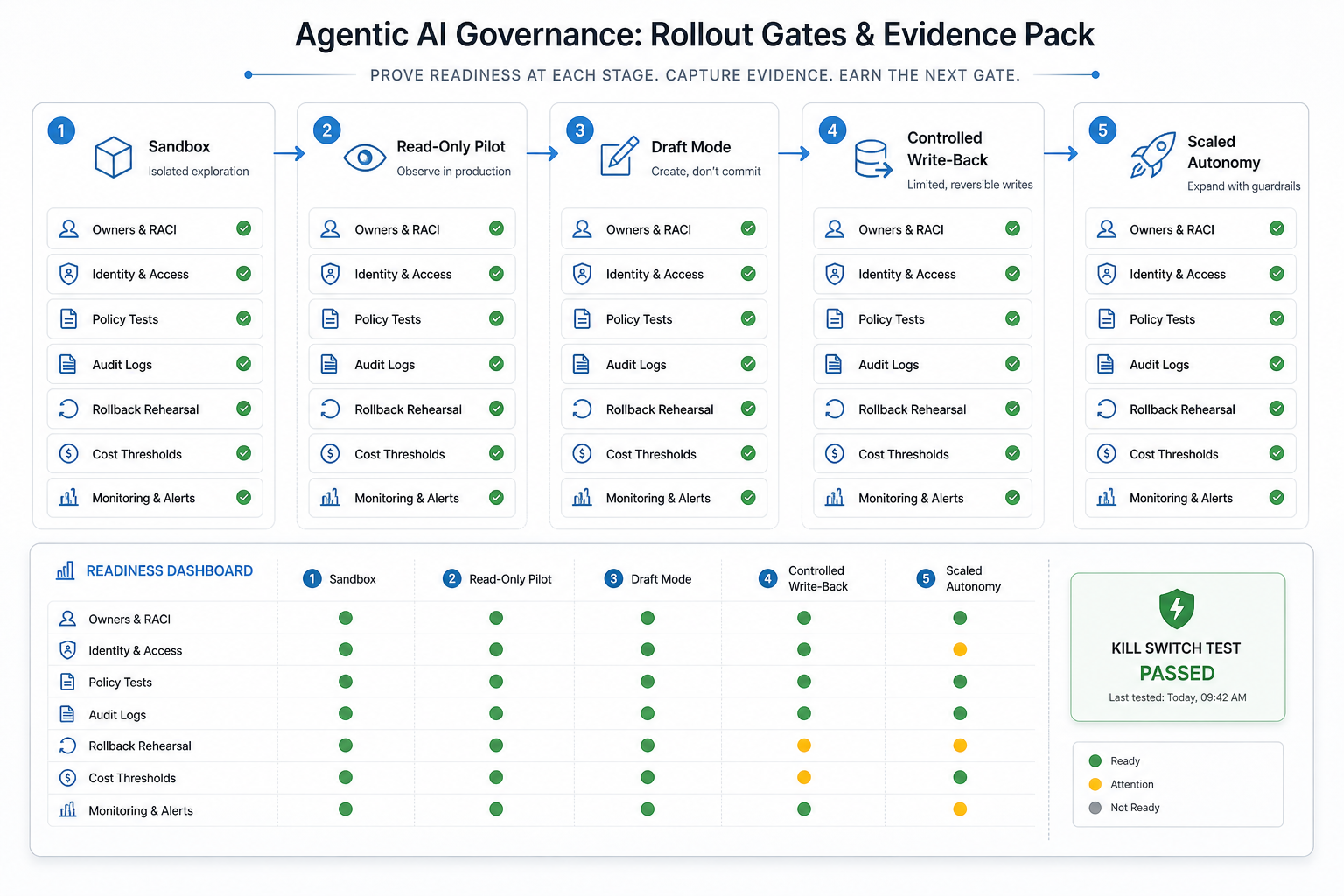
Production Rollout Gates
| Stage | Allowed Behavior | Gate To Advance |
|---|---|---|
| Sandbox | Test data only | Evaluation set and risk review complete |
| Read-Only Pilot | Retrieve, summarize, classify | Outputs are useful and traceable |
| Draft Mode | Prepare actions for human review | Correction and escalation rates are acceptable |
| Controlled Write-Back | Execute reversible low-risk actions | Rollback and monitoring are proven |
| Scaled Autonomy | Limited autonomous actions by policy | Governance, cost, safety, and support capacity hold at volume |
The First 30 Days Of Agentic AI Governance
A practical first month should produce evidence, not just policy drafts. In week one, inventory agents and workflows, assign business and technical owners, classify data access, and identify which actions are read-only, draft-only, reversible, or high impact. In week two, implement scoped identities, tool allowlists, secrets controls, and human-review queues for actions that affect customers, money, compliance, security, or production data.
In week three, add audit logs, cost thresholds, anomaly alerts, and a tested pause path. In week four, rehearse rollback, credential revocation, evidence preservation, and owner notification. If any of those controls are missing, keep the agent in shadow, read-only, or draft mode. Teams building broader AI workflow automation should make these gates part of the product roadmap, not a separate afterthought.
How NextPage Helps
NextPage helps teams design governed AI agents with workflow scope, data access, tool orchestration, review UX, observability, and production support. We can help convert a broad agent idea into a risk-ranked backlog, build a pilot, add policy gates, and measure whether the workflow deserves more autonomy. If the work also needs custom integrations, dashboards, or model-backed decision flows, our AI development services team can connect agent controls to the surrounding product architecture.
The right next step is a readiness review. Bring one target workflow, systems, permissions, sample cases, current cost baseline, risk concerns, and business owner. The output should be a build-ready governance plan with acceptance criteria, monitoring needs, and a clear decision on whether to launch, harden, or hold.