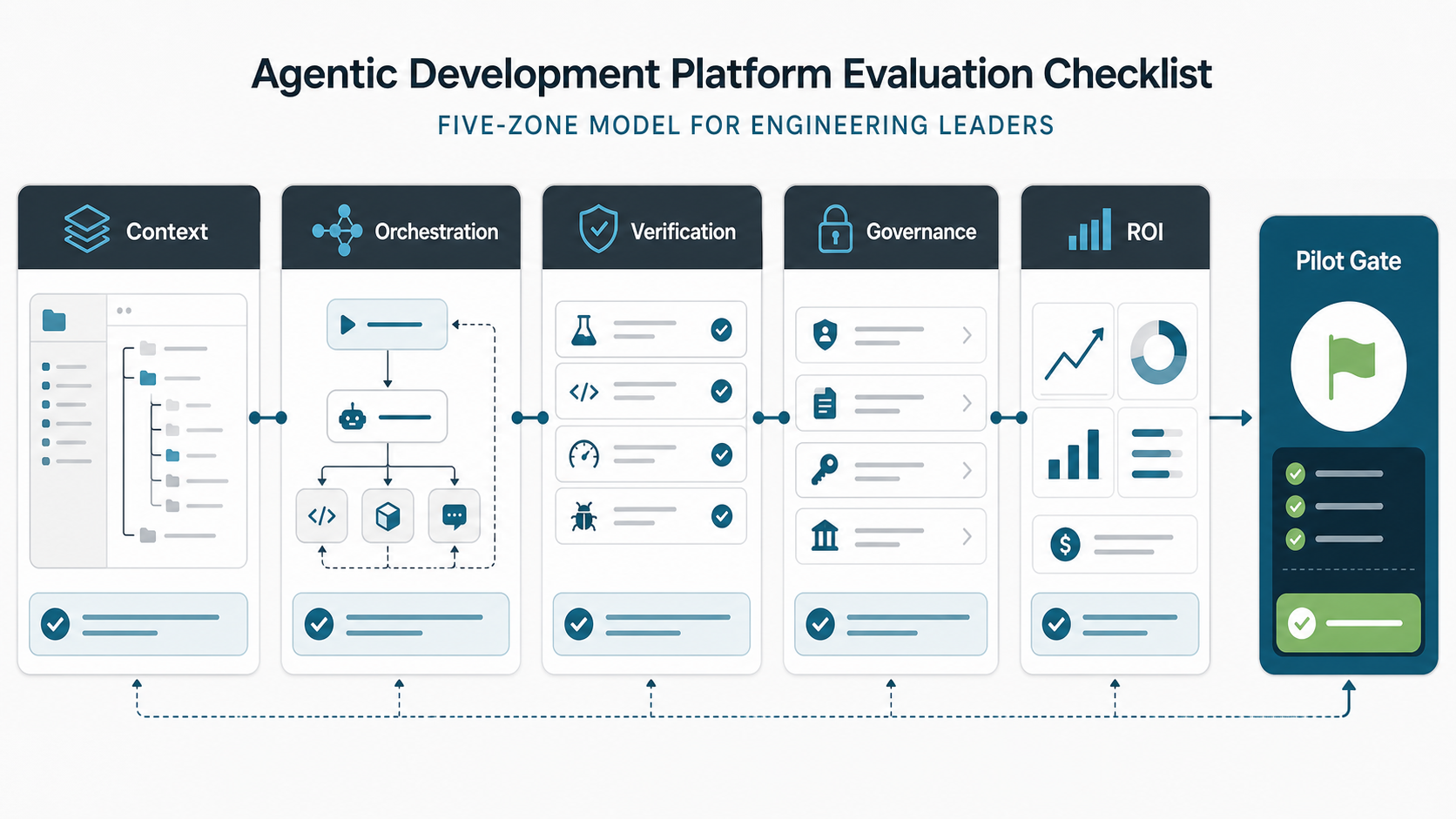

Quick answer: an agentic development platform is worth piloting only when it improves delivery throughput without weakening engineering control. Evaluate it as an SDLC operating layer, not as a smarter autocomplete tool. The shortlist should prove repository context, multi-step orchestration, code review evidence, test generation, security controls, model flexibility, integration depth, audit trails, cost visibility, and a practical rollout path for your teams.
This checklist is for CTOs, VPs Engineering, platform teams, and software product leaders comparing agentic development platforms after the market shifted from individual AI coding assistants to enterprise SDLC systems. Forrester's Q3 2026 agentic development platform landscape describes a fast-expanding category that goes beyond code generation into code understanding, modernization, pull-request review, unit test generation, and wider SDLC orchestration. That is the right framing: the buying decision is no longer "which tool writes code fastest?" It is "which platform can safely participate in how our software gets planned, built, verified, and released?"
As of August 2026, this evaluation needs to cover both IDE-native agents and cloud agents. GitHub describes Copilot's cloud agent as a system that can research a repository, plan changes, work on a branch, and support pull-request review. OpenAI describes Codex as available across IDE, CLI, web, mobile, CI/CD, and SDK surfaces for agentic software engineering. Cursor's enterprise material also emphasizes team-wide AI coding workflows. Treat those examples as category signals: the platform decision is now about controlled work execution, not only developer autocomplete.
If you need a starting readiness screen before vendor demos, run the AI Agent Readiness Assessment or benchmark the business case with the AI Automation ROI Calculator. It helps identify which workflows have enough clarity, data access, and human-review controls for an agentic pilot.
What Makes An Agentic Development Platform Different?
A coding assistant helps a developer inside an editor. An agentic development platform coordinates work across more of the software development lifecycle: issue interpretation, repository search, implementation planning, code generation, test scaffolding, code explanation, pull-request review, documentation updates, and sometimes deployment or remediation steps. The important difference is not autonomy for its own sake. It is orchestration under policy.
That means the platform must understand enterprise context. It should respect architecture decisions, coding standards, data boundaries, backlog priorities, CI/CD rules, security gates, and review ownership. Without that shared context, teams get local productivity spikes but create downstream review queues, brittle code, and unclear accountability.
Use this mental model during demos: a useful platform turns engineering intent into a bounded, reviewable change set. A weak platform turns prompts into unowned diffs.
The Evaluation Scorecard
Score each platform from 1 to 5 across the criteria below. Do not let a beautiful demo compensate for missing controls. Agentic systems can produce more work than teams can review, so the scorecard must measure verification capacity as much as generation quality.
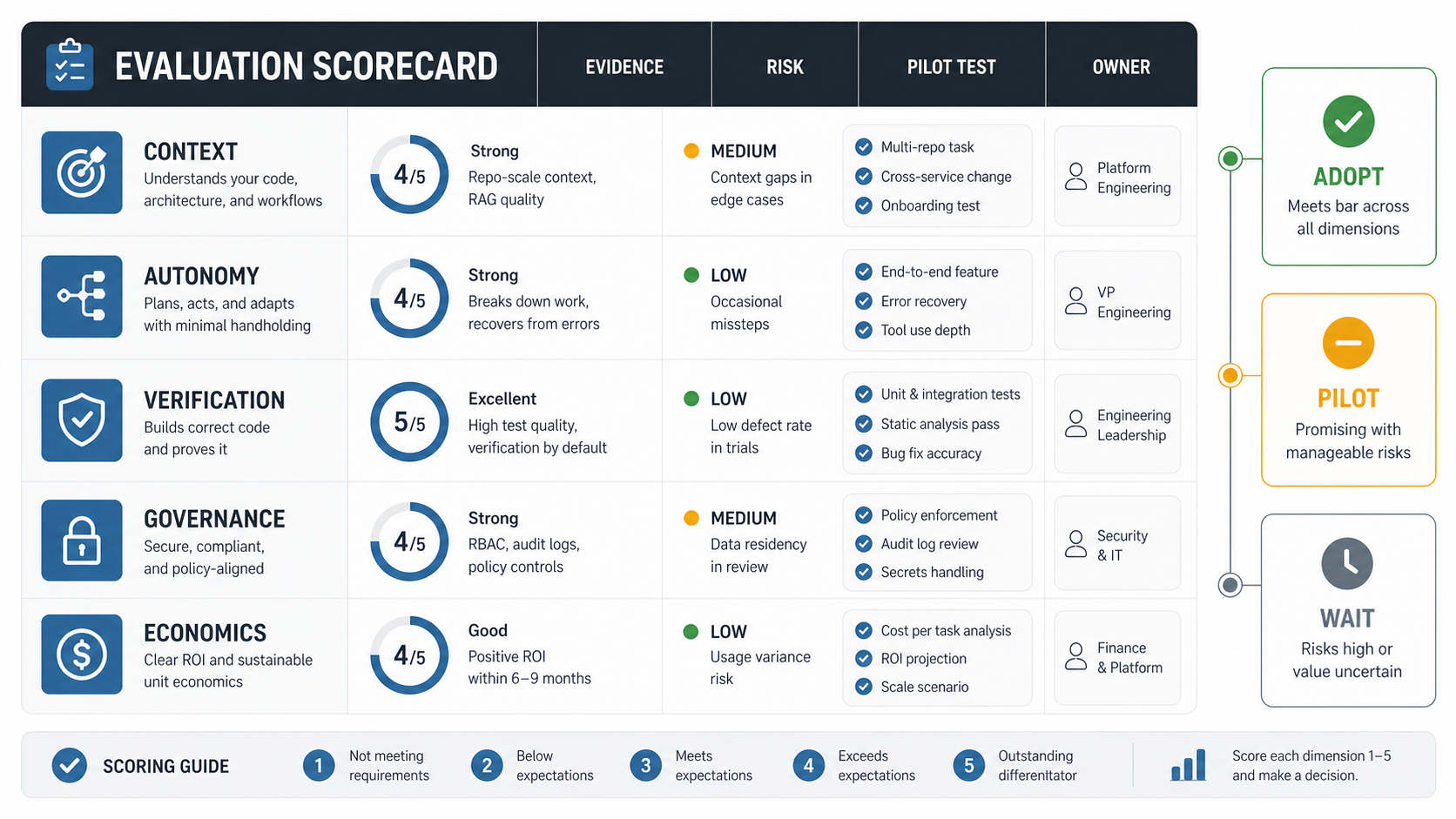
| Criterion | What To Test | Strong Evidence |
|---|---|---|
| Repository Context | Can the platform understand monorepos, services, design docs, tests, and dependency boundaries? | It cites files, respects architecture constraints, and avoids unrelated rewrites. |
| SDLC Orchestration | Can it move from issue to plan, diff, tests, review notes, and docs without losing traceability? | Every action has a visible plan, state, owner, and rollback path. |
| Verification | Can it run deterministic tests, static checks, security scans, and acceptance criteria? | It produces reproducible evidence, not just confident explanations. |
| Governance | Can admins set permissions, data boundaries, approval gates, and audit logs? | Policies are enforceable by repo, role, workflow, and environment. |
| Economics | Can leaders see usage, token/model spend, time saved, review load, and defect impact? | Cost and productivity reporting maps to teams and workflows. |
Start With Workflows, Not Vendors
Before comparing vendors, choose three pilot workflows. Good candidates are frequent, well-scoped, and easy to verify. Examples include test generation for legacy modules, small bug fixes with strong reproduction steps, API client updates after contract changes, documentation refreshes after code changes, and dependency upgrade pull requests with automated checks.
Avoid starting with architecture redesign, ambiguous product discovery, high-risk security changes, payment flows, compliance-heavy data migrations, or production incident remediation. Those workflows may benefit from agents later, but they need stronger guardrails and more organizational maturity.
For custom product teams, this is where custom software development governance matters. Agentic platforms should fit the way your team scopes, reviews, tests, and releases software rather than forcing every workflow into the vendor's preferred demo path.
Test Context Quality Before Code Quality
Code quality depends on context quality. During vendor trials, give the platform a realistic task with incomplete but normal enterprise context: a ticket, a related design note, a few relevant files, existing tests, and one known constraint. Watch how it asks for missing information, narrows scope, and chooses files.
A strong agentic development platform should explain what it is about to change before it changes anything. It should identify unknowns, avoid broad edits, preserve existing style, and make tradeoffs visible. If the platform jumps straight to a large diff, your team will inherit review debt.
Ask vendors how context is indexed, refreshed, permissioned, and deleted. Engineering leaders should know whether the platform stores repository embeddings, sends code to third-party models, uses customer data for training, and supports data residency or private deployment options.
Verify The Orchestration Layer
The orchestration layer is where agentic platforms either become useful systems or expensive prompt wrappers. Test whether the platform can break work into steps, run tools in the right order, pause for approval, recover from failed checks, and maintain a readable activity trail.
Look for workflow controls such as branch policies, pull-request templates, CI integration, issue tracker updates, test selection, code owner review, and release notes. If your team has a mature API development roadmap, the platform should respect API contracts, consumer impact, versioning, and documentation gates instead of only editing implementation files.
The best pilots include one happy path and one failure path. For example, ask the platform to implement a small API change, then introduce a failing test or contract mismatch. A production-ready platform should surface the failure, explain the likely cause, propose a bounded fix, and keep the evidence attached to the task.
Governance And Security Checklist
For regulated or high-change products, pair this section with NextPage's AI development services review so platform policy, model access, deployment risk, and engineering operating model are evaluated together. Agentic development platforms need stronger controls than individual coding assistants because they can perform multi-step work across sensitive repositories and delivery systems. Your evaluation should cover:
- Access control: role-based access by repository, environment, branch, tool, and workflow.
- Human approval: explicit gates before writes, external calls, production-impacting actions, dependency changes, or secret-touching code.
- Tool permissions: scoped execution for terminals, browsers, package managers, cloud APIs, ticket systems, and CI/CD actions.
- Auditability: logs that show prompts, context used, files touched, tools run, model selected, and reviewer decisions.
- Data handling: clear policy for source code, secrets, customer data, embeddings, retention, and model-provider routing.
- Supply-chain defense: dependency review, generated-code provenance, package risk scanning, and prompt-injection resistance.
For broader implementation controls, connect the platform evaluation to your AI development services governance model and secure SDLC process. The vendor should reduce coordination burden without becoming a new ungoverned execution path.
Model Agility And Vendor Lock-In
Model quality changes quickly. A platform that is impressive in August 2026 may be less competitive six months later if it cannot route work across models or support new context and tool patterns. Ask whether the platform supports model choice by task, private models, evaluation suites, fallback routing, cost caps, and explainable model selection.
Vendor lock-in is not only about the model. It also includes workflow definitions, agent skills, repository indexes, review history, telemetry, prompt libraries, and policy configurations. During procurement, ask how you export activity logs, workflow definitions, generated artifacts, and evaluation results if you switch vendors.
Developer Experience Still Matters
Agentic platforms fail when developers experience them as opaque automation imposed from above. The best platforms make developers faster while preserving judgment. Developers should be able to inspect plans, edit instructions, constrain scope, review diffs, rerun checks, and reject outputs without fighting the tool.
Run a pilot with senior engineers, mid-level engineers, QA, security, and engineering managers. Measure where each group gains time and where the platform adds work. If review load rises faster than implementation speed, your team has not improved throughput.
For teams extending capacity with offshore or dedicated squads, connect the pilot to team operating rules. A dedicated India team cost model becomes more useful when you know which tasks agents can accelerate and which tasks still need senior human ownership.
ROI Metrics To Track In A Pilot
Do not measure agentic development platforms only by lines of code, number of pull requests, or generated test counts. Those metrics are easy to inflate. Track delivery economics and quality together:
- Cycle time from ticket-ready to reviewed pull request.
- Review time per pull request and number of review iterations.
- Automated test pass rate on first agent-generated diff.
- Defect escape rate for agent-assisted changes.
- Security or static-analysis warnings introduced per change.
- Documentation completeness after merged work.
- Developer satisfaction and perceived interruption cost.
- Model/tool spend per accepted change.
If leadership needs a business-facing estimate, pair engineering telemetry with an AI automation ROI calculator. Keep the estimate conservative until you have review and defect data from your own repositories.
A Practical Four-Week Pilot Plan
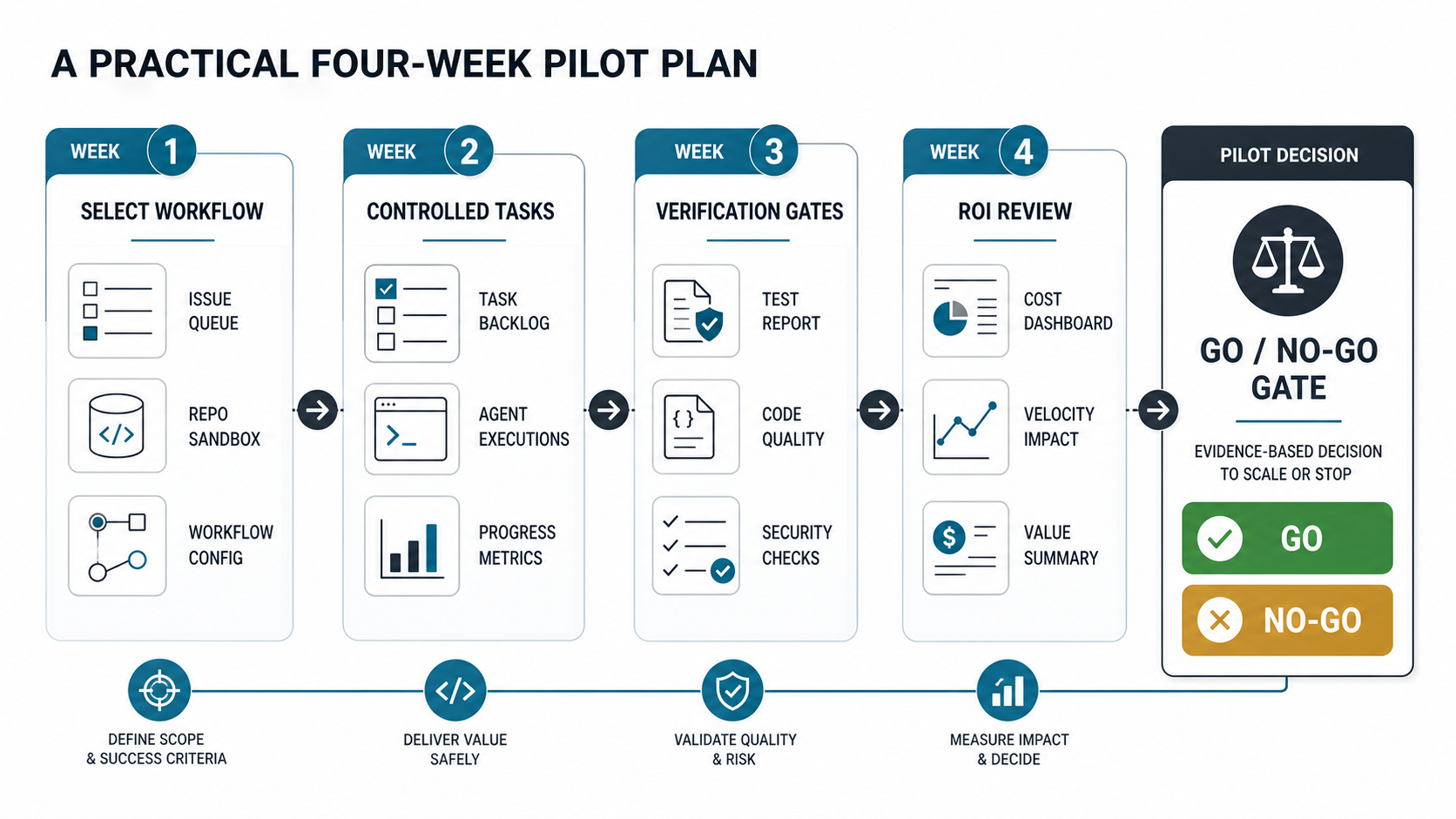
Week 1: shortlist and sandbox. Choose two or three platforms. Connect them to non-production repositories or tightly scoped pilot repos. Define policies, approval gates, data constraints, and evaluation tasks before developers start experimenting.
Week 2: controlled workflow tests. Run the same tasks across vendors: one bug fix, one test-generation task, one documentation update, one dependency update, and one API or integration change. Capture time, review effort, failures, and developer notes.
Week 3: governance and failure testing. Test permission boundaries, prompt-injection scenarios, failing CI, poor requirements, branch protection, dependency risks, and audit-log completeness. A platform that cannot fail safely should not reach production workflows.
Week 4: scale decision. Compare evidence. Decide which workflows move forward, which controls must be added, which teams need training, and which metrics will define a 90-day rollout.
Common Mistakes To Avoid
- Buying from a demo: polished demo repositories hide context and governance problems.
- Skipping QA capacity planning: agentic tools can create more work for reviewers and QA if verification is weak.
- Ignoring integration depth: a platform that cannot work with your issue tracker, CI, code review, documentation, and release process will stay peripheral.
- Letting every team choose separately: fragmented adoption creates inconsistent policies, duplicated spend, and weak auditability.
- Equating autonomy with maturity: the safest platforms are often the ones that make boundaries and approvals explicit.
Next Step
If you are evaluating agentic development platforms, start with workflow readiness before vendor scoring. NextPage can help you identify the right pilot workflows, define governance controls, build integration architecture, and run a practical evaluation sprint through our AI agent development, AI development, and dedicated engineering team paths.