
NLP project cost depends less on the word "NLP" and more on the workflow you are trying to automate, the condition of your data, and how production-ready the system must be. A short pilot for classification, entity extraction, or a document search assistant can be planned very differently from a secure production workflow connected to CRM, helpdesk, ERP, document stores, approvals, and human review.
For 2026 planning, use broad bands carefully: a focused NLP pilot often starts around $25,000 to $60,000; a production NLP workflow with private data, retrieval, integrations, evaluation, and admin controls often lands around $75,000 to $180,000; and enterprise-scale document intelligence, regulated workflows, or high-volume AI assistants can move beyond $200,000 once monitoring, security, governance, and runtime cost are included.
If leadership needs a starting estimate, use the Custom Software Cost Estimator. If the business case is tied to hours saved, run the AI Automation ROI Calculator before choosing a model or vendor.
Quick Answer: NLP Project Cost By Scope
| NLP Scope | Planning Budget Band | Typical Timeline | Best For |
|---|---|---|---|
| Discovery and prototype | $10,000-$30,000 | 2-5 weeks | Validating use case, sample data, expected outputs, and technical fit. |
| Focused pilot | $25,000-$60,000 | 6-10 weeks | Classification, extraction, search, summarization, or chatbot proof with limited users. |
| Production workflow | $75,000-$180,000 | 12-24 weeks | Secure app, retrieval, integrations, evaluation, admin controls, and human review. |
| Enterprise NLP platform | $200,000+ | 6-12+ months | Multiple workflows, high volume, regulated data, custom models, governance, and monitoring. |
These ranges are not vendor quotes. They are planning bands that help buyers separate the pilot budget from the production budget. The production version often costs more because it must survive real data, real users, integration failures, privacy requirements, and operating-cost pressure.
What Drives NLP Project Cost?
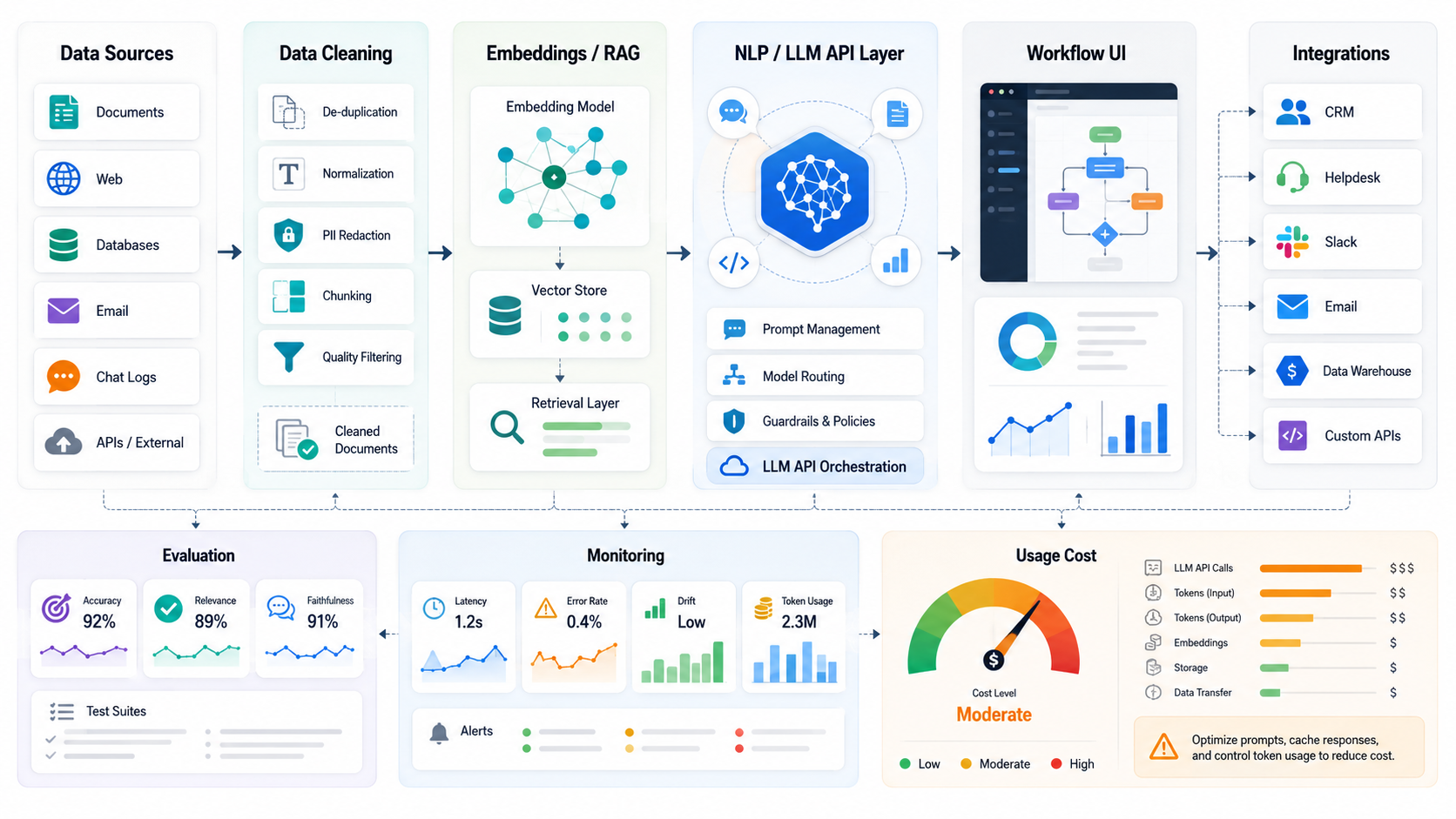
The model is only one part of the cost. A useful NLP system needs data ingestion, cleaning, labeling or gold examples, prompts or extraction rules, model/API selection, workflow screens, permissions, integrations, test sets, monitoring, and maintenance.
NextPage's AI development services and LLM development pages frame the same point: production AI is a workflow system, not just an API call. Model quality matters, but so do latency, data sensitivity, integration depth, evaluation, and human review.
- Data readiness: source formats, OCR quality, duplicates, labels, language coverage, privacy constraints, and sample size.
- Task type: classification, entity extraction, summarization, semantic search, RAG, chatbot, routing, sentiment, or document automation.
- Model approach: managed NLP API, LLM API, open-source model, fine-tuning, custom classifier, or hybrid retrieval system.
- Workflow integration: CRM, support desk, document store, ERP, ticketing, email, Slack, dashboards, approvals, and audit logs.
- Evaluation: test set, acceptance criteria, error taxonomy, human review, regression checks, and production monitoring.
- Runtime cost: token volume, embedding volume, cloud NLP units, vector database, storage, queues, observability, and retries.
Pilot Vs Production: Why The Budget Changes
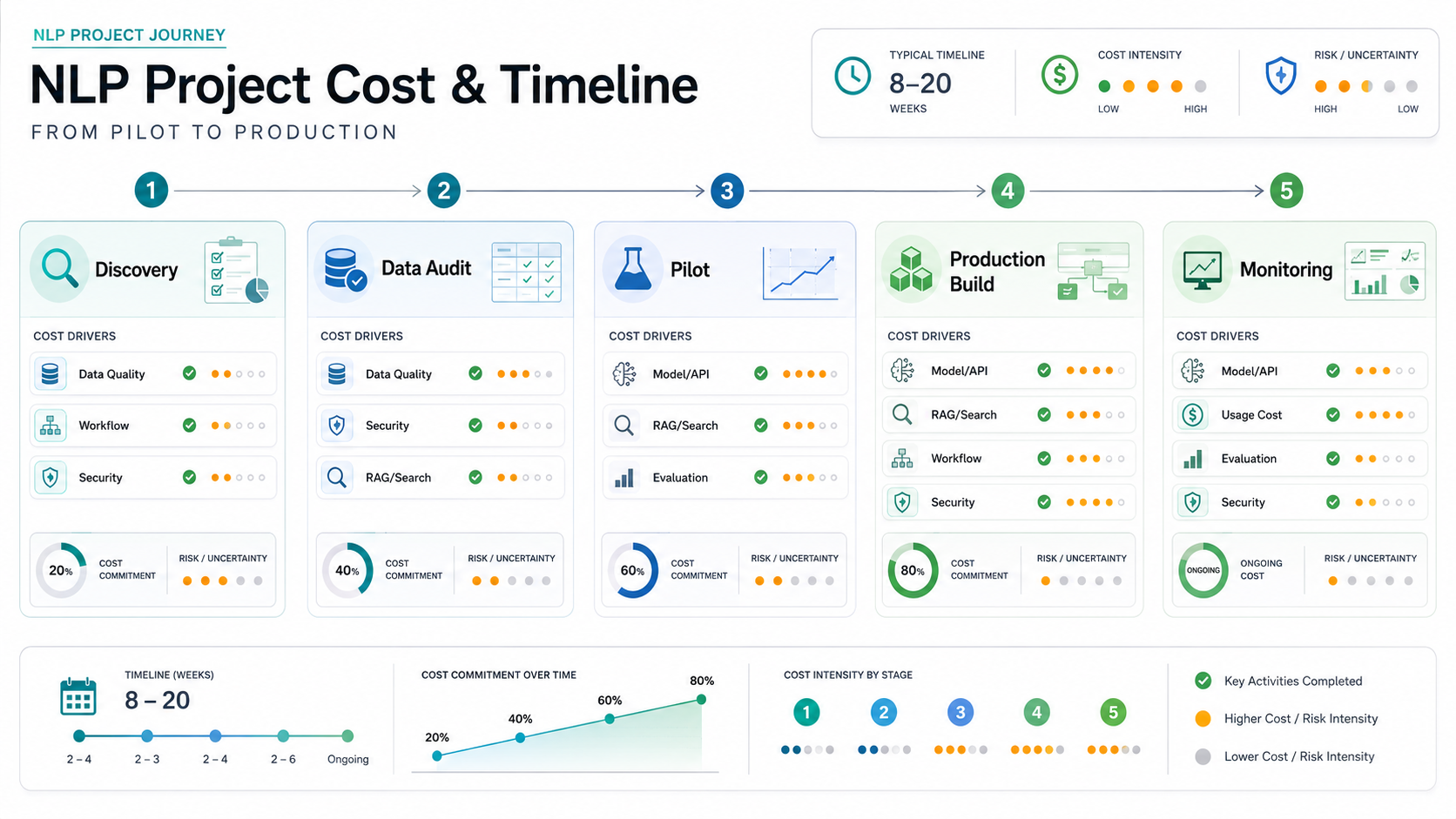
A pilot can be lightweight because it answers a narrow question: can NLP improve this workflow enough to justify the next investment? A production system answers a harder question: can the business trust this output repeatedly, securely, and at scale?
| Phase | What It Proves | Cost Driver |
|---|---|---|
| Discovery | Business workflow, success metric, user group, and output requirements. | Stakeholder clarity and workflow complexity. |
| Data audit | Whether source data is usable, representative, and safe to process. | Data cleanup, labeling, privacy review, and access permissions. |
| Pilot | Model/API fit, prompt or rule quality, retrieval relevance, and user feedback. | Experiment count, sample size, model choice, and evaluation effort. |
| Production build | Secure workflow, integrations, admin controls, human review, and rollback paths. | Engineering, QA, security, and integration depth. |
| Monitoring | Quality drift, cost trends, failure modes, and retraining or prompt updates. | Observability, analytics, and operational ownership. |
API And Runtime Costs Need Their Own Line Item
Official AI and cloud NLP pricing is usage-based and can change during the year, so current vendor pricing pages should be checked before a production budget is approved. OpenAI embeddings are priced by tokens, while services such as Amazon Comprehend measure natural-language processing requests by character units and offer separate pricing for custom classification or entity extraction. The exact bill depends on document volume, average length, input/output tokens, batching, retries, storage, vector search, and how often the system reprocesses content.
Do not bury runtime cost inside the build estimate. Model a few scenarios: pilot usage, expected production usage, peak usage, and failure/retry usage. For RAG systems, include embedding generation, vector database storage, search, LLM calls, monitoring, and the ingestion jobs that refresh private knowledge. For document processing, include OCR, page volume, extraction, validation, exception queues, and human review.
NextPage's generative AI development cost guide explains the same pattern for LLM products: the chat interface is not the expensive part; trusted context, workflow integration, evaluation, and operating controls drive the real budget.
Runtime And Evaluation Cost Controls To Add Before Production
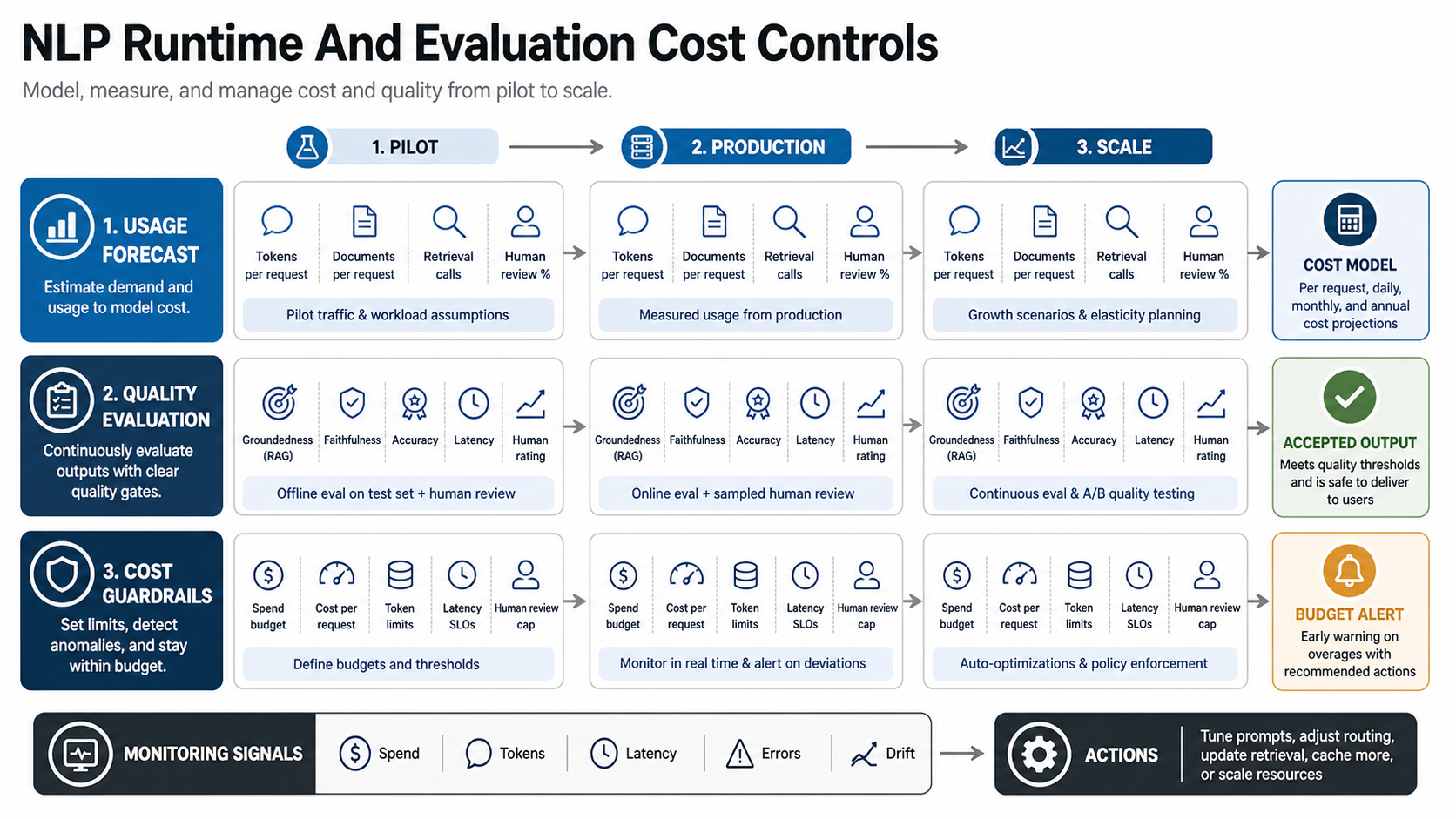
Production NLP budgets should include a separate operating model for runtime and evaluation. Official pricing pages for OpenAI, Amazon Comprehend, and Google Cloud Natural Language show why this matters: usage is usually tied to tokens, characters, documents, requests, training units, or model operations. A low-volume pilot can look inexpensive, while production usage can change quickly once the system processes historical documents, re-embeds content, retries failed calls, or serves multiple teams.
Before approving the production phase, create three scenarios: expected usage, peak usage, and failure/retry usage. For each scenario, estimate input text volume, output length, embedding refresh cadence, retrieval calls, OCR or document parsing, human-review time, observability, and storage. If the NLP workflow touches support tickets, invoices, contracts, or internal documents, pair the budget with AI automation services planning so the estimate includes routing, approvals, handoff, and exception queues instead of model calls alone.
| Control | What To Estimate | Why It Changes Cost |
|---|---|---|
| Usage forecast | Documents, messages, pages, tokens, users, and peak periods. | Runtime services charge by volume, and production usually exposes more demand than the pilot. |
| Evaluation gate | Golden examples, review criteria, regression checks, and human acceptance. | Quality measurement prevents expensive rework after model, prompt, or retrieval changes. |
| Retrieval refresh | Embedding cadence, vector storage, metadata filters, and access permissions. | RAG systems can incur recurring cost when documents change often or permissions are granular. |
| Human review | Queue size, confidence thresholds, escalation rules, and audit needs. | Human-in-the-loop workflows are often cheaper than blind automation when accuracy risk is high. |
| Budget alerts | Cost per accepted output, latency, retry rate, drift, and override rate. | Monitoring lets teams stop runaway usage before it becomes a monthly surprise. |
If the project needs custom pipelines, internal APIs, or batch processing around the model, Python development services can be the practical integration layer for ingestion, text cleanup, model orchestration, vector search, and reporting.
Data Readiness Checklist Before You Estimate
Most NLP overruns start with optimistic assumptions about data. A buyer may say "we have all the documents," but the engineering team later discovers scanned PDFs, inconsistent templates, missing labels, duplicate records, multiple languages, unclear ownership, or restricted access. That changes both cost and timeline.
Before committing to a budget, check these items:
- Source location: where the text lives today: CRM, helpdesk, cloud drive, database, email, PDFs, scanned files, transcripts, or spreadsheets.
- Format quality: whether text is machine-readable, OCR is needed, tables are preserved, and document layout matters.
- Ground truth: whether the team has examples of correct answers, labels, extracted fields, or human-reviewed outcomes.
- Volume and variance: how many documents or messages exist, how different they are, and how often the structure changes.
- Access and privacy: who can read the data, which fields are sensitive, and what retention or redaction rules apply.
- Workflow owner: who will approve outputs, tune examples, monitor failures, and decide when automation is good enough.
A strong pilot budget includes a data audit because it prevents the team from spending weeks tuning prompts or models against a dataset that does not represent production reality. If data quality is the main uncertainty, start with a scoped data migration checklist style inventory before estimating production NLP automation.
Common NLP Project Types And Budget Shape
| Project Type | Typical Scope | Budget Risk |
|---|---|---|
| Text classification | Route tickets, emails, leads, feedback, or documents into categories. | Label quality, edge cases, changing taxonomy. |
| Entity extraction | Extract names, dates, amounts, clauses, SKUs, policies, or fields. | Document variation, accuracy target, review workflow. |
| Semantic search / RAG | Answer questions over documents, policies, tickets, or knowledge bases. | Data cleaning, retrieval tuning, hallucination controls, access permissions. |
| AI chatbot or assistant | Support, sales, operations, HR, or internal knowledge workflows. | Escalation, integrations, compliance, human handoff, tone and safety. |
| Intelligent document processing | Invoices, forms, contracts, reports, claims, or onboarding files. | OCR quality, validation rules, exception handling, auditability. |
If your scope is document-heavy, review NextPage's intelligent document processing services. It shows how extraction, validation, workflow handoff, and monitoring shape production AI systems.
Example NLP Budget Scenarios
Use these scenarios to pressure-test scope. They are not quotes, but they show why two NLP projects with the same model can have very different budgets.
| Scenario | Likely First Build | Why Cost Changes |
|---|---|---|
| Support ticket classification | Classify tickets by product, urgency, topic, and owner; route to helpdesk queues. | Label quality, queue taxonomy, confidence thresholds, and helpdesk integration. |
| Contract clause extraction | Extract renewal dates, liability terms, payment terms, notice windows, and risky clauses. | Document variation, OCR/layout quality, review workflow, and audit trail. |
| Internal policy assistant | RAG assistant over policies, SOPs, and onboarding documents with citations. | Document cleanup, access permissions, retrieval tuning, answer evaluation, and monitoring. |
| Customer support chatbot | Answer FAQs, retrieve account/order context, escalate unresolved cases. | Brand tone, integrations, privacy, human handoff, analytics, and safety rules. |
| Invoice or claims processing | Extract fields, validate totals, flag exceptions, route for approval. | OCR, template diversity, validation logic, ERP integration, exception handling. |
Evaluation And Monitoring Are Not Optional
NLP systems need a measurement plan before launch. For classification, measure precision and recall by category, not just overall accuracy. For extraction, measure field-level accuracy and review time saved. For RAG assistants, measure answer usefulness, citation quality, refusal behavior, unsupported claims, and escalation rate. For summarization, review factual accuracy, missing details, and tone.
The evaluation budget should include representative examples, a test set, review criteria, baseline performance, regression checks, and a feedback loop. Production monitoring should track usage, latency, cost per accepted output, error categories, human override rate, drift, and repeated failure patterns.
This is where many underfunded NLP pilots fail. The demo works, but the team cannot prove whether quality is getting better or worse after new documents, prompts, models, or integrations are added.
Build, Buy, API, Or Custom Model?
Most teams should not start by training a custom NLP model. Managed APIs and LLMs can move faster for many classification, extraction, summarization, search, and assistant workflows. Buy or integrate an existing product when the workflow is standard and the vendor covers your data, compliance, and integration needs. Build custom software when the workflow, data, approvals, or user experience creates business advantage.
Machine learning development services, custom training, or fine-tuning become more reasonable when the team has enough representative data, stable labels, domain-specific language, a clear quality target, and a reason managed APIs cannot meet the need. Self-hosted or open-source models can help with data control or cost predictability, but they add infrastructure, MLOps, monitoring, and model-maintenance work.
The practical path is usually staged: prototype with a managed API, validate the workflow, measure cost and quality, then decide whether a more custom architecture is justified.
Security, Privacy, And Governance Costs
NLP projects often process sensitive text: contracts, customer conversations, support tickets, HR data, invoices, medical notes, financial documents, or internal policies. Budget for access control, redaction, audit logs, data retention, vendor review, prompt/data leakage prevention, and environment separation. If the tool acts on behalf of users, budget for approval steps and human review.
Before building an agentic or autonomous workflow, use the AI Agent Readiness Assessment to check workflow clarity, data readiness, integration access, and governance gaps. Many NLP projects should begin as assistive workflows before they become automated workflows.
How NextPage Estimates NLP Projects
NextPage estimates NLP projects by mapping the workflow, data sources, model options, integrations, evaluation target, security requirements, user interface, human review, and operating-cost assumptions. A useful estimate should show what is included in the pilot, what must be added for production, and what ongoing usage or monitoring costs remain after launch.
For most buyers, the right first step is not choosing a model. It is choosing a narrow workflow where better text understanding creates measurable value, then comparing that value against the AI automation ROI case before committing to a larger platform. NextPage can help with generative AI development, LLM/RAG systems, document processing, chatbot workflows, and production AI integrations, but the scope should start with a business outcome that can be tested.