
Quick Answer: What Should A Real Estate IoT App Roadmap Include?
A real estate IoT app roadmap should connect devices, building systems, tenant workflows, maintenance teams, and analytics into one operating plan. The roadmap should define the first building use case, sensor and gateway strategy, tenant mobile experience, facility dashboard, alert rules, data model, access control, security, integrations, rollout phases, and support ownership.
The mistake is treating IoT as a device purchase. Smart-building value appears when device data changes a workflow: a leak sensor creates a work order, an occupancy trend changes cleaning schedules, an energy anomaly triggers investigation, or a tenant app lets residents manage access, comfort, requests, and communication without another helpdesk call. In 2026, the roadmap also needs a tenant-data trust plan because occupancy, access, IAQ, and comfort signals can feel intrusive if the app does not explain what is collected, why it is collected, and who can act on it.
If you are estimating scope, start with the Custom Software Cost Estimator. For the build path, NextPage's IoT app development services cover connected products, telemetry, dashboards, mobile apps, integrations, and support workflows.
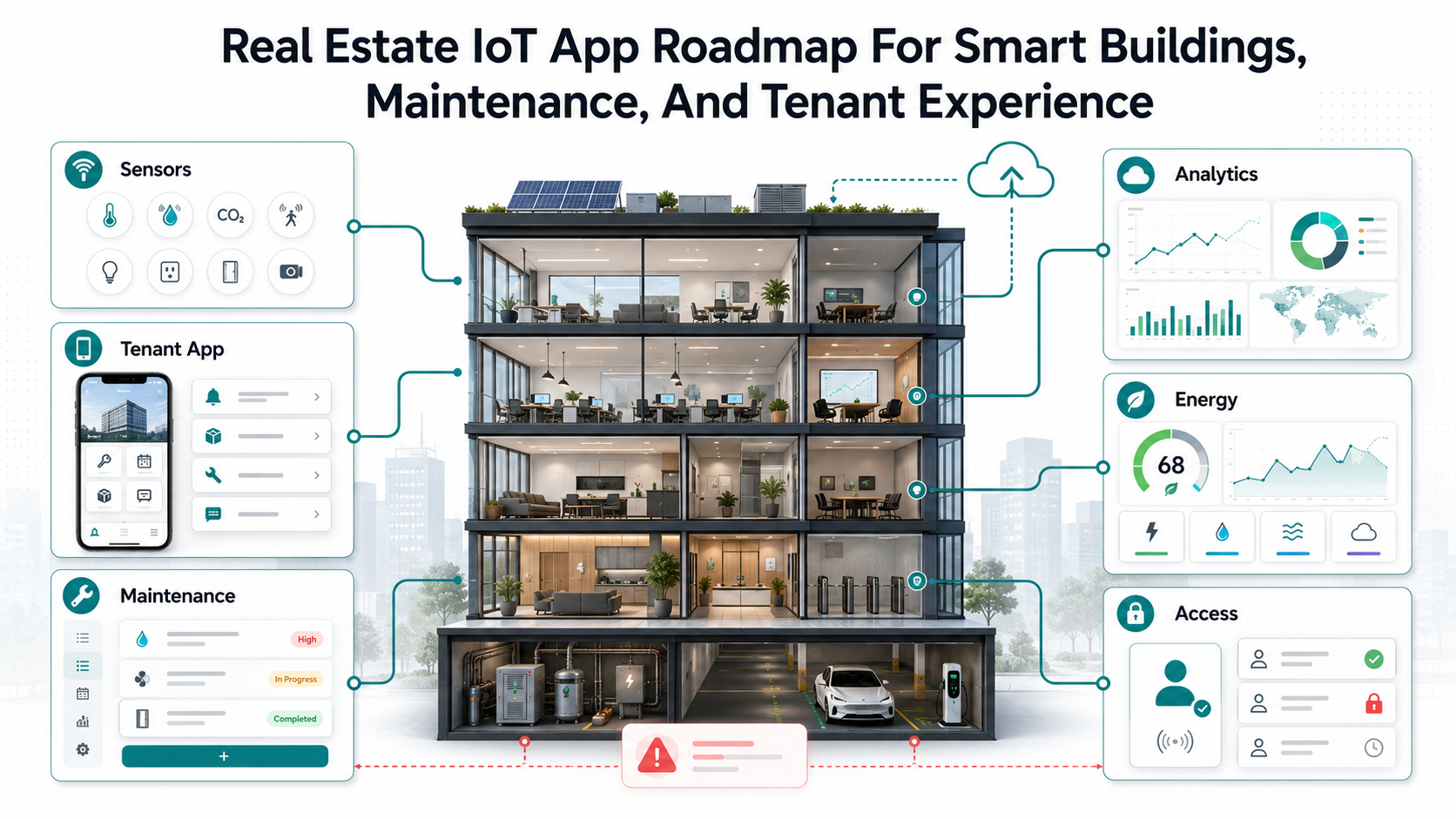
Start With The Building Use Case, Not The Device Catalog
Property teams can buy sensors for almost anything: occupancy, temperature, humidity, vibration, noise, light, air quality, water leaks, electricity, elevators, doors, parking, equipment runtime, and more. A roadmap should not start by listing all possible devices. It should start with the operating outcome.
Choose one primary business outcome for the first release:
- Reduce reactive maintenance by detecting equipment or leak issues earlier.
- Improve tenant experience through mobile requests, updates, access, and comfort controls.
- Cut energy waste with occupancy-aware schedules, HVAC insights, and anomaly alerts.
- Improve facility visibility across multiple buildings and vendors.
- Create evidence for ESG, compliance, or asset-performance reporting.
That first use case determines the sensors, data model, dashboards, integrations, and rollout metrics. A smart building app that begins with maintenance needs work-order routing and technician evidence. A tenant-experience app needs mobile UX, identity, access rules, communication, and support workflows. A portfolio analytics product needs normalized building data and executive reporting.
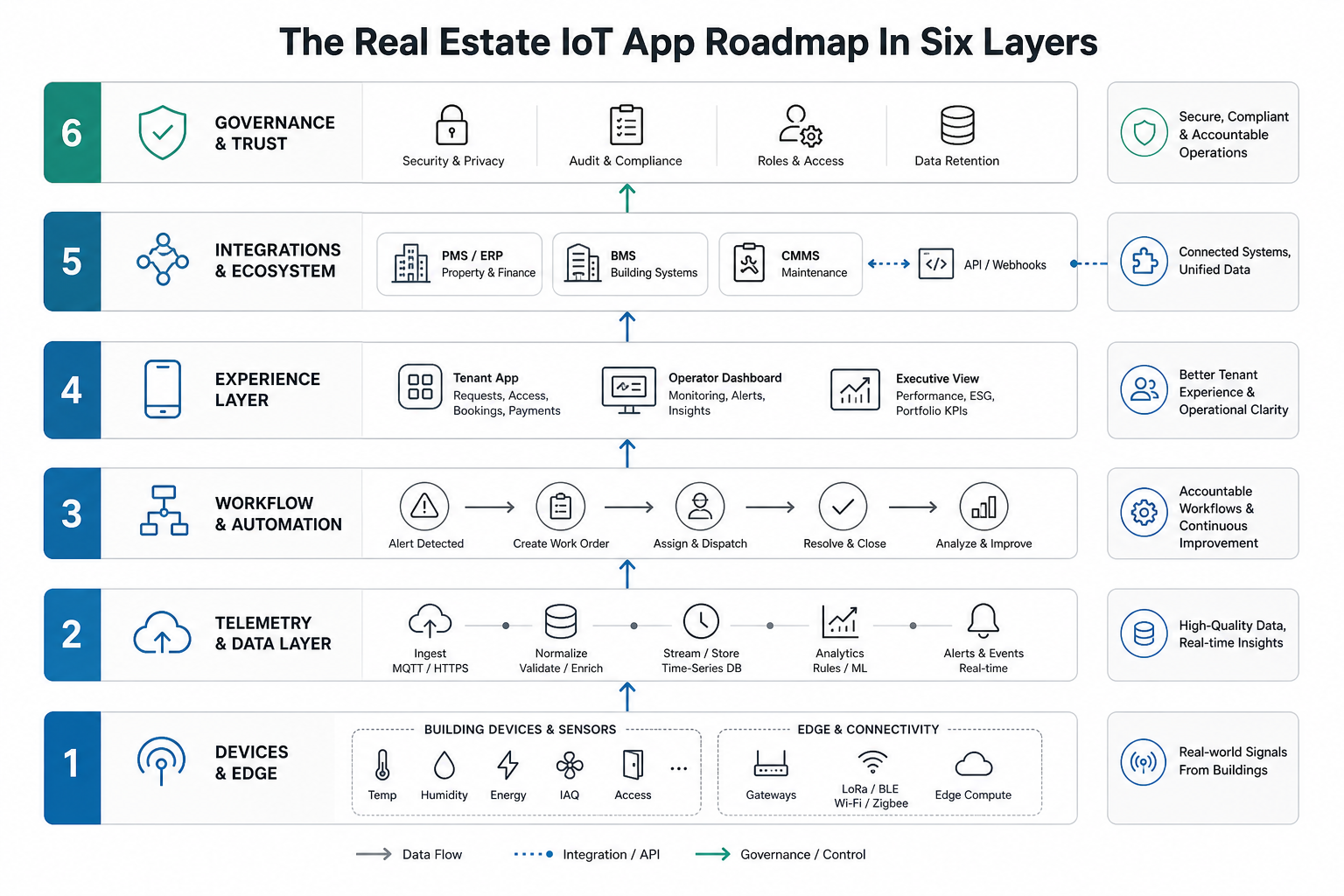
The Real Estate IoT App Roadmap In Six Layers
A useful roadmap separates the platform into layers. This keeps the team from designing a polished tenant app on top of unreliable device data or building a device lake that no operator uses.
| Layer | What To Decide | Common Failure Mode |
|---|---|---|
| Device And Gateway Layer | Sensors, protocols, gateways, firmware updates, offline behavior, and device identity. | Devices are installed without a supportable enrollment and monitoring model. |
| Telemetry And Event Layer | Data ingestion, event rules, thresholds, stream volume, retention, and alert priority. | Every sensor reading becomes noise instead of actionable signals. |
| Workflow Layer | Maintenance, tenant requests, inspections, access events, escalation, and approvals. | Dashboards show problems but do not trigger accountable work. |
| Experience Layer | Tenant mobile app, facility dashboard, vendor portal, admin tools, and notifications. | Different roles see the same interface despite different jobs. |
| Integration Layer | Property management system, CMMS, BMS, access control, CRM, billing, and analytics. | The IoT app becomes another silo instead of improving existing operations. |
| Governance Layer | Security, privacy notices, audit trails, permissions, data ownership, and support SLAs. | Sensors collect sensitive occupancy or access data without clear controls. |
For a deeper platform view, pair this roadmap with NextPage's guide to real estate IoT platform development. That article focuses on the platform logic behind smart building data, energy, tenant apps, and ROI.
Design The Tenant App Around Daily Jobs
The tenant app should not be a thin wrapper around building automation data. Tenants care about daily jobs: getting into the building, inviting visitors, reporting issues, receiving updates, booking amenities, tracking requests, paying charges where relevant, and understanding comfort or energy information that affects them.
For the first release, choose a small set of high-frequency jobs:
- Maintenance request with photos, status, technician updates, and satisfaction feedback.
- Access pass, visitor invite, package notification, or parking request.
- Building announcements, outage updates, safety alerts, and community notices.
- Comfort feedback for temperature, air quality, noise, lighting, or common areas.
- Self-service profile, lease/contact details, and support history.
This may be native mobile, responsive web, or PWA depending on usage. When mobile access, push notifications, camera uploads, visitor passes, or resident engagement are central, mobile app development may be justified. For facility teams and admins, a web dashboard is usually more efficient.
Make Predictive Maintenance Actionable
Predictive maintenance is one of the strongest smart-building use cases, but it fails when alerts are not connected to work ownership. A vibration anomaly, leak alert, elevator fault, or HVAC efficiency signal must become a triaged action with priority, asset context, location, history, owner, SLA, and closeout evidence.
| Maintenance Signal | Software Workflow | Evidence Needed |
|---|---|---|
| Water leak or humidity spike | Create urgent ticket, notify property team, attach sensor history, confirm fix. | Location, timestamp, affected unit/zone, technician note, before/after reading. |
| HVAC anomaly | Route to facility engineer, compare trend, schedule inspection, monitor recurrence. | Runtime, temperature delta, equipment ID, service history, energy impact. |
| Elevator or pump vibration | Flag potential failure, assign vendor, track inspection and replacement decision. | Threshold, trend, vendor action, downtime risk, parts status. |
| Tenant comfort complaint | Connect mobile feedback to zone conditions and response workflow. | Tenant report, IAQ/temperature data, response time, resolution rating. |
The roadmap should define whether maintenance integrates with an existing CMMS, property management system, vendor portal, or custom work-order module. This decision affects scope more than the alert UI. A practical pilot should measure alert precision, mean time to acknowledge, mean time to resolve, repeat alerts, vendor response quality, and technician closeout evidence before adding more device types.
Plan Energy, Occupancy, And IAQ Monitoring Together
Energy efficiency, occupancy, and indoor air quality are connected. Occupancy sensors can inform HVAC scheduling, cleaning frequency, meeting-room availability, and lighting policies. IAQ readings can inform ventilation decisions and tenant communication. Energy meters can expose anomalies, but operators need context before taking action.
For each metric, define the operating decision it supports:
- Energy: identify waste, abnormal usage, peak-load risk, and equipment inefficiency.
- Occupancy: tune space planning, cleaning schedules, access policies, and hybrid-work planning.
- IAQ: monitor CO2, humidity, temperature, particulate matter, and comfort complaints.
- Water: detect leaks, abnormal usage, equipment risk, and sustainability opportunities.
A dashboard should distinguish real-time alerts from trend analysis. Real-time alerts need escalation and SLA ownership. Trend analysis needs comparisons by building, floor, zone, asset, season, and operating schedule. Treat IAQ and comfort data as tenant-experience evidence, not just facilities telemetry: publish clear thresholds, show response status, and avoid exposing granular occupancy data to roles that do not need it.
Treat Access Control And Security As Core Architecture
Access control is a natural tenant-app feature, but it raises security, privacy, and operational questions. The app may connect to smart locks, visitor systems, parking gates, elevators, package rooms, cameras, or identity providers. Each connection needs permissions, audit logs, fail-safe behavior, and support processes.
Discovery should answer:
- Who can grant, revoke, or delegate access?
- What happens when the app, network, or access vendor is unavailable?
- Which events are logged, and who can view them?
- How are visitors, contractors, residents, employees, and facility vendors separated?
- What privacy notice is required when occupancy, access, or camera-adjacent data is collected?
For operators handling multiple properties, these decisions belong inside broader real estate software development planning, not only the IoT device rollout.
Build Data, Privacy, And Tenant Trust Into The Roadmap
Smart-building apps often collect semi-public signals such as occupancy, access events, visitor movement, comfort feedback, camera-adjacent security events, and device health. That data can improve service quality, but it also changes the trust contract with tenants, employees, vendors, and property teams.
Add a governance track to the roadmap before launch:
- Classify data by sensitivity: building telemetry, asset data, tenant profile data, access events, occupancy patterns, photos, messages, and payment or lease references.
- Define role-based access for owners, property managers, facility teams, front-desk staff, vendors, tenants, and executives.
- Publish simple tenant notices that explain which data is collected, which workflows use it, retention windows, and support contacts.
- Separate operational dashboards from portfolio reporting so executives see trends without unnecessary personal or unit-level data.
- Log admin actions, access changes, alert overrides, vendor handoffs, and data exports.
This is also where platform choices matter. If the app needs telemetry ingestion, edge gateways, mobile access, dashboards, alert routing, and vendor integrations, review NextPage's IoT app development services before choosing a custom architecture or vendor-heavy stack.
Integrate With The Property Stack Instead Of Creating Another Silo
A real estate IoT app becomes more valuable when it connects to existing property operations. Common integrations include property management systems, CMMS/work-order tools, building management systems, access control providers, payment systems, CRM, ERP, data warehouses, messaging, and identity providers.
| Integration | Why It Matters | Roadmap Question |
|---|---|---|
| Property Management System | Tenant, lease, unit, owner, and building records. | Which records are source of truth? |
| CMMS Or Work Orders | Maintenance assignment, SLA tracking, vendor evidence. | Do IoT alerts create tickets automatically or after human triage? |
| BMS And Device Vendors | HVAC, meters, access, elevators, and environmental data. | Which APIs, protocols, and gateways are supportable? |
| Analytics Warehouse | Portfolio reporting, ESG, operating metrics, and executive dashboards. | Which data is stored, normalized, retained, and governed? |
This is where cost planning gets practical. NextPage's custom real estate software development cost guide explains how platform type, user roles, integration depth, compliance, and AI scope drive the real budget more than generic page counts.
Choose A Realistic MVP Scope
The first release should prove one operating loop end to end. Do not try to connect every device type, every tenant feature, every vendor, and every executive dashboard in the first launch. Use the MVP Scope Builder to pressure-test whether the first release is focused enough for one building, one workflow, and a measurable operational outcome.
Strong MVP patterns include:
- Maintenance-first MVP: leak or equipment sensors, facility dashboard, work-order integration, alerts, and resolution evidence.
- Tenant-experience MVP: mobile requests, announcements, access/visitor workflow, comfort feedback, and admin tools.
- Energy-visibility MVP: meter ingestion, anomaly alerts, building/floor comparisons, and action tracking.
- Portfolio-dashboard MVP: normalized building metrics, asset status, open risks, and management reporting.
If the app includes listings, CRM, portals, broker workflows, or tenant/owner portals beyond IoT, review real estate app development cost planning before locking the roadmap.
Roll Out By Building, Zone, And Workflow
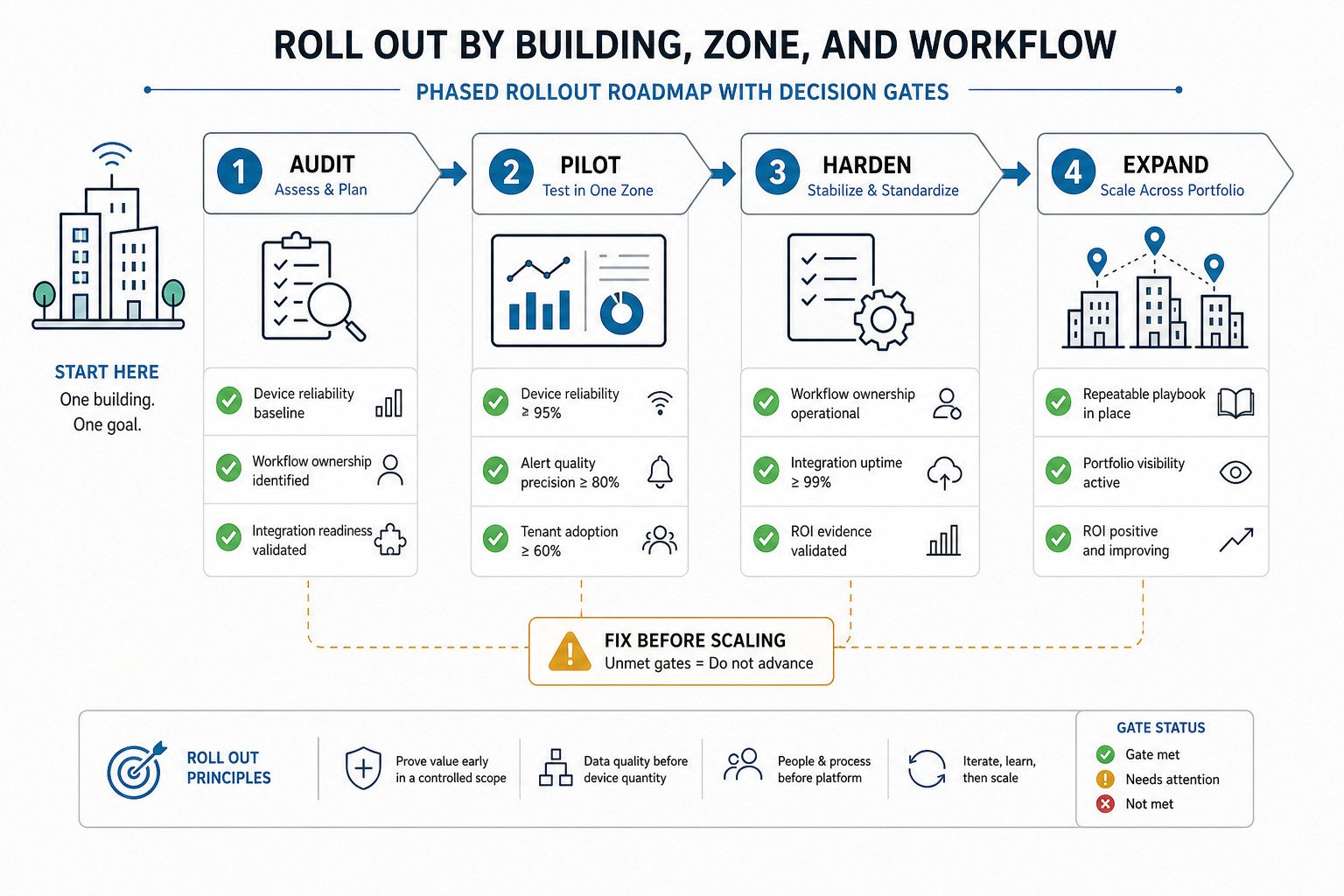
IoT rollouts should be phased because buildings vary. Sensor density, network quality, vendor systems, tenant expectations, facility processes, and data quality can differ by property. A roadmap should include a pilot building, success metrics, support playbook, and expansion criteria.
| Phase | Goal | Exit Criteria |
|---|---|---|
| Discovery And Audit | Map buildings, devices, stakeholders, integrations, and data risks. | Use case, MVP scope, vendor access, data model, and rollout plan approved. |
| Pilot Build | Connect limited devices and one workflow in one building or zone. | Alerts, dashboard, tenant/admin flow, and support process work reliably. |
| Operational Hardening | Add monitoring, audit logs, failure handling, admin tools, and training. | Facility team can run the workflow without engineering support. |
| Portfolio Expansion | Replicate to more buildings, vendors, devices, and analytics views. | Repeatable deployment checklist and portfolio reporting are ready. |
Use expansion gates. If the pilot produces noisy alerts, poor tenant adoption, unreliable connectivity, or unclear ownership, fix the operating model before adding more buildings.
Measure Adoption, Reliability, And ROI Before Scaling
A smart-building roadmap should define the evidence required to continue investment. Without measurement gates, teams can mistake a technically working sensor network for a useful operating product.
| Gate | What To Measure | Why It Matters |
|---|---|---|
| Device Reliability | Uptime, packet loss, battery health, gateway failures, and field replacement rate. | Unreliable telemetry creates distrust in every downstream workflow. |
| Alert Quality | False positives, false negatives, duplicate alerts, acknowledgement time, and escalation accuracy. | Noisy alerts cause facility teams to ignore the system. |
| Tenant Adoption | Active users, completed requests, visitor/access usage, comfort feedback, and satisfaction ratings. | The tenant app is only valuable when it reduces friction in daily jobs. |
| Operational Impact | Resolved work orders, avoided downtime, energy anomalies acted on, vendor closeout evidence, and repeat incidents. | Executives need proof that the app changes outcomes, not just dashboards. |
| Integration Health | PMS, CMMS, BMS, identity, messaging, and analytics sync success rates. | Smart-building apps fail when the system of record drifts from the app experience. |
Real Estate IoT App Cost Drivers
Cost depends on more than app screens. The largest drivers are device/vendor complexity, integration depth, data volume, security requirements, role count, analytics sophistication, and rollout support.
- Number and type of sensors, gateways, and building systems.
- Need for real-time streaming, rules engine, event storage, and historical analytics.
- Tenant mobile app complexity, access control, notifications, and offline needs.
- Facility dashboard, work orders, vendor workflows, admin tools, and reporting.
- PMS, CMMS, BMS, identity, payment, and data warehouse integrations.
- Security, privacy, audit logs, role-based access, and compliance requirements.
- Portfolio rollout, support tooling, observability, training, and vendor coordination.
The Custom Software Cost Estimator can model a first directional range, but a real IoT estimate should also include hardware procurement, installation, network readiness, vendor API validation, pilot support, and post-launch monitoring. For adjacent proptech product budgets, compare the integration and role-count assumptions in the real estate app development cost guide.
How NextPage Helps Build Real Estate IoT Apps
NextPage helps property operators, proptech founders, and facility teams plan software around real workflows rather than isolated smart-building devices. We can scope the device/data architecture, tenant app, facility dashboard, maintenance workflow, integrations, security model, rollout phases, and support plan.
For product teams, that can start as discovery and MVP planning. For operators, it can start as a pilot building with a narrow maintenance, energy, access, or tenant-experience workflow. The goal is the same: connect building data to decisions that reduce operational cost, improve tenant experience, and make property teams faster. Teams that need a broader property operations platform can combine IoT planning with NextPage's real estate portals, CRM, property management, and reporting work.