
Quick Answer: When Should You Use Microservices?
Use microservices when independently owned business capabilities genuinely need different release cycles, scaling profiles, reliability targets, security boundaries, or technology choices—and when your teams can operate a distributed system in production. Keep a modular monolith when one team still changes most features together, transactions cross many modules, deployment is not the real bottleneck, or observability and release automation are immature.
The decision is not “old architecture versus modern architecture.” It is a trade: microservices exchange in-process simplicity for organizational and operational independence. That trade pays only when the independence is valuable enough to cover network calls, versioned contracts, partial failures, distributed data, more deployments, and more production ownership.
If an existing system is slowing delivery, start with evidence rather than service count. NextPage’s monolith-to-microservices migration services focus on capability boundaries, dependency mapping, reversible migration waves, and operating readiness before extraction begins.
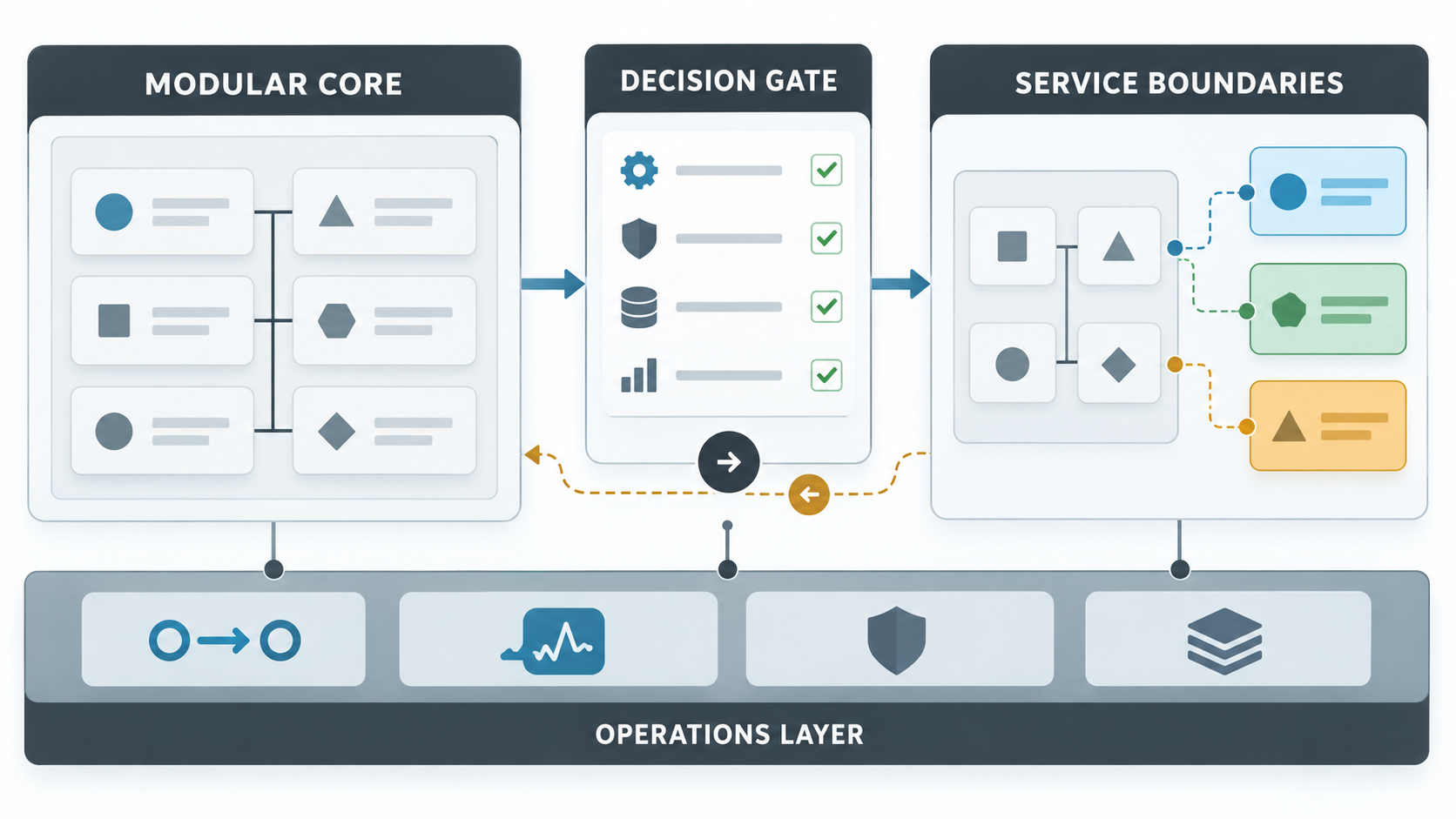
Microservices, Modular Monolith, Or Something In Between?
A monolith is an application deployed as one unit. It can still be cleanly modular, well tested, scalable, and reliable. A microservices architecture splits capabilities into independently deployable services that communicate through APIs or messages and usually own their own data. The middle ground—a modular monolith plus a few extracted services—is often the most practical architecture for growing products.
| Decision Area | Modular Monolith Fits When | Microservices Fit When |
|---|---|---|
| Team Structure | One or two teams collaborate across the product and release together. | Several durable teams own distinct business capabilities end to end. |
| Change Pattern | Features regularly span the same modules and need coordinated transactions. | Capabilities change at different speeds with few coordinated releases. |
| Scale | The application can scale as a unit without unacceptable cost. | One capability has proven, materially different load or latency needs. |
| Reliability | A shared availability target and recovery plan are sufficient. | Capabilities need separate SLOs, blast-radius controls, or recovery objectives. |
| Data | Strong cross-module transactions dominate the workflow. | Clear data authorities exist and workflows tolerate asynchronous consistency. |
| Operations | Simple releases and centralized debugging are valuable. | Teams can own pipelines, telemetry, on-call, contracts, and incident response. |
Do not split a system simply because the codebase is large. First improve module boundaries, build and test speed, ownership, and deployment safety. If that removes the delivery bottleneck, a modular monolith may remain the better design. If specific capabilities still need independence, extract only those capabilities.
The CHANGE Decision Model
NextPage uses the following six-part framework as a practical conversation tool. It is not an industry certification or automatic scoring formula. Its purpose is to make architecture assumptions visible before they become infrastructure.
| Signal | Question | Evidence That Supports Extraction |
|---|---|---|
| C — Coupling Pressure | Which changes are blocked by unrelated code, tests, or release coordination? | Repeated release delays trace to a stable capability boundary, not generally poor engineering hygiene. |
| H — Hand-Off Ownership | Can one durable team own the capability from roadmap to production? | A named team can own code, data, support, incidents, and business outcomes. |
| A — Autonomy Need | What decision becomes faster when this capability releases independently? | Independent delivery removes a measured coordination constraint. |
| N — Non-Functional Divergence | Does the capability need a distinct SLO, security boundary, latency, or scale profile? | The difference is material, measurable, and expensive to meet across the whole application. |
| G — Growth Evidence | Is demand proven or merely forecast? | Production load, roadmap pressure, customer commitments, or compliance needs justify isolation. |
| E — Execution Maturity | Can the team operate more deployable units safely? | Automated delivery, telemetry, ownership, incident response, and contract testing already work. |
A candidate should show several strong signals, not one exciting reason. A hot endpoint may need a cache, queue, read model, or separate worker rather than a new business service. A team bottleneck may need clearer ownership rather than network isolation. Architecture follows the constraint.
Design Service Boundaries Around Business Change
Good boundaries group rules and data that change together. Poor boundaries split horizontal layers—such as controllers, validation, and database access—into separate network services even though every feature still requires coordinated changes. That produces a distributed monolith: many deployments with the same coupling.
Before extraction, apply the BOUNDARY test:
- Business capability: state the outcome the service owns in language product and operations teams use.
- Owner: name the team accountable for roadmap, production behavior, and support.
- Uptime and SLO: define latency, availability, recovery, and degradation expectations.
- Data authority: identify the records and invariants this service owns.
- API or event contract: describe what consumers depend on and how compatibility is maintained.
- Release independence: prove the service can change without a coordinated release across neighboring capabilities.
- Yield and rollback evidence: specify the measurable benefit and the path back if extraction performs poorly.
Microsoft’s current architecture guidance also emphasizes domain analysis, loose coupling, high cohesion, and boundaries around business capabilities rather than technical layers. Use that as a principle, then validate the boundary against your own change history and operating model.
Choose Communication By Failure Semantics
Service communication should be chosen by what the business workflow can tolerate when a dependency is slow, unavailable, duplicated, or delayed.
| Pattern | Use It When | Design Obligations |
|---|---|---|
| Synchronous API | The caller needs an immediate answer to continue. | Timeouts, bounded retries, idempotency, compatibility, fallback, and latency budgets. |
| Asynchronous Event | The producer should continue while consumers react independently. | Durable delivery, deduplication, ordering assumptions, schema evolution, replay, and poison-message handling. |
| Command Queue | Work can be accepted now and processed later by a known owner. | Job state, retries, cancellation, progress visibility, dead-letter handling, and SLA. |
| Batch Or File Exchange | Latency is relaxed and reconciliation matters more than immediacy. | Versioned format, completeness checks, reruns, lineage, and exception ownership. |
Long synchronous call chains hide availability multiplication: a user request succeeds only when every dependency in the path succeeds within budget. Prefer a short critical path, tolerate stale reads where the business permits it, and move side effects out of the request path when they do not need immediate completion. For backend contracts and integration-heavy products, review backend and API development services alongside the architecture plan.
Data Ownership Is The Hard Boundary
Code can be moved faster than data authority. If two services write the same tables, share undocumented joins, or depend on one another’s internal schema, they are not meaningfully independent. The target is not “a database per container”; it is one accountable authority for each business fact.
| Need | Useful Pattern | Risk To Control |
|---|---|---|
| Reliable event publication after a local write | Transactional outbox plus an idempotent publisher | Duplicate delivery and lag between write and publication. |
| Workflow across several authorities | Saga with explicit state and compensating actions | Compensation is not a database rollback; business effects may be irreversible. |
| Fast cross-domain read | Materialized read model owned by the consuming experience | Staleness, rebuild strategy, and authorization drift. |
| Legacy coexistence | Change capture, API facade, or controlled dual run | Reconciliation gaps and unclear cutover authority. |
| Historical reporting | Analytics pipeline or warehouse rather than operational joins | Lineage, freshness, privacy, and metric-definition mismatch. |
Classify every cross-service workflow by consistency need. Some actions—such as authorization or inventory commitment—may require a single authority and strong local transaction. Other views can accept eventual consistency if the UI communicates freshness and repair paths exist. Microsoft’s data guidance recommends identifying where strong consistency is required and treating one service as the source of truth for a given entity.
A Reversible Monolith-To-Microservices Roadmap
A safer migration behaves like a series of controlled product releases, not a long rewrite. The legacy application modernization roadmap provides the wider decision context; the sequence below focuses on service extraction.
- Baseline the constraint. Measure lead time, change failure, incident patterns, scaling cost, dependency hotspots, and ownership delays. Define the reason for extraction in observable terms.
- Stabilize the seam. Create an internal module boundary or facade before a network boundary. Add characterization tests around existing behavior and map callers, jobs, reports, and data access.
- Define the contract. Version the API or event, set timeouts and compatibility rules, document data authority, and build consumer contract tests.
- Extract one thin capability. Route a controlled slice through the new service while the monolith remains the fallback. Avoid extracting several tightly connected domains in the same wave.
- Separate data authority. Move writes first or establish an explicit source of truth, then build reconciliation and repair. Do not allow indefinite dual writes without an exit gate.
- Observe in parallel. Compare outputs, latency, failures, cost, and business results. Use shadow traffic or dual reads where risk permits.
- Shift and retire. Increase traffic behind a reversible routing control. Remove old paths only after rollback criteria, reconciliation, and a stable observation window pass.
AWS Prescriptive Guidance documents business-capability, subdomain, strangler, and wave-based decomposition patterns. The important planning lesson is that different capabilities can need different patterns; a migration does not have to force the entire application through one method.
Observability And Reliability Before Service Count
In a monolith, a stack trace may explain most failures. In a distributed system, one user action can cross an edge, gateway, service, queue, worker, and data store. The operating model needs correlation across that path before production traffic depends on it.
- Propagate a trace or correlation context across HTTP, messaging, jobs, and callbacks.
- Collect metrics for traffic, errors, latency, saturation, queue age, retries, dependency health, and business outcomes.
- Use structured logs with consistent service, environment, release, tenant, request, and error fields.
- Define service-level objectives and error budgets for user-visible capabilities, not only infrastructure uptime.
- Alert on symptoms users feel and on repair queues that can silently accumulate.
- Make release version, configuration version, and feature-flag state visible during incidents.
OpenTelemetry describes traces, metrics, and logs as complementary telemetry signals. Standardizing their context early makes a later tool change easier and gives teams a shared vocabulary for investigation. The broader delivery discipline is covered in NextPage’s DevOps consulting guide for SaaS teams and DevOps consulting services.
Design for partial failure: time out calls, retry only safe operations, use idempotency keys, limit concurrency, isolate resource pools, degrade non-critical features, and stop retry storms. A circuit breaker is not a substitute for a useful fallback, and a retry policy without a total time budget can make an outage worse.
Security, Platform Standards, And Ownership
More services create more identities, secrets, network paths, dependencies, deployment permissions, and supply-chain artifacts. Establish a small paved road before teams choose different solutions for every concern.
- Service identity and least-privilege authorization for both people and workloads.
- Central secrets management, rotation, and environment separation.
- Dependency and image scanning with a clear remediation owner.
- API and event schema review, compatibility policy, and deprecation windows.
- Standard build, test, deploy, rollback, telemetry, and incident templates.
- Cost ownership by service, environment, and team.
- A lightweight architecture decision record for every extraction.
Standardize the operational surface while allowing domain teams to make bounded product decisions. Too little standardization produces incompatible telemetry and delivery paths; too much central control removes the autonomy the architecture was meant to create.
Common Microservices Failure Modes
| Failure Mode | What It Looks Like | Corrective Move |
|---|---|---|
| Distributed Monolith | Every release changes several services and must be coordinated. | Merge services that change together or redesign contracts around a real capability. |
| Nanoservice Sprawl | Tiny services add calls and deployments without independent value. | Prefer coarser boundaries and earn smaller ones with evidence. |
| Shared Database Coupling | Teams bypass contracts and write one another’s tables. | Name data authorities, prohibit cross-boundary writes, and provide supported read paths. |
| Chatty Request Chains | One screen triggers many sequential internal calls. | Rework boundaries, aggregate reads, cache safely, or use asynchronous composition. |
| Platform Before Product | The organization builds a large internal platform before one extraction proves value. | Build the minimum paved road required by the first two or three real services. |
| Ownership Theatre | A team owns code but not incidents, cost, data, or roadmap. | Assign end-to-end capability ownership with explicit service health and business metrics. |
| Forever Coexistence | Dual writes, adapters, and old code never reach a retirement gate. | Define reconciliation, traffic-shift, and deletion criteria before the wave starts. |
Microservices Production Readiness Gate
Do not approve an extraction because the new service works in isolation. Approve it when the capability can be changed, operated, repaired, and rolled back independently.
- The business capability, owner, data authority, consumers, and SLO are documented.
- API or event compatibility rules and consumer contract tests are automated.
- Timeouts, retries, idempotency, overload behavior, and degraded modes are tested.
- Traces, metrics, structured logs, dashboards, alerts, and runbooks follow the user journey.
- Security identities, permissions, secrets, dependency scanning, and audit evidence are reviewed.
- Data migration, reconciliation, replay, backup, restore, and repair procedures are proven.
- Deployment uses progressive exposure with explicit rollback triggers.
- On-call ownership, incident escalation, support hours, and cost allocation are accepted.
- The old code path has retirement criteria and a named deletion owner.
If several of these controls are missing, improve the delivery platform before multiplying services. Teams planning a wider estate change can also use the application migration readiness checklist and cloud migration services guidance.
Turn The Guide Into An Architecture Workshop
A useful first workshop does not draw a final target architecture. It selects one business capability, reconstructs its change and incident history, maps data and integrations, scores it with CHANGE, applies the BOUNDARY test, and defines one reversible experiment.
The deliverable should fit on a few pages: current constraint, proposed boundary, contract, data authority, operational gap list, migration wave, success measures, and rollback trigger. That is enough to decide whether to extract, modularize in place, replatform, or leave the system alone.
NextPage can help teams turn that evidence into a modernization path through legacy software modernization and custom software development. The goal is not a fashionable diagram. It is safer change with clear ownership and measurable improvement.
Frequently Asked Questions
What Is A Microservices Architecture?
A microservices architecture organizes an application as independently deployable services around business capabilities. Each service has a clear owner and contract, and meaningful independence over its code, release, and data authority.
Are Microservices Better Than A Monolith?
No. A modular monolith is often simpler to build, test, deploy, and debug. Microservices become useful when capability-level independence creates enough business or operational value to justify distributed-system complexity.
How Many Microservices Should An Application Have?
There is no ideal count. Start with the fewest deployable units that match real ownership and change boundaries. A service that cannot release, scale, fail, and be owned independently may not need to be separate.
What Should Be The First Microservice Extracted From A Monolith?
Choose a capability with a clear owner, stable seam, limited dependencies, measurable benefit, manageable data boundary, and reversible routing path. Avoid the most critical transaction unless the team already has strong distributed-system operations.
Should Every Microservice Have Its Own Database?
Every service should own its data authority and prevent unsupported cross-boundary writes. That does not require a unique database server for every service, but schemas, permissions, contracts, and operational ownership must preserve independence.
How Do You Migrate Without A Big-Bang Rewrite?
Stabilize a seam, introduce a facade or routing layer, extract one capability, run old and new paths with reconciliation, shift traffic gradually, and retire the old path only after success and rollback gates pass.