
Quick Answer: What AI App Maintenance Costs
For an AI-enabled or API-heavy mobile app, a realistic maintenance budget usually starts at 15-25% of the original build cost per year, then adds usage-based spend for AI models, backend infrastructure, observability, third-party APIs, and support. A simple production app may need $2,500-$6,000 per month. A growing app with AI workflows, payments, location, notifications, analytics, and frequent releases can need $8,000-$25,000+ per month before major new feature work.
The exact number depends less on whether the app was built in Swift, Kotlin, Flutter, or React Native, and more on how many moving parts must stay reliable after launch. If your product depends on model calls, API contracts, store compliance, security patches, and live user support, maintenance is an operating budget, not a leftover warranty line.
This guide gives product owners a practical way to estimate the monthly run rate. If you are still planning the initial build, pair this with NextPage's AI mobile app development cost guide so launch scope and post-launch ownership are budgeted together.
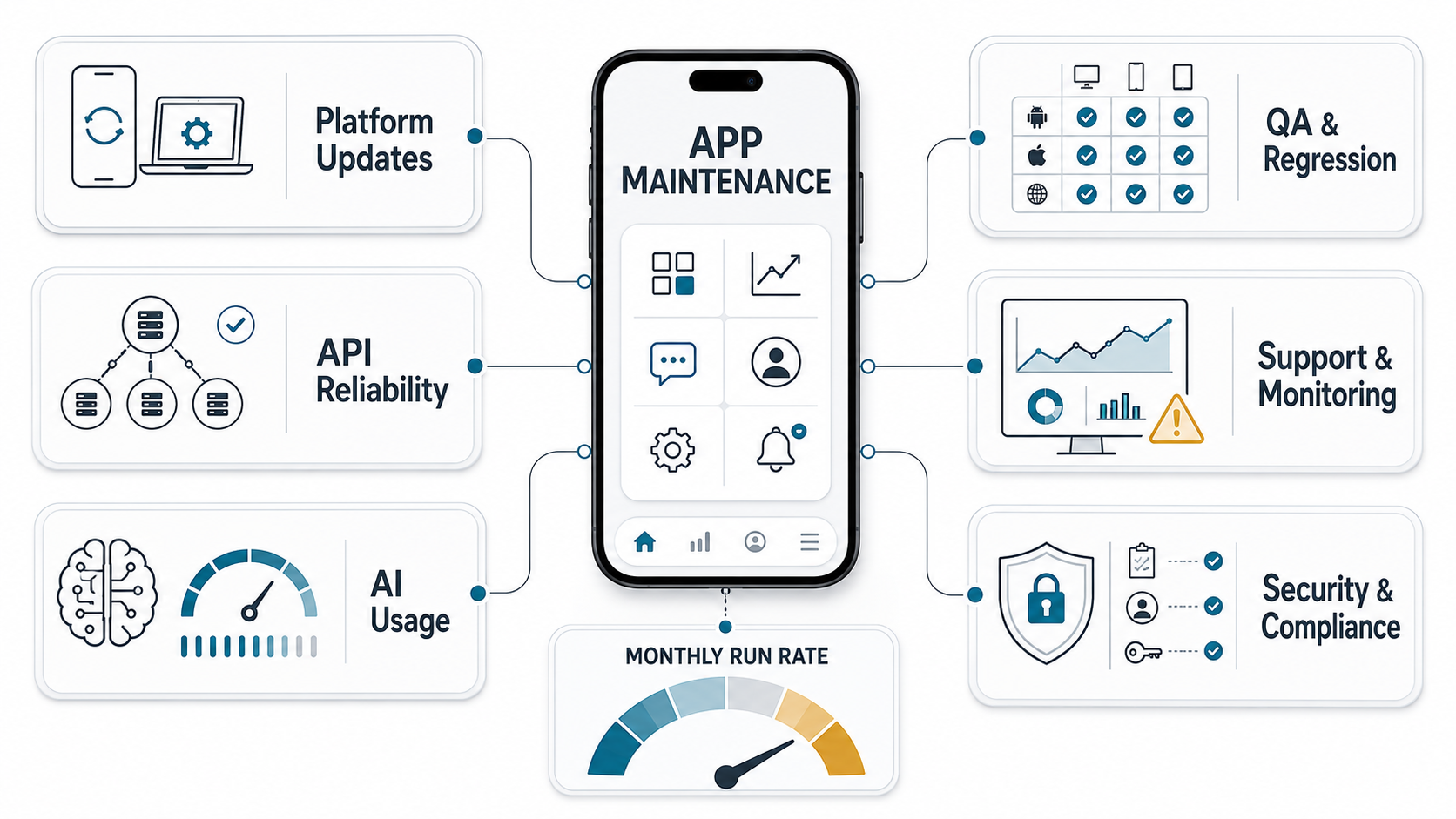
Mobile App Maintenance Cost Bands
Use these bands for planning conversations, not as a fixed quote. A production estimate should still review active users, release frequency, platform count, backend architecture, AI usage, data sensitivity, and support expectations.
| App Type | Typical Monthly Maintenance | What It Usually Includes | Main Risk If Underfunded |
|---|---|---|---|
| Simple content or utility app | $1,500-$4,000 | Minor fixes, dependency updates, store submissions, basic monitoring | Slow compatibility updates and stale UX |
| Transactional mobile app | $4,000-$10,000 | API support, payment or booking fixes, analytics, release QA, support triage | Revenue-impacting defects and broken integrations |
| AI-enabled app with managed backend | $8,000-$18,000 | Model prompt/version monitoring, API reliability, regression testing, privacy controls, cost review | Token spend, hallucination risk, or model behavior changes go unnoticed |
| API-heavy platform app | $10,000-$25,000+ | SLA monitoring, observability, security hardening, performance tuning, vendor/API change handling | Outages, data drift, support backlog, and missed platform policy deadlines |
These ranges include engineering maintenance and operational reliability work. They do not include a large new feature roadmap, paid acquisition, customer support headcount, legal review, or enterprise compliance audits. If the app is mission-critical, maintenance should be budgeted as a standing monthly capacity lane plus a quarterly improvement budget.
Why AI And API-Heavy Apps Cost More
Traditional app maintenance is already a mix of corrective, adaptive, preventive, and perfective work. AI and API-heavy apps add a fifth lane: behavioral operations. The app can be technically online while the AI output quality, latency, cost per task, or API dependency health silently degrades.
AI features create costs in four ways. First, each model call can carry input, output, retrieval, moderation, storage, or regional processing fees. OpenAI's current API pricing is published per model and token volume, which means product teams need usage forecasts rather than one-time line items. Second, AI behavior changes when prompts, model versions, retrieval data, or user patterns change. Third, sensitive data workflows require additional privacy and logging discipline. Fourth, support teams need a way to diagnose bad outputs, timeout patterns, and escalation paths.
API-heavy apps have similar pressure. A payment provider changes an SDK, a logistics API deprecates a field, a maps quota grows with usage, or a CRM integration starts failing because authentication changed. The app owner experiences these as "maintenance," but the work is closer to continuous integration management.
This is why a post-launch plan should include the post-launch mobile app maintenance checklist, not only a bug-fix retainer.
The Cost Drivers To Budget Separately
A useful maintenance estimate separates fixed engineering capacity from usage-based and vendor-driven costs. Blending everything into one vague percentage makes it hard to see what should scale with adoption.
| Cost Driver | What To Budget | Planning Notes |
|---|---|---|
| iOS and Android platform updates | SDK upgrades, OS compatibility testing, store submissions, dependency updates | Google Play target API requirements keep moving; for 2026, Google says many new apps and updates must target Android 16/API 36 from August 31, 2026. Apple also expects apps to keep improving with platform and review guideline changes. |
| Backend and API reliability | Monitoring, incident response, API contract tests, queue and database checks | Budget extra if the app depends on payments, location, booking, ERP, CRM, or third-party logistics APIs. |
| AI model usage | Token spend, embeddings, retrieval storage, moderation, prompt/version evaluation | Track cost per user action and set alerts before usage grows into an unplanned gross-margin problem. |
| Firebase or managed backend services | Authentication, Firestore/SQL, functions, storage, bandwidth, logging | Firebase has generous no-cost services, but pay-as-you-go billing applies after limits and across connected Google Cloud products. |
| QA and regression testing | Device testing, automated checks, release candidate validation, crash review | Regression QA becomes more important when AI output or API payloads can change outside the app binary. |
| Security and privacy | Dependency patching, secrets rotation, access control review, abuse monitoring | Apps handling health, finance, location, identity, or workplace data need more than casual patching. See NextPage's mobile app security hardening service for deeper launch and audit readiness. |
| Observability and support | Crash analytics, performance traces, alerting, support diagnostics, runbooks | Crash-free users alone are not enough; track latency, failed API calls, model errors, and funnel drop-offs. |
| Product improvements | UX fixes, backlog grooming, small features, analytics-based iteration | Keep this separate from maintenance so reliability work is not starved by feature requests. |
Build A Maintenance Budget Model
The cleanest budget model has four layers: a fixed retainer, usage-based spend, release/regression capacity, and a quarterly improvement backlog. This keeps finance, product, and engineering aligned when traffic or AI usage changes.
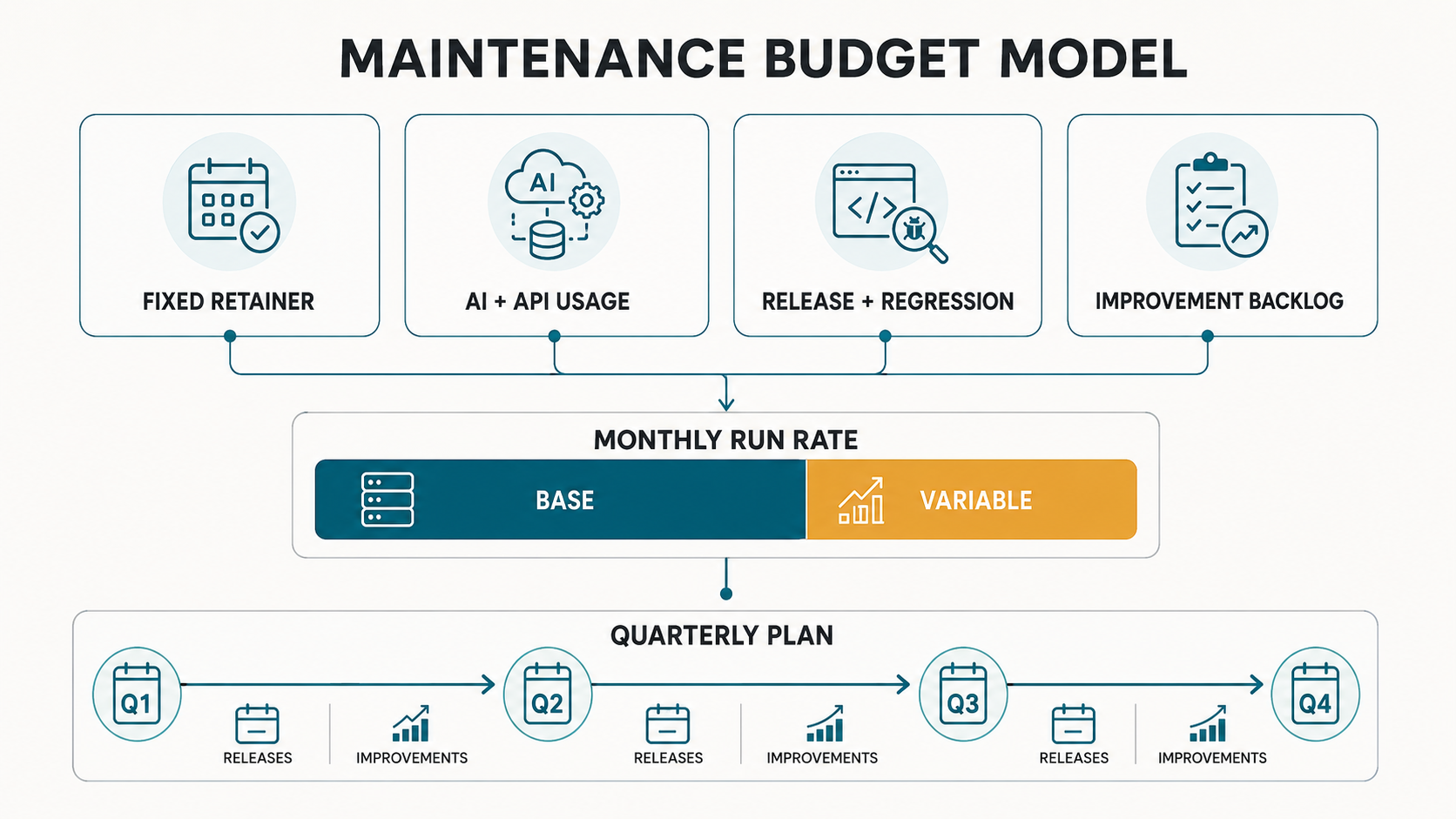
Fixed retainer. This is the monthly capacity for triage, dependency updates, small fixes, store submissions, operational checks, and release support. It should not depend on whether a major incident happens; the value is having a team close enough to the system to respond quickly.
Usage-based spend. Put AI model calls, vector/database storage, messaging, bandwidth, SMS, maps, logging, and managed backend consumption in a separate line. These costs should be measured per active user, per workflow, or per transaction.
Release and regression work. Budget for planned releases even when there are no major features. App-store submissions, SDK updates, real-device QA, and regression checks are predictable enough to plan. The mobile app performance optimization checklist is a useful companion when release quality and speed are part of the maintenance goal.
Improvement backlog. Set aside quarterly capacity for product fixes that reduce support load or improve conversion. Without this lane, teams often spend the whole budget keeping the app alive while the product slowly becomes less competitive.
Review The AI/API Run Rate Every Month
AI-enabled and API-heavy apps need a monthly operating review, not only a quarterly maintenance check. The review should compare usage, reliability, platform deadlines, vendor/API changes, and support tickets against the budget model. This is where product, engineering, and finance decide whether the next month needs cost controls, regression coverage, API remediation, or product backlog work.
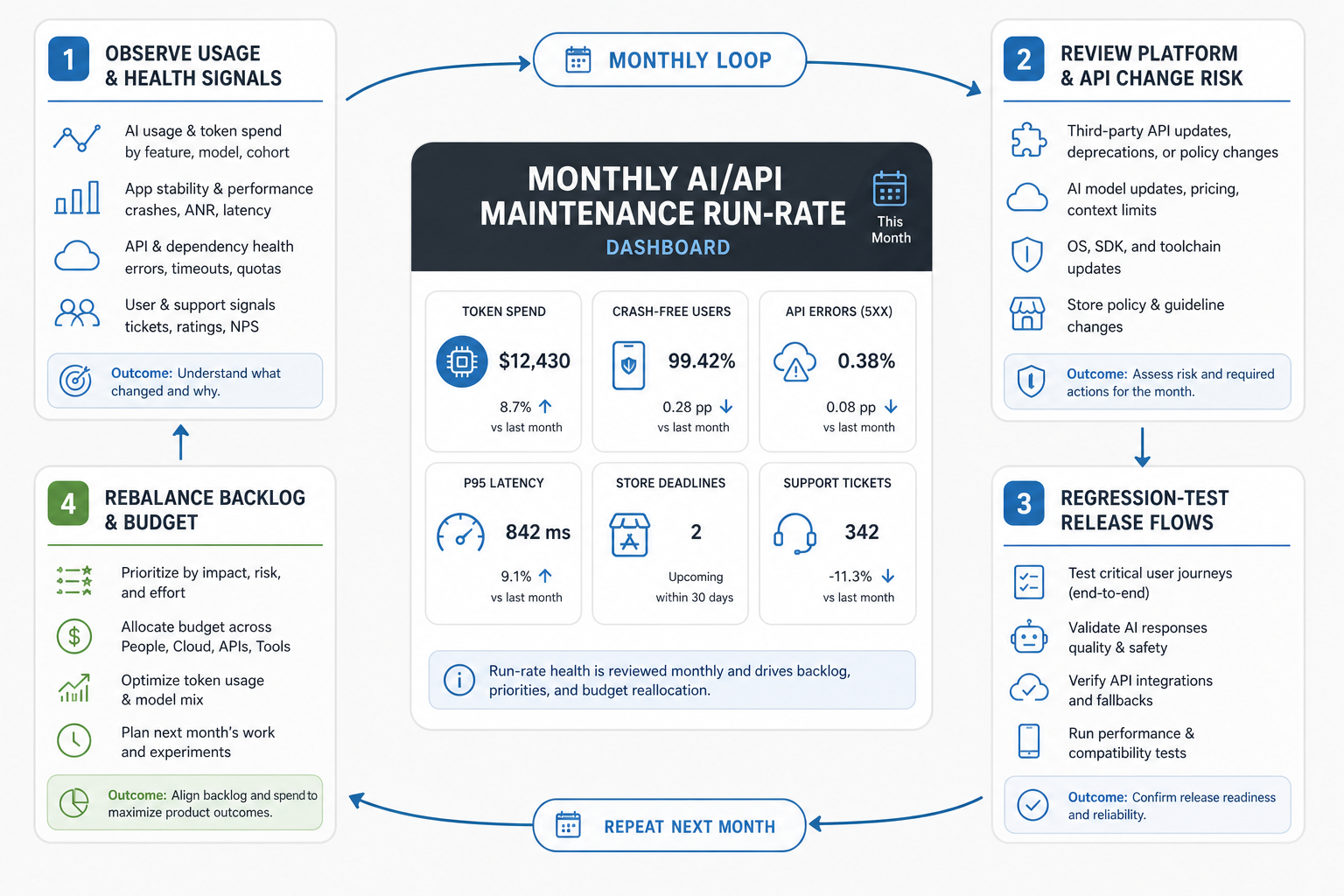
A practical review looks at six signals together: token or model spend by workflow, crash-free users and ANR rates, third-party API errors, P95 latency, store policy or SDK deadlines, and support-ticket themes. If one signal is moving in the wrong direction, the maintenance plan should assign ownership before it turns into an outage, compliance issue, or budget surprise.
What To Maintain At Each Product Stage
An MVP does not need the same support structure as a scaled app, but it still needs enough ownership to avoid expensive rebuilds later.
| Stage | Maintenance Priority | Budget Emphasis |
|---|---|---|
| Post-launch MVP | Crash triage, analytics, user feedback, quick UX fixes | Lean retainer plus fast learning loop |
| Validated product | Release cadence, API hardening, regression tests, support tooling | Stable monthly capacity and test automation |
| AI-enabled growth app | Model cost monitoring, output QA, prompt/version control, privacy checks | Usage budget and AI behavior review |
| Enterprise or regulated app | Security evidence, access reviews, compliance support, incident runbooks | Higher reliability and audit-readiness budget |
If your roadmap includes a major rebuild or new mobile product, a mobile app development company should help you model both build cost and year-one support cost before engineering starts.
Red Flags Your Maintenance Budget Is Too Low
The first sign is not always a crash spike. It is often slower releases, unresolved store warnings, unreviewed dependency alerts, unclear ownership of AI outputs, or support tickets that engineering cannot reproduce.
- No one reviews monthly AI token spend, latency, or failure rate.
- App updates are delayed because dependencies, certificates, or SDK versions are out of date.
- Regression testing happens only after users report a problem.
- Crash monitoring exists, but there are no owners or response targets.
- Third-party API changes are discovered only after production failures.
- Security patches compete with small feature requests for the same tiny budget.
- Product analytics do not explain where users drop off after AI/API failures.
When these signals appear, the issue is rarely one bad sprint. The maintenance model is underspecified.
How To Control Maintenance Costs Without Creating Risk
The goal is not to minimize maintenance spend. The goal is to buy the right reliability for the product stage and avoid paying for avoidable chaos.
- Track cost per core workflow. For AI apps, measure token and infrastructure cost per recommendation, summary, support answer, search, or automation.
- Use model routing where quality allows it. Reserve premium models for high-value or high-risk tasks and use smaller models for classification, extraction, drafts, or fallback paths.
- Automate regression checks around revenue and AI flows. Cover login, payment, booking, search, push, AI response, and support escalation paths first; NextPage's mobile app testing checklist is a useful release gate when maintenance work touches core journeys.
- Keep API contracts explicit. Add monitoring for changed response fields, authorization failures, quota limits, and latency spikes.
- Schedule platform maintenance. Treat iOS, Android, Firebase, and dependency updates as planned work, not emergencies.
- Separate reliability from product growth. A maintenance retainer should protect the running system. A product-growth budget should fund new experiments.
For many teams, the best starting point is a maintenance audit: what is live, what can fail, what costs scale with usage, what is unmonitored, and what the next three releases require. NextPage can connect that audit to AI development services or mobile engineering support when the product needs deeper model or backend ownership.
Next Step: Estimate The Run Rate Before It Surprises You
If you are budgeting a new AI-enabled app, estimate maintenance before launch. If the app is already live, build a current-state run-rate model from real crash data, API usage, cloud bills, token spend, release history, and support tickets.
Use NextPage's Custom Software Cost Estimator to frame the initial scope, then add the maintenance layers from this guide: fixed retainer, usage-based AI/API costs, release QA, security, observability, and quarterly improvements. That gives leadership a budget they can defend and engineering a support model that does not rely on heroic cleanup.