
Quick Answer: What Should An Insurance AI Agent Implementation Roadmap Include?
An insurance AI agent implementation roadmap should start with one controlled workflow, not a broad promise to automate claims or underwriting. The practical sequence is: pick a high-volume workflow, audit data and system access, define policy rules, design human review, build a narrow pilot, capture compliance evidence, measure operational impact, and scale only after quality and risk gates are met.
Good early candidates include claims intake, document completeness checks, policy lookup, FNOL triage, underwriting packet preparation, support routing, renewal outreach, and fraud-signal review. Riskier decisions such as claim denial, final settlement, coverage interpretation, pricing, and eligibility should stay under human approval until the organization has enough evidence, audit trails, and governance maturity. In 2026, the practical bar is higher than a proof of concept: insurers need a documented AI inventory, use-case risk tier, reviewer policy, third-party diligence trail, and incident path before the agent becomes part of a regulated workflow.
Use this roadmap when claims, underwriting, support, product, and technology leaders need to move beyond AI-in-insurance use-case lists. A focused AI Agent Readiness Assessment can help decide which workflow is ready for a pilot and which one still needs data, process, or integration cleanup first.
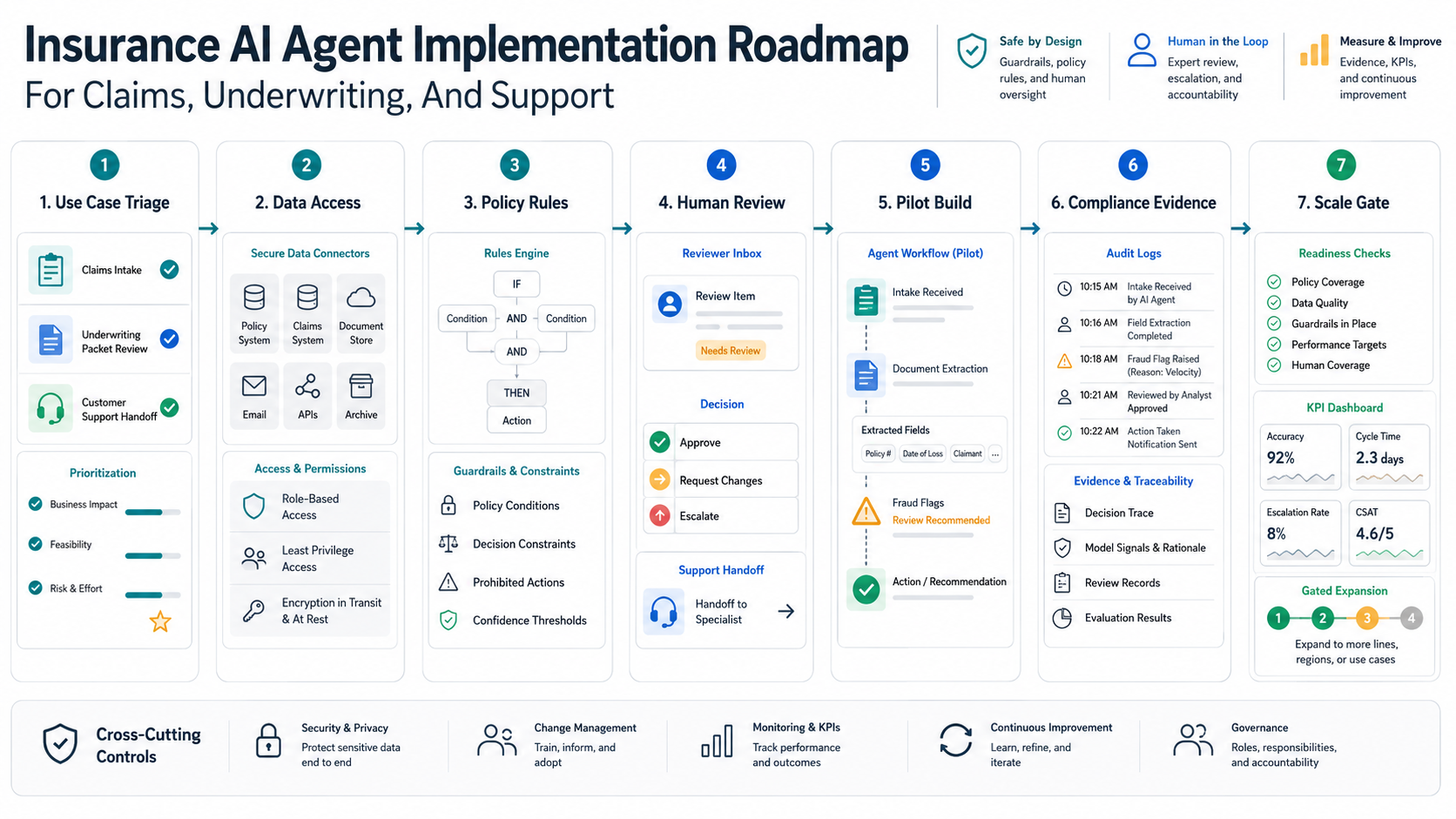
Why Insurance AI Agents Need A Controlled Roadmap
Insurance workflows are document-heavy, rules-heavy, and exception-heavy. They are also sensitive. A claims assistant may read medical records, invoices, vehicle images, loss descriptions, policies, adjuster notes, and fraud signals. An underwriting assistant may review applications, third-party data, coverage rules, exclusions, prior claims, and risk scores. A customer support agent may answer questions that affect expectations about coverage or settlement.
That is why insurance AI agents should begin as supervised workflow software. The agent can retrieve policy context, summarize documents, classify requests, check completeness, draft responses, and recommend next steps. Production teams should also decide when classical machine learning development services are a better fit than generative reasoning, especially for scoring, anomaly detection, and repeatable classification. Humans should approve decisions that affect coverage, payment, risk selection, pricing, or customer obligations.
Generic insurance AI articles often list use cases like claims automation, underwriting, fraud detection, customer service, and personalization. Those are useful categories, but they do not tell a team how to safely implement the first workflow. If your team still needs the broader use-case map, pair this roadmap with NextPage's AI in insurance implementation guide. The roadmap here goes one level deeper: data access, permissions, policy rules, evidence requirements, evaluation metrics, escalation paths, and post-launch ownership.
Step 1: Select The Right Insurance Workflow
The first AI agent should solve a repetitive operational problem where input patterns are visible and success can be measured. If the workflow needs new intake screens, reviewer queues, API connectors, or case dashboards, scope those pieces as controlled custom software development instead of treating the model as the whole product. Do not begin with the most legally sensitive decision. Begin with a workflow where the agent can help people work faster while keeping final judgment human-owned.
| Workflow | Good First-Agent Scope | Keep Human Approval For | Primary Metric |
|---|---|---|---|
| Claims Intake | Classify FNOL, collect missing fields, route by claim type and severity | Coverage position, settlement, denial, fraud action | Intake completion time |
| Document Review | Extract document types, check completeness, summarize evidence | Materiality decisions and disputed evidence | Document cycle time |
| Underwriting Support | Prepare packets, retrieve policy rules, flag missing data | Risk acceptance, pricing, exclusions, final quote | Submission-to-decision time |
| Customer Support | Answer policy FAQs, summarize status, draft next-step messages | Binding commitments or disputed claims responses | First response time |
| Fraud Triage | Surface anomalies and route suspicious cases for review | Fraud determination or adverse action | Investigator queue quality |
Score candidate workflows by volume, repeatability, data access, policy clarity, risk, and measurable baseline. If a workflow lacks clean data, stable rules, or an accountable business owner, fix those prerequisites before building the agent.
Step 2: Audit Data And System Readiness
Insurance agents usually need data from policy administration systems, claims platforms, document stores, CRMs, payment systems, underwriting workbenches, identity systems, email, call transcripts, and analytics tools. The roadmap should name what the agent can read, what it can write, and which data is intentionally excluded.
| Readiness Area | Questions To Answer | Launch Gate |
|---|---|---|
| Source Systems | Where do policy, claim, customer, document, and interaction records live? | Each source has an owner and approved access path. |
| Data Quality | Which fields are missing, inconsistent, stale, duplicated, or manually entered? | Critical fields are validated or the agent handles gaps explicitly. |
| Permissions | Which roles can see each document, note, and decision field? | Agent access mirrors user roles instead of using broad shared credentials. |
| Retention | How long should prompts, logs, summaries, and extracted data be kept? | Retention aligns with policy, legal, and operational rules. |
| Integration | Can the agent use APIs, events, or a workflow layer rather than manual screens? | Tool calls are logged and reversible where possible. |
For knowledge-heavy workflows, retrieval quality is as important as model quality. If policy documents, endorsements, claim guidelines, and support scripts are not current or permissioned, a RAG-based agent will amplify the mess. NextPage's enterprise RAG implementation cost guide explains why source readiness, access control, and evaluation are major cost drivers.
Step 3: Encode Policy Rules And Human Review Boundaries
An insurance AI agent should have explicit boundaries. It should know which actions are allowed, which actions require approval, and which actions are blocked. This is where product, legal, compliance, claims, underwriting, and technology leaders need to agree before development moves too far. Treat the agent like an operational access-control system: identify the agent, bind it to a role, constrain tool permissions, log every retrieval and action, and preserve evidence for reviewers.
- Allowed: summarize a claim file, classify a document, draft a customer reply, retrieve policy sections, flag missing evidence, create an internal task, or recommend routing.
- Approval required: coverage interpretation, settlement recommendation, underwriting exception, fraud escalation, premium-impacting recommendation, or customer-facing commitment.
- Blocked: final denial, final settlement, binding coverage decision, unmanaged data export, or autonomous action outside defined policy rules.
This staged approach lets teams learn safely. The first release can be a recommendation system with approval. Later releases can automate low-risk internal updates when evidence supports trust. For regulated financial workflows that share the same data, review, and audit constraints, NextPage's AI development services for banking and financial services page shows how we structure permissioned AI delivery around compliance evidence rather than model demos.
Step 4: Build A Reference Architecture For Insurance Agents
A practical insurance AI agent architecture has six layers. The trigger layer starts the workflow from a claim event, submission, support ticket, document upload, or scheduled review. The context layer retrieves policy, claim, customer, document, and workflow data. The reasoning layer drafts, classifies, summarizes, or recommends. The tool layer reads and writes to approved systems. The control layer handles human review, logging, permissions, and escalation. The measurement layer tracks quality, cycle time, cost, and risk.
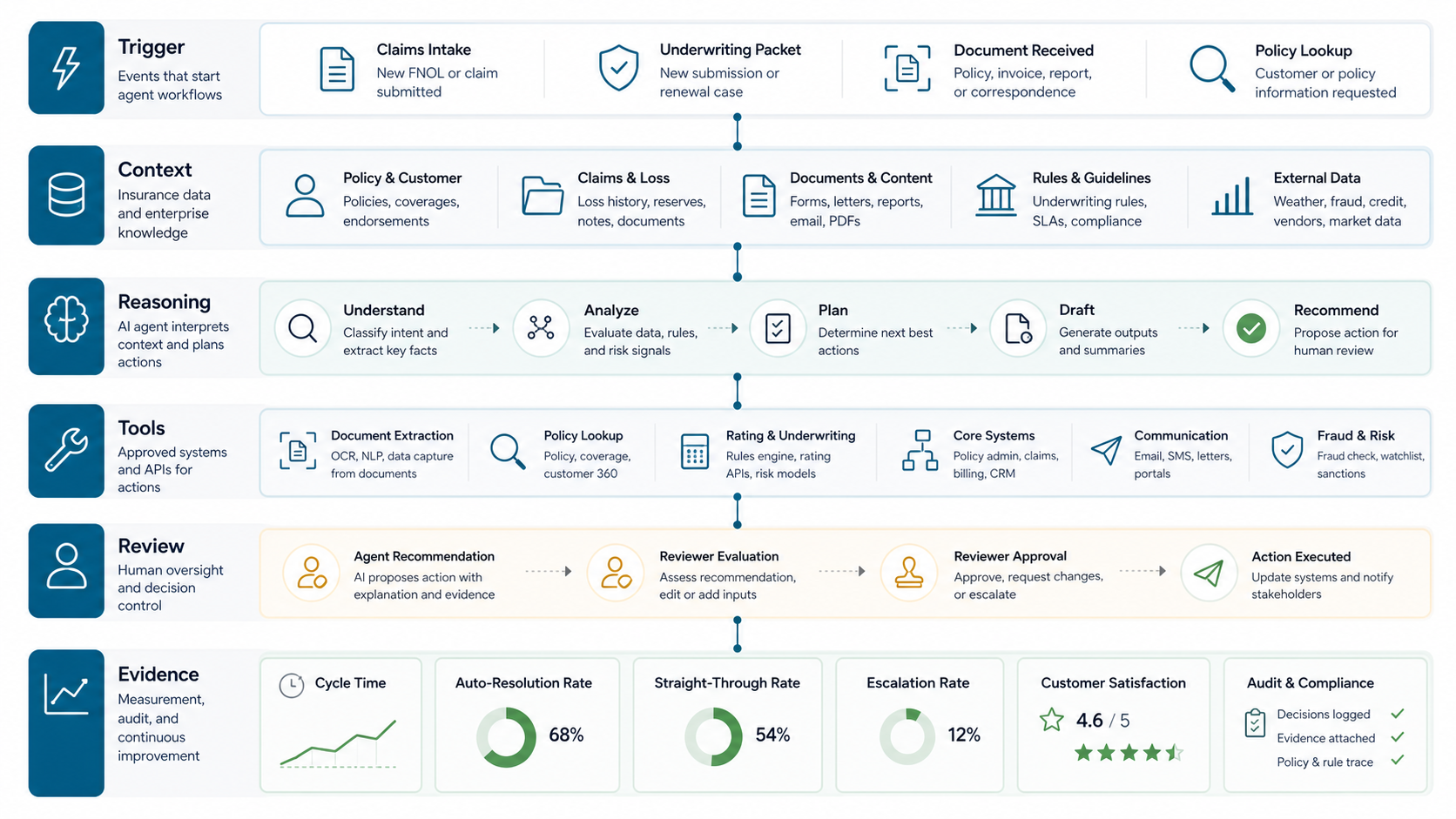
Do not connect the agent to every insurance system in the first pilot. Start with the minimum useful path. A claims intake agent might read FNOL fields and uploaded documents, classify severity, check missing information, draft a checklist, and route the claim. An underwriting assistant might prepare a submission summary, check data completeness, retrieve guidelines, and draft underwriter questions without making a final decision.
For adjacent supervised financial workflows, NextPage's AI agents for banking and finance workflows page shows a similar pattern: document review, policy context, human approval, and auditability before action.
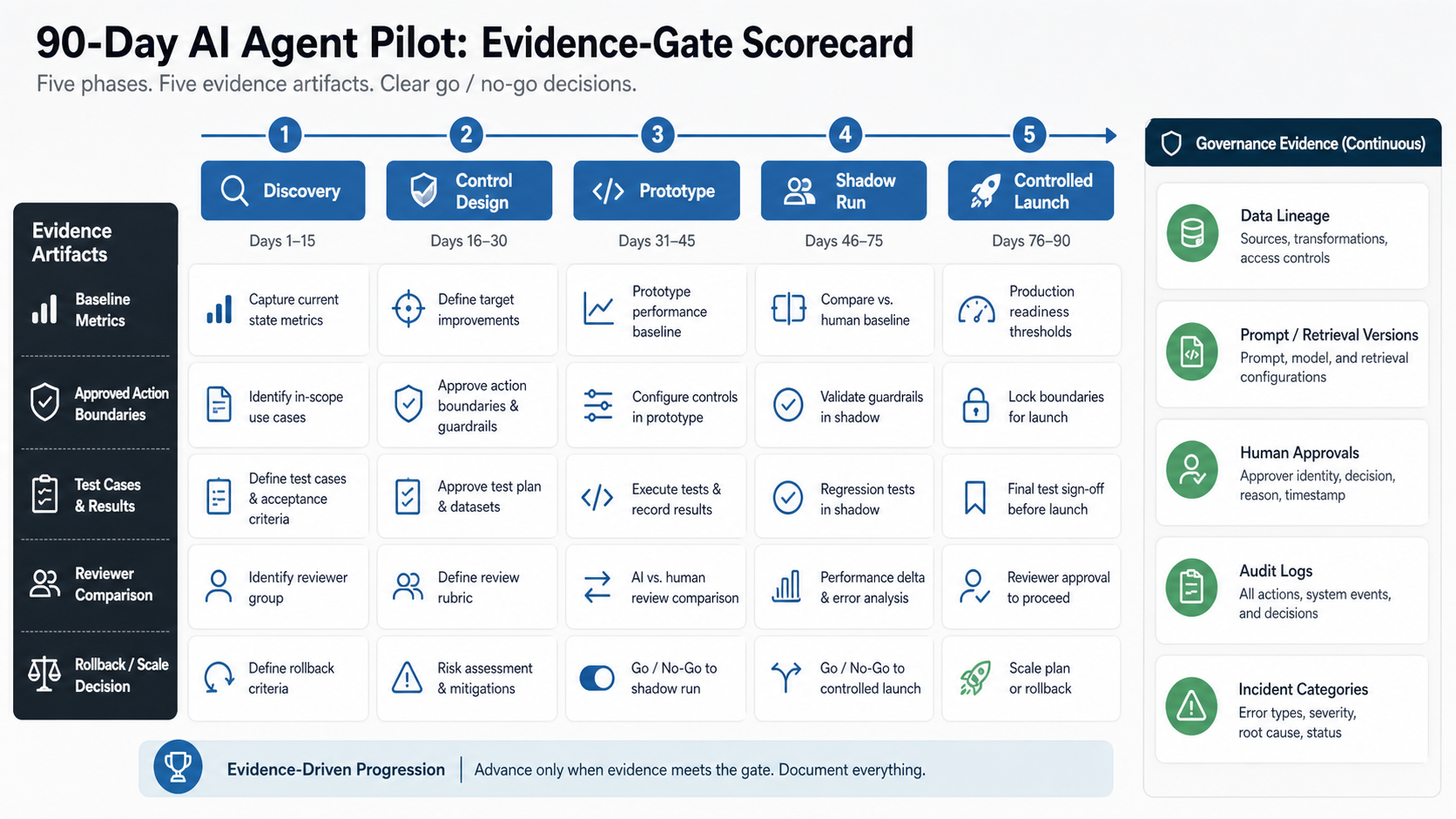
Step 5: Run A 90-Day Pilot With Evidence Gates
A 90-day pilot is long enough to test real operational behavior and short enough to prevent an open-ended transformation program. The pilot should have a named workflow owner, data owner, technical owner, compliance reviewer, and support owner.
| Phase | Timeline | Output | Decision Gate |
|---|---|---|---|
| Discovery | Weeks 1-2 | Workflow map, baseline metrics, risks, systems, data gaps | Proceed only if value and owner are clear. |
| Control Design | Weeks 3-4 | Allowed actions, approval rules, blocked actions, audit needs | Proceed only if risk boundaries are approved. |
| Prototype | Weeks 5-7 | Agent slice, retrieval/tool path, test cases, review UI | Proceed only if representative cases work. |
| Shadow Run | Weeks 8-10 | Agent output compared with human decisions | Proceed only if quality and failure modes are visible. |
| Controlled Launch | Weeks 11-12 | Limited users, monitoring, feedback loop, rollback plan | Scale, narrow, harden, or stop. |
The pilot should produce reusable assets: data inventory, prompt and retrieval versions, evaluation sets, approval rules, audit logs, incident categories, cost measurements, and a rollout backlog. These assets matter because insurance AI agents are operational systems, not one-time demos.
Step 6: Measure ROI And Risk Together
Insurance AI agent ROI should not be measured only by hours saved. A workflow that saves time but increases rework, complaint risk, regulatory exposure, or customer confusion is not ready to scale. Pair one primary productivity metric with quality and risk guardrails.
| Metric Type | Examples |
|---|---|
| Operational | Cycle time, queue age, first response time, document review time, submission-to-decision time |
| Quality | Human edit rate, approval rejection rate, unsupported answer rate, missing evidence rate |
| Risk | Escalation rate, complaint flags, privacy incidents, policy mismatch rate, audit exceptions |
| Adoption | User activation, repeat use, reviewer satisfaction, workflow coverage |
| Cost | Cost per case, model/API spend, support time, integration maintenance |
For similar controlled workflow design, the AI agents for loan processing guide is a useful comparison because it deals with document completeness, policy context, human review, and regulated decision support.
Before estimating rollout budget, include the non-model work: integration hardening, reviewer UX, data remediation, evaluation suites, observability, and support operations. The custom software cost estimator is a useful early frame when the agent pilot also requires internal tools, dashboards, or workflow automation around the model.
Add 2026 Insurance AI Governance Evidence Before Scale
Insurance AI governance should be visible before the pilot leaves a controlled user group. The NAIC Model Bulletin expects insurers to manage AI systems through governance, risk management controls, validation, testing, monitoring, documentation, and third-party oversight. For an AI agent, that means the implementation team should be able to explain which data was used, which policy source was retrieved, which tool call was made, which human approved the outcome, and which evidence supports the decision.
| Governance Artifact | What It Proves | Owner |
|---|---|---|
| Use-case risk tier | The workflow has been classified by potential customer, compliance, and operational harm. | Product and compliance |
| Data lineage and permissions | The agent only reads approved policy, claim, customer, and document sources. | Data owner and security |
| Evaluation set | Representative claims, submissions, support questions, and edge cases are tested before scale. | Workflow owner and QA |
| Human approval log | Material recommendations are reviewed with approver identity, timestamp, reason, and outcome. | Operations lead |
| Third-party review | Vendor models, APIs, and document tools have documented controls and failure handling. | Legal, procurement, and engineering |
For audit-heavy product design patterns, the AuditLedger portfolio case study is a useful proof point because it shows how evidence capture, review state, and operational traceability can be treated as product features rather than afterthoughts.
Common Mistakes That Derail Insurance AI Agent Projects
The most common mistake is starting with a high-risk autonomous decision instead of a supervised workflow. The second is treating messy data as an implementation detail. The third is skipping compliance evidence until after the pilot.
- Automating final claim or underwriting decisions before proving recommendation quality.
- Using broad service accounts instead of role-scoped access.
- Letting the model answer from stale policy documents or disconnected guidelines.
- Measuring only speed while ignoring rework, escalation, and complaints.
- Skipping prompt, retrieval, model, and tool-call version history.
- Failing to design a reviewer experience for adjusters, underwriters, or support leads.
- Launching without a rollback and incident path.
A safer first goal is to make experts faster and more consistent. Once the team has evidence, selected low-risk tasks can move from suggestion to approved write-back.
How NextPage Helps Insurance Teams Build AI Agent Roadmaps
NextPage helps insurance and financial-services teams scope AI agents around real workflows, data readiness, controls, integration paths, and measurable pilots. We can help evaluate claims intake, document review, underwriting support, customer service, renewal, and fraud-triage workflows before choosing the first build.
Our AI development services and AI automation services combine product engineering, workflow UX, API integration, RAG, evaluation, monitoring, and rollout support. The goal is not to add AI everywhere. It is to build controlled agents that reduce cycle time while protecting policyholders, reviewers, and the business.
The best next step is a readiness review: bring one target workflow, sample cases, current systems, policy constraints, baseline metrics, and the human decision owner. The output should be a pilot scope, acceptance criteria, evidence plan, and delivery estimate.