
Quick Answer: What Does News App Development Cost?
A production news app usually costs more than a simple content reader because the app is only one part of the system. The real budget depends on the reader experience, CMS and editorial workflow, paywall rules, subscription billing, ad monetization, push notifications, analytics, personalization, moderation, integrations, and the operating team that will keep content moving after launch.
As a practical planning range, a narrow MVP for one or two platforms can often be scoped in the low-to-mid five figures when the CMS is already stable and monetization is simple. A more complete custom news product with native or cross-platform apps, a usable editorial dashboard, subscriptions, ads, analytics, and launch support can move into the mid-to-high five figures or six figures. Enterprise media platforms with multi-brand publishing, advanced personalization, data pipelines, custom paywall logic, and newsroom operations cost more because they behave like a full publishing SaaS platform.
The safest first step is not asking for a fixed number from a feature list. Define the first release, confirm CMS and subscription assumptions, then estimate the build with a scope tool such as NextPage's Custom Software Cost Estimator. If the feature set is still unclear, use the MVP Scope Builder to separate launch requirements from later-phase ideas.
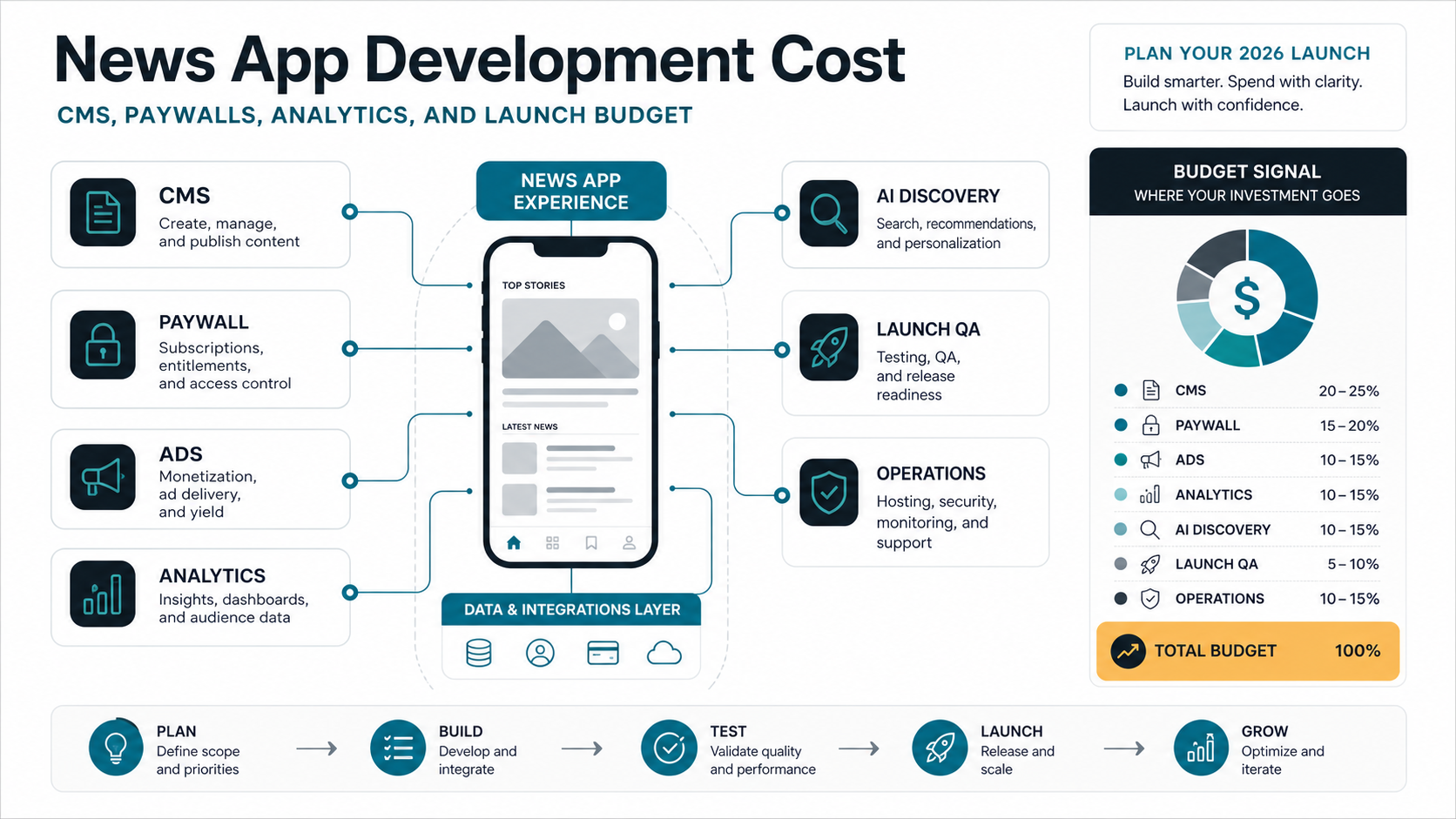
Why News App Cost Varies So Much
Public cost guides often look contradictory because they answer different questions. Some estimate a basic content app. Some include a custom CMS. Some assume a WordPress feed and a template app. Others include native apps, payment flows, ad operations, data infrastructure, and editorial tools. A publisher comparing quotes should ask what system is actually being estimated.
For a news product, budget usually rises when the app needs to support paid content, editorial roles, breaking-news push workflows, multiple content types, video/audio, offline reading, ad slots, reader segmentation, comments, moderation, and custom analytics. It also rises when the app must integrate with an existing CMS, CRM, subscription platform, data warehouse, or ad server.
That is why a news app should be scoped as a product system, not as a set of screens. The mobile app may be the visible surface, but the cost is often driven by backend workflows, publishing permissions, monetization rules, and reporting needs. NextPage's broader mobile app development cost guide is useful background, and the mobile app development RFP checklist helps publishers document the platform, analytics, subscription, and support assumptions that generic app budgets can miss.
News App Cost Tiers By Scope
The ranges below are directional planning bands, not universal quotes. They help teams understand which decisions move the project into a different complexity tier.
| Scope tier | Typical build shape | Cost drivers | Best fit |
|---|---|---|---|
| Reader MVP | Mobile or PWA reader app, article feed, categories, search, basic push notifications, existing CMS feed | Platform count, CMS API quality, design depth, basic analytics, app-store setup | Digital publishers validating mobile distribution or replacing a weak template app |
| Monetized news app | Reader app plus paywall, subscriptions, saved articles, newsletters, ads, richer analytics, editorial controls | Billing rules, access control, ad slots, reader events, moderation, QA across devices | Publishers with paid-content or ad-revenue goals |
| Custom media platform | Apps, custom CMS workflows, multi-role editorial dashboard, personalization, data pipelines, multi-brand support | Workflow complexity, integrations, permissions, personalization, reporting, infrastructure, support | Media companies modernizing publishing operations or building a differentiated product |
A reader MVP can be a smart launch when the existing CMS is reliable and the team mainly needs mobile distribution. If the scope is still fluid, run the first release through NextPage's Build vs Buy Decision Tool before pricing a custom CMS, template wrapper, or full product build. A monetized app needs more careful engineering because subscriptions, ads, and access rules affect user trust and revenue. A custom media platform should be treated closer to SaaS development services because roles, billing, dashboards, integrations, and support expectations become part of the product.
Core Features That Shape The Budget
Most news app budgets are shaped by eight feature groups.
- Reader experience: home feed, article detail, sections, search, bookmarks, authors, related stories, video/audio, and offline reading.
- CMS and editorial workflow: article creation, scheduling, approvals, breaking-news alerts, media library, taxonomy, author profiles, and preview states.
- Paywall and subscriptions: metered access, hard paywall, trials, coupons, recurring billing, entitlements, cancellation, receipts, and restore-purchase flows.
- Advertising: ad slots, sponsorship placements, ad server integration, viewability, frequency controls, and reporting.
- Notifications: breaking news, personalized alerts, topic subscriptions, quiet hours, and push-performance reporting.
- Analytics: article reads, scroll depth, video plays, subscription funnel, ad events, referral source, churn signals, and editorial dashboards.
- Personalization: topic preferences, saved interests, recommendation logic, reader segments, and editorial override controls.
- Moderation and trust: comments, abuse reporting, user roles, privacy controls, consent, and staff review queues.
The expensive part is not always the feature name. It is the number of states behind it. The mobile app integrations checklist is useful here because news apps combine payments, push, analytics, CMS APIs, identity, app-store review, and admin workflows in one release. A paywall sounds simple until the app needs trials, annual plans, app-store subscriptions, web subscriptions, coupons, gifts, refunds, expired cards, restored purchases, and article-level access rules.
CMS And Editorial Workflow: The Hidden Cost Center
The CMS decision can make or break a news app budget. If the newsroom already has a stable CMS with clean APIs, structured taxonomy, image renditions, author data, and publishing states, the app can reuse that foundation. If the CMS is old, manually updated, or missing API access, the app team may need middleware, import jobs, custom editorial tools, or a new publishing workflow.
At minimum, confirm how the app will receive article data, section order, home page curation, breaking-news flags, media assets, author profiles, tags, related stories, and scheduled publishing. Also confirm who can publish, who can send push notifications, who can override home feed order, and who can correct an article after it goes live.
Teams often underestimate editorial tooling because it is less visible than the mobile UI. But editors need preview, scheduling, rollback, media handling, and approval controls to run the app safely. If the CMS becomes custom, include admin UX, permissions, QA, and support in the budget.
CMS, Paywall, Ads, And Analytics Architecture
A publisher should ask for an architecture estimate before asking for a screen estimate. The core path usually starts with editorial CMS and media workflows, moves through an article API, checks entitlement rules, records billing and ad events, sends analytics to dashboards, and then returns a reliable reader experience across mobile, web, email, and push surfaces.
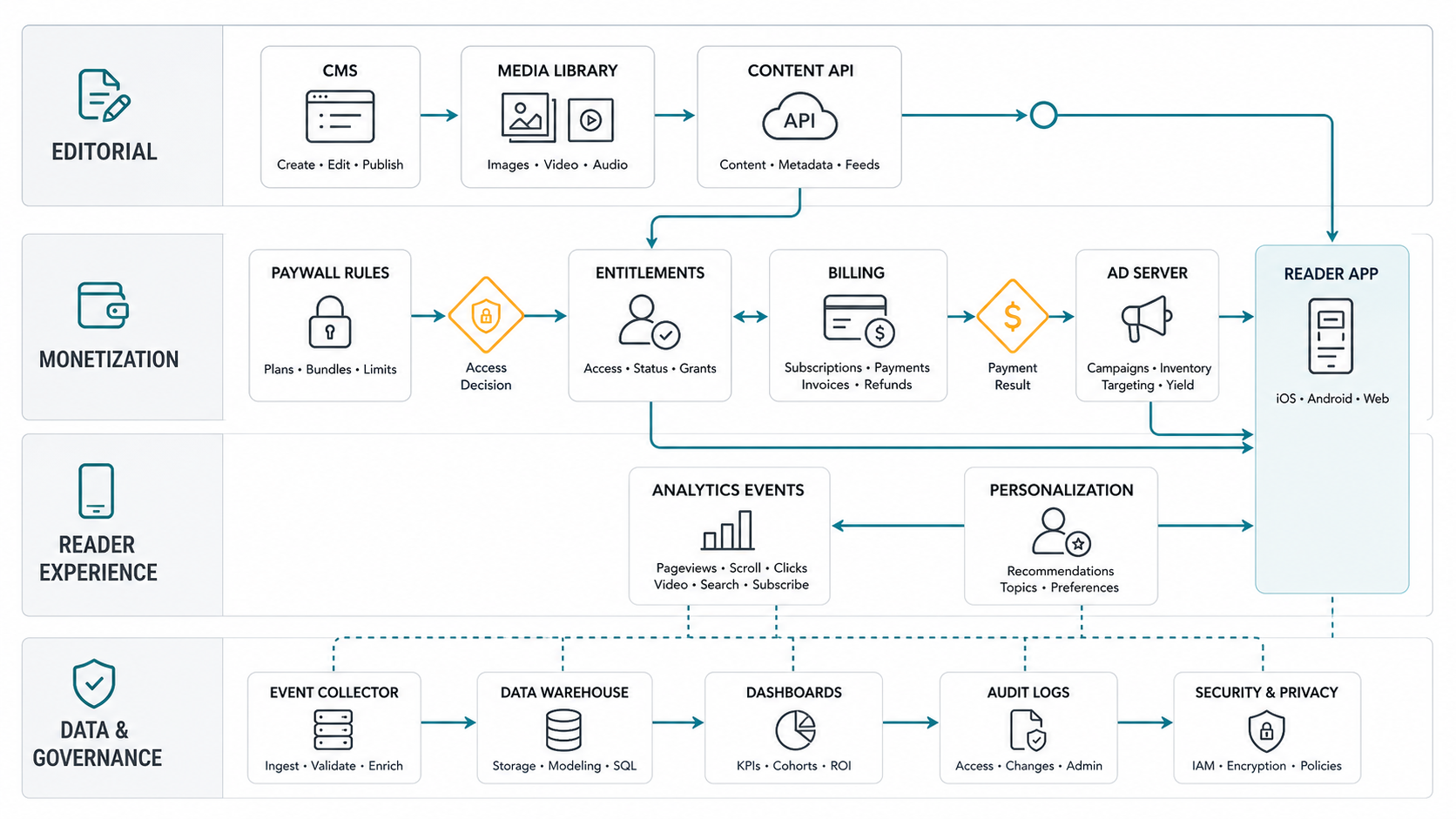
This architecture is where custom work often becomes valuable. A template reader app can show articles, but publisher operations need preview states, scheduled publishing, taxonomy rules, author data, image renditions, subscription entitlements, ad inventory, reader events, moderation, and audit logs. When those workflows are strategic, NextPage's custom software development and web app development teams can scope the backend and admin product alongside the mobile app.
Personalization should also be priced as a product feature, not a magic layer. A basic launch may only need topic follows and editorial curation. A growth release can use rules and reader segments. A mature product may justify AI recommendation engine development services when the publisher has clean content metadata, behavioral events, and editorial controls.
Paywalls, Subscriptions, And App Store Readiness
Paid news apps need a monetization model before engineering starts. Decide whether the product uses a metered paywall, hard paywall, freemium sections, premium-only content, ad-free subscription, newsletter bundle, membership perks, or a hybrid model. Each model changes the access-control logic and user journey.
For mobile apps, subscription implementation also has platform-policy implications. Apple's App Store guidelines cover auto-renewable subscriptions and in-app purchase expectations for digital content. Google Play subscription implementation similarly requires clear entitlement handling, cancellation support, base-plan/offer planning, and non-deceptive purchase experiences. These are not just legal notes; they affect UX, product setup, QA, review notes, and launch timing.
Build time increases when web subscriptions and app subscriptions must stay synchronized. The app may need account linking, entitlement checks, restore-purchase flows, receipt validation, promotional campaigns, grace periods, cancellation states, and customer-support tools. A weak entitlement model creates subscriber frustration and support load.
For 2026 planning, treat subscription states as a test matrix, not a payment checkbox. Apple positions auto-renewable subscriptions as ongoing access until cancellation, while Google Play Billing models active, cancelled, grace-period, on-hold, and paused states. A publisher estimate should therefore include entitlement reconciliation, receipt or purchase-token validation, refund and revocation handling, renewal analytics, support tooling, and QA scenarios for web, iOS, Android, and customer-service changes.
2026 Paywall And Subscription Budget Assumptions
For 2026 planning, publishers should budget paywall work as a revenue system rather than a checkout feature. The cost depends on how many access rules the app must enforce, whether subscriptions are sold through app stores, web checkout, or both, how entitlement data syncs back to the CMS, and how customer support will resolve failed renewals, refunds, trial changes, and account linking issues.
Apple's developer program fee, Google Play registration, and platform transaction rules are small compared with engineering effort, but they shape the commercial architecture. A news app that sells subscriptions inside the app needs clean entitlement checks, receipt validation, restore-purchase flows, account deletion support, invoice or CRM handoff rules, and analytics that separate registered readers from paying subscribers. If the publisher also sells web subscriptions, the budget should include account unification, payment-provider integration, fraud handling, tax or invoice rules, and support dashboards.
The practical cost-control move is to choose one launch paywall model and one subscription offer structure before development starts. A metered paywall, hard paywall, registration wall, donation model, bundle subscription, or sponsor-supported free model can all work, but mixing them too early increases CMS, analytics, QA, and support scope. Teams planning paid access should connect the release plan to mobile app development timeline expectations so billing, store review, editorial training, and subscription analytics are tested before launch week.
Ads, Analytics, And Reader Data
Advertising and analytics should be planned together. A publisher needs to know which ad placements are loaded, viewed, refreshed, clicked, and blocked by user state. The editorial team needs article-level engagement, while the business team needs subscription funnel and ad performance. Product teams need retention, crash, performance, and notification metrics.
Basic analytics may cover app opens, article views, traffic sources, and top sections. A stronger setup tracks scroll depth, read completion, video/audio plays, saved articles, push opens, paywall impressions, trial starts, subscription conversion, cancellation, ad viewability, cohort retention, and first-party audience segments that can be used with consent across owned channels. For deeper reporting, NextPage's custom dashboard development services can support dashboards that combine reader, subscription, ad, editorial, and AI-search distribution metrics. If the team is deciding between BI embeds and a purpose-built reporting product, compare options with the Power BI vs custom dashboard app guide.
Do not wait until after launch to define event names and dashboards. Retrofitting analytics creates gaps in the first months of product learning, which is exactly when a publisher needs evidence for the next release.
2026 First-Party Data And Personalization Budget Checks
In 2026, publishers should treat first-party reader data as a product requirement, not a reporting extra. A news app can collect article views, section follows, saved stories, newsletter clicks, subscription state, ad interactions, notification responses, and support events across owned channels. That data is useful only when it is collected with clear consent, mapped to a stable reader profile, and translated into editorial, subscription, ad, and product decisions.
This changes the budget. A basic launch can start with registered-reader events, topic preferences, and a small analytics dashboard. A growth release may need audience segments, consent-aware personalization, paywall experiments, and ad-performance reporting. An enterprise release may need a customer data platform, warehouse pipelines, clean-room or ad-server integrations, churn models, recommendation controls, and governance workflows for editorial and revenue teams.
| Capability | MVP Budget Check | Growth Or Enterprise Check |
|---|---|---|
| Reader identity | Email, registration state, subscription state, consent record | Unified web, app, newsletter, CRM, and support profile |
| Personalization | Topic follows, saved articles, editorial curation | Rules, recommendation models, editorial overrides, explainability, and opt-outs |
| Revenue analytics | Article views, paywall impressions, trials, subscriptions, ad events | Cohorts, churn signals, LTV, campaign attribution, ad yield, and newsroom dashboards |
| Governance | Consent copy, privacy settings, event naming, owner list | Data quality checks, role permissions, retention rules, and audit-ready reporting |
The cost-control move is to define which first-party signals are needed for the first two product decisions after launch. If the team cannot act on a data point, avoid building the pipeline too early. If personalization becomes part of the revenue case, connect the scope to machine learning development services only after the newsroom has clean taxonomy, enough reader behavior, and clear editorial controls.
AI Search And Distribution Readiness Budget
In 2026, a news app budget also needs to account for how stories are discovered outside the app itself. Google now documents AI features such as AI Overviews and AI Mode as part of Search, and its guidance still points publishers back to useful, crawlable, high-quality content, accessible pages, and standard search controls rather than a separate AI-only markup path. That means the app and CMS should publish clean canonical URLs, schema-supported article data, entity-rich metadata, image variants, and fast pages that can support both classic search and AI-assisted discovery.
Source status checked August 17, 2026: Google Search Central still frames AI Overviews and AI Mode as Search features supported by the same fundamentals: useful content, crawlable pages, clear page structure, snippets, previews, and normal search controls. Apple and Google Play subscription documentation also still make entitlement states, base plans, offers, restore flows, and support handling real engineering scope. Treat AI discovery, subscriptions, and app analytics as publishing-system requirements, not launch-week marketing tasks.
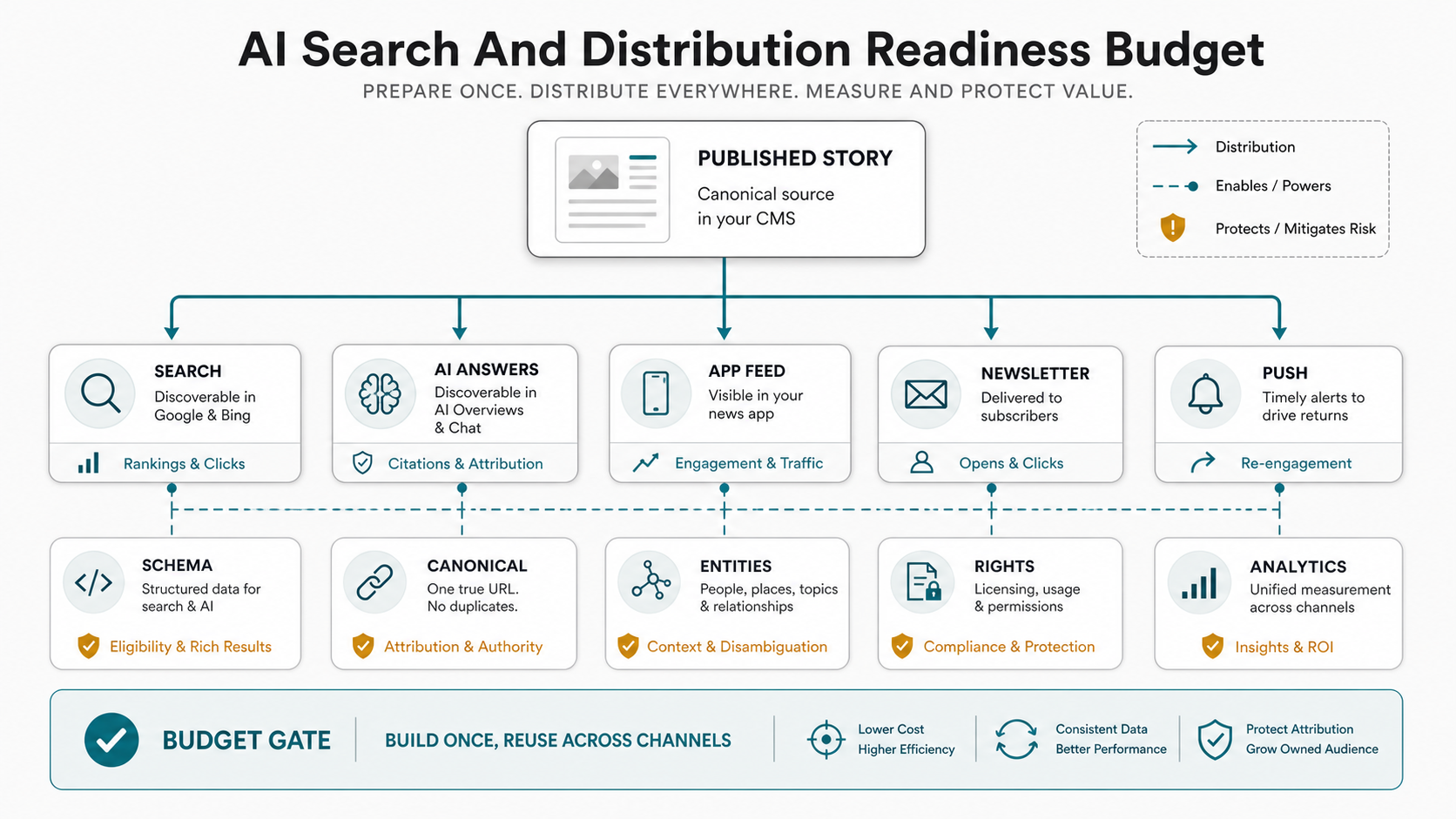
This work is not only SEO. Publishers need distribution and measurement plumbing that connects search visibility, AI-answer attribution, app-feed engagement, newsletter clicks, push re-engagement, and subscription outcomes. The CMS should make canonical source pages obvious, expose structured fields consistently, keep rights and licensing controls visible, and send reliable events into the analytics model. For product teams, this adds scope to CMS modeling, frontend rendering, analytics implementation, editorial training, and release QA.
The practical budget decision is to build once and reuse across channels. If article data is structured well, the same story can support web search, app feeds, newsletters, push, recommendation modules, and dashboards without duplicate editorial effort. If it is not, each channel becomes a workaround. Teams planning AI-assisted discovery, reader segmentation, or recommendation features should connect this section to AI personalization for news and media apps and budget AI development services only when content governance, event data, and editorial controls are ready.
MVP Vs Growth Vs Enterprise Scope
A strong news app roadmap separates must-have launch functionality from features that become valuable only after reader behavior is known.
| Area | MVP | Growth release | Enterprise release |
|---|---|---|---|
| Reader app | Feed, sections, article pages, search, saves | Topic follows, offline reading, video/audio | Multi-brand experiences, regional editions, advanced accessibility workflows |
| CMS | Existing CMS integration and basic curation | Editorial dashboard, preview, scheduling, push workflow | Custom CMS, approval workflows, newsroom roles, audit trail |
| Monetization | Simple subscription or ad model | Metered paywall, coupons, trials, ad reporting | Multi-channel entitlements, bundles, CRM, data warehouse integration |
| Analytics | Core app and article events | Subscription funnel, cohort retention, editorial dashboards | Custom BI, segmentation, predictive churn, revenue attribution |
| Personalization | Manual sections and saved interests | Rules-based recommendations | Machine-learning recommendations with editorial controls |
Personalization is a good example of phased scope. For news and media teams specifically, NextPage's AI personalization for news and media apps guide can help separate editorial controls, reader segments, and recommendation logic before a team buys or builds the feature.
A launch app may only need topics, saved articles, and manual editorial curation. A growth release can add rules-based recommendations. A mature product may justify AI recommendation engine development services when there is enough reader behavior and editorial control to make recommendations useful and safe.
Native, Cross-Platform, PWA, Or Template App?
Platform choice changes cost and operating flexibility. Native iOS and Android can be best when the product needs deep performance, platform-specific UX, rich offline behavior, or a premium app-store presence. Cross-platform development can reduce duplicated work when the experience is similar across platforms. A PWA can work when speed, web distribution, and lower maintenance matter more than app-store-native features. A template app can fit a small publisher with standard needs, but it may limit UX, monetization, and integration control.
Choose based on reader behavior, content format, monetization, CMS access, analytics needs, internal team capacity, and release cadence. A publisher that relies on breaking-news pushes, paid mobile subscriptions, and offline reading has different needs from a local publication that wants a lightweight companion app for an existing website.
When the app needs to win repeat use and avoid backend surprises, involve a mobile app development team early enough to review architecture, API contracts, subscription flows, analytics, QA, and launch operations.
Timeline And Team Shape
A realistic news app timeline usually moves through four stages.
- Discovery and architecture: 2-4 weeks to define platforms, CMS integration, monetization, analytics events, editorial roles, and launch risks.
- MVP build: 10-16 weeks for the reader experience, CMS connection, core notifications, basic analytics, QA, and app-store preparation.
- Monetization and growth: 6-12 more weeks for paywall logic, subscription states, ad reporting, personalization, moderation, and deeper dashboards.
- Scale hardening: ongoing work for performance, infrastructure, automation, editorial tooling, data pipelines, and support workflows.
The team may include a product strategist, UX/UI designer, mobile engineers, backend engineer, QA engineer, DevOps support, and a data/analytics specialist. If the CMS or subscription architecture is complex, backend and QA effort grows quickly.
Ongoing Costs Publishers Should Budget For
The launch budget is only part of the business case. News apps carry ongoing costs for hosting, CMS licensing, app maintenance, push providers, analytics tools, ad technology, payment processing, subscription platforms, moderation, security updates, bug fixes, performance monitoring, app-store compliance, and new feature releases.
Plan for maintenance from the start. Mobile operating systems change, app-store requirements evolve, analytics setups need tuning, and editorial teams discover workflow gaps once the app is in daily use. A launch with no maintenance budget quickly becomes a stagnant app that readers stop opening.
A practical recurring budget should include product support, monthly QA, analytics review, performance monitoring, minor enhancements, and at least one larger product improvement cycle per quarter.
Launch Readiness Scorecard For Publishers
Before funding the full roadmap, score the news app against six launch gates: revenue proof, user trust, editorial load, store review, analytics readiness, and maintenance capacity. A feature can be technically possible but still be a poor first-release decision if it creates subscription support tickets, editorial workarounds, unclear consent, or reporting gaps the team cannot operate.
The scorecard should shape procurement. Revenue-critical subscriptions may belong in the first release, but complex bundles, coupons, winback offers, and cross-platform entitlement repair can wait. Analytics events may be mandatory at launch, while advanced churn modeling can wait until the app has enough behavior data. For release evidence and QA planning, pair this scorecard with NextPage's mobile app QA launch checklist and mobile app performance optimization checklist.
Cost Control Checklist Before You Ask For Quotes
- Confirm whether the existing CMS has reliable APIs, media renditions, taxonomy, and publishing states.
- Decide whether subscriptions, ads, or both are required for launch.
- Define the first release by reader outcome, not by every feature competitors mention.
- Document platform needs: iOS, Android, PWA, web portal, admin dashboard, or all of them, then identify whether an existing publisher CMS can support those channels.
- List the exact analytics events needed for editorial, subscription, ad, and product decisions.
- Separate launch push notifications from later personalization workflows.
- Identify app-store review dependencies for subscriptions and paid digital content.
- Budget for QA across devices, offline states, payment states, and content-update scenarios.
- Include monthly maintenance, monitoring, and editorial-support costs.
How NextPage Scopes A News App Build
NextPage starts by separating the reader product, editorial workflow, monetization system, analytics layer, and operating model. That prevents the estimate from collapsing into a generic app feature list. The goal is to understand what the publisher needs to prove in the first release: reader retention, subscription conversion, ad revenue, newsroom efficiency, or mobile distribution.
From there, we shape a build plan around the safest first release and the highest-risk dependencies. If the CMS is ready, the app can move faster. If the CMS, paywall, or analytics model is unclear, those decisions become discovery work before engineering. That is usually cheaper than discovering entitlement, editorial, or reporting gaps after launch.
If you are budgeting a news app, start with the Custom Software Cost Estimator, narrow your launch scope with the MVP Scope Builder, review NextPage's VenueCart portfolio example for a commerce-style mobile workflow reference, or talk to NextPage about a reviewed roadmap for your mobile news product.